
New critical infrastructure projects must account for security, worker safety, environmental risks, and contractor coordination long before assets become operational. For utility, energy, water, transportation, and public works teams, managing these risks across developing sites is essential to keeping projects on schedule and preparing infrastructure for future demands.
Maintaining visibility across sites can be challenging, particularly when theft, vandalism, safety incidents, or severe weather can delay work and increase project costs. When security, safety, and environmental data live in different systems, problems surface much later than they should and make it harder to piece together what went wrong.
This guide covers 6 priorities for U.S. critical infrastructure professionals planning for 2027, from resilience and physical security to worker safety, environmental duties, evidence management, and project oversight across multiple sites.
6 Critical Infrastructure Priorities for 2027
These priorities apply across most critical infrastructure sectors:
1. Build a resilience plan
Resilience means preparing for threats, adapting to changing conditions, absorbing disruptions, and maintaining operational continuity while you recover.
The American Society of Civil Engineers (ASCE) gave U.S. infrastructure an overall C grade in its 2025 Report Card, the highest since 1998. Yet it still projected a $3.7 trillion gap between planned investment and what's needed to maintain infrastructure. With aging assets now facing more severe weather and physical threats such as theft and vandalism, that gap leaves little room for error.
When budgets are tight, resilience is often pushed back, but delayed improvements can lead to higher costs later, including emergency repairs, unplanned outages, and overtime.
A resilient critical infrastructure plan ranks assets, especially legacy systems, by the impact their failure would have, not just their current condition. This helps direct investment toward the sites where an outage would cause the most damage. This approach also aligns with the White House’s August 2026 National Security Science & Technology Strategy (NSSTS), which commits to modernizing aging and vulnerable infrastructure on a risk-informed basis.
On development sites, materials, copper, and equipment are often left exposed before a site becomes operational. Resilience measures such as flood protection, temporary security, and backup power are usually easier to build in during construction than to add once the site is live.
For each priority site in 2027, review:
- How materials, copper, and equipment will be secured on development sites before they go live
- Power, connectivity, and temporary monitoring during construction, so assets stay protected until permanent systems are in place
- How exposed new (and existing) sites are to severe weather, such as flooding and high winds
- Which assets would cause the widest service disruption if they failed
- Security weak points that could let theft, vandalism, or trespassing take the site offline
- Backup power, communications, and the order services will be restored, and who owns each step
Continuous monitoring and records of incidents, site activity, and weather conditions show which locations face the most frequent problems, helping teams justify where investment should go first.
2. Strengthen physical security across sites and perimeters
Physical attacks, theft, and vandalism have become a regular operating concern for infrastructure owners. The Electricity Information Sharing and Analysis Center (E-ISAC) received reports of more than 3,500 physical security incidents across North America's electric grid in 2025, 3% of which caused operational disruptions.
Most incidents never interrupt service, but damaged fencing, stolen copper and cable, and emergency callouts still cost money and pull crews away from planned work. Sites under development are more exposed because materials and equipment are often stored on-site with little to no security measures in place.
Effective protection should start during construction, when a site is often at its most vulnerable, and carry on once it's operational. This starts with a risk assessment that finds each site's weak points and the assets most likely to be targeted, followed by layers of deterrence, detection, verification, and response so that no single measure carries the whole load.
For each site, assess:
- Perimeter weak points, unlit areas, and gaps in camera coverage
- Copper, cable, fuel, and equipment most likely to be targeted, including materials stored on development sites
- Repeat after-hours activity, such as trespassing or recurring vehicles
- How quickly an alert is verified and reaches someone who can respond
Visible surveillance paired with verified response closes many of these gaps. Depending on the site, that layered approach might include:
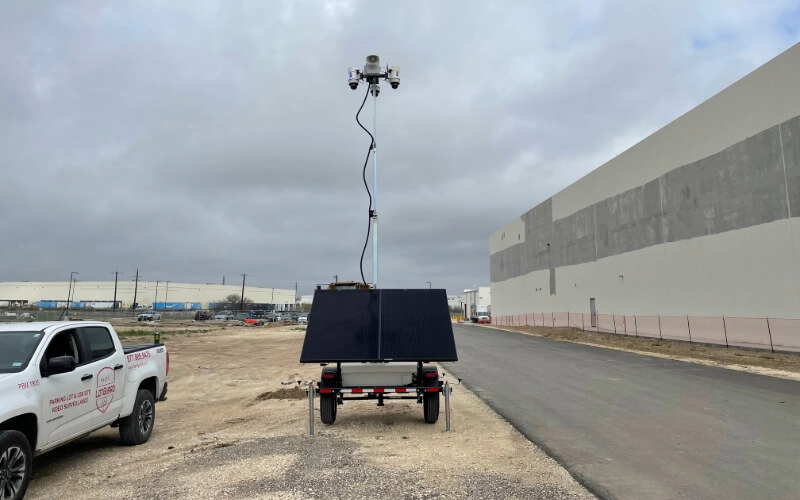
- Deterrence: Mobile Solar Surveillance Trailers give sites 24/7 perimeter security and a visible deterrent from a mast of up to 20 feet, so anyone approaching can see the site is being watched.
- Detection: Intrusion Detection, part of our Smart Detection System add-ons, uses AI to flag unusual activity in defined, high-risk zones while filtering false alarms caused by wildlife or weather.
- Vehicle tracking/access controls: Add-on License Plate Recognition (LPR) records plates and vehicle details at entry/exit points and access roads, making it easier to spot vehicles that keep returning after hours.
- Verification and response: Live Video Monitoring operators at U.S.-based monitoring centers check each alert, issue a live voice-down challenge, activate strobe lights to deter crime, and escalate to law enforcement where necessary.
- Multi-site oversight: Alerts and footage from every unit feed into our cloud-based software, so security teams can track incidents across all their locations and cameras from one dashboard.
Read more:
- How Surveillance Trailers Benefit Critical Infrastructure Security
- Protecting Critical Infrastructure Against Metal & Copper Theft
- How Do Solar Surveillance Trailers Deter Crime?
3. Protect remote and vulnerable assets
Many critical assets are located far from staff and fixed infrastructure, including substations, telecommunication facilities, solar farm developments, laydown yards, and transport and rail networks.
On a remote development, problems often aren't found until building teams arrive the next morning. By then, materials may be gone, copper stripped from a substation build, or fuel may have been siphoned from generators left on-site overnight. Without 24/7 visibility, it's difficult for project managers to piece together what occurred and when. There's often no record of which persons or vehicles gained access to the site after hours, or whether intruders came back more than once.
On established sites, the same issues may not surface until the next scheduled inspection. Replacing stolen materials/equipment can push back key milestones, and sending crews to manually check sites pulls labor away from the build itself.
The fix is to identify where visibility is weakest and match coverage to the risk, whether that's permanent for operational sites with fixed power in place, or temporary coverage for development sites where utilities aren't connected yet.
Your 2027 review should identify:
- Unstaffed sites that rely on periodic inspections
- Locations without mains power or wired connectivity
- Laydown yards and storage areas where materials, equipment, and fuel are kept overnight
- Access control at gates and site roads, including after-hours vehicle movements
- Short-term risks that need temporary coverage, such as construction phases
Our temporary security camera rentals bring 24/7 coverage to sites with no power or network connection. Our Solar Surveillance Trailers run on solar panels and battery storage for weeks of coverage and send live video and alerts over secure 4G/5G networks, while timestamping every incident in real-time in the cloud.
Add-on LPR technology records each vehicle's plate, make, model, color, and speed and can alert your team when a flagged vehicle returns or blacklisted plates are detected.
Read more:
- Why Energy Companies are Turning to Mobile Surveillance
- How Mobile Surveillance Cameras Boost Substation Security
4. Keep workers safe on live and changing sites
Infrastructure work often happens beside live traffic, near energized equipment where an electrical fault can start a fire, in extreme weather, and on poles and towers where a fall from height can be fatal. According to reports, electrical power-line installers and repairers had a fatal injury rate of 13.8 per 100,000 full-time equivalent workers in 2024, roughly 4X the rate of 3.3 for all U.S. workers.
A serious incident can halt work, trigger an Occupational Safety and Health Administration (OSHA) investigation, and put schedules at risk. OSHA's construction rules also say personal protective equipment (PPE) has to fit each worker properly, so it's worth checking how gear is worn, not just whether it's handed out.
A 2027 safety review should set consistent standards across critical infrastructure sites and contractors, covering:
- PPE and fall protection requirements for each work zone, including fit checks
- Safe working distances from live traffic and energized equipment
- Early warning for smoke and fire
- Severe weather thresholds that pause outdoor work
- Contractor inductions and incident reporting, so every crew follows the same rules
Smart critical infrastructure systems can help supervisors spot risks on sites they can't visit in person.
PPE Detection flags workers missing hard hats, high-visibility clothing, gloves, or safety glasses in high-risk zones and alerts workers in real-time for quick correction. Supervisors also receive timestamped evidence, so issues can be corrected before they lead to injury, while every incident is stored in our cloud-based software for later review.
Smoke and fire detection systems use AI video analytics to spot visible smoke or flame while filtering false alarms caused by dust or debris. These systems trigger real-time alerts at the earliest sign of smoke or fire, such as flickering light or a change in color, enabling critical infrastructure teams to keep workers safe and respond quickly before issues escalate.
IoT-based Weather Monitoring Stations track temperature (-4° F to 122° F), wind speeds (0–110mph), humidity (10-99%), and rainfall, logging readings to the same platform. Teams can pause work before conditions become dangerous and use recorded data to support audits or explain safety-related work stoppages.
Read more:
5. Meet environmental responsibilities and compliance requirements
The commercial facilities sector produces dust, noise, and emissions, often near homes, schools, and waterways, particularly when sites are being developed.
The Environmental Protection Agency (EPA) enforces the Clean Air Act, and its stormwater program requires permits when construction disturbs 1 acre or more of land. OSHA also limits worker exposure, including a construction limit for respirable crystalline silica of 50 µg/m³ over 8 hours, among others.
On top of federal rules, state and local permits often set their own conditions, such as noise limits, working hours, and dust controls. Falling short can lead to complaints, stop-work orders, and penalties, and without reliable records, it's hard to show that limits were met.
The fix is to map which regulations and permit conditions apply to each site, set clear limits, monitor conditions continuously, and keep records that stand up to an inspection.
Your environmental and compliance plan for 2027 should define:
- Permits and regulations for each site, including stormwater rules and OSHA exposure limits
- Dust, noise, and air quality limits for each work phase
- Working hours near homes, schools, and other sensitive areas
- Who reviews readings, responds to exceedances, and keeps records ready for an inspection
Our Environmental Monitoring Solutions mount onto our Solar Surveillance Trailers and send real-time alerts when readings exceed predefined thresholds. Everything is timestamped and stored in our cloud platform for trend analysis and later review, and reports can be generated in a click or two.
Air Quality Sensors measure particulates (PM1, PM2.5, and PM10), carbon dioxide (CO₂), carbon monoxide, and total volatile organic compounds (TVOC), storing up to 180,000 timestamped records. Noise Monitoring Sensors log noise levels from 30 to 130 decibels (dB) and record logs in the same dashboard. Readings are cross-referenced with timestamped video, showing what was happening on site when a limit was exceeded.
Read more:
- Compliance Challenges Facing Construction and Infrastructure Projects in California
- The Overlap of CPRA, OSHA, and Federal Rules: What Construction Leaders Need to Know
- Noise Monitoring Sensors: Legal Defense Against OSHA and EPA Complaints
- Why Is Real-Time Monitoring Important for CPRA and OSHA Compliance
6. Centralize evidence and oversight across dispersed locations
Infrastructure operators often manage multiple sites with separate systems for security, safety, and reporting. When incidents occur, evidence needed by police, insurers, regulators, or contractors can be scattered across systems, delaying investigations and decisions.
Fragmented data also makes reporting harder and hides patterns across sites. Missing or overwritten footage can delay claims, weaken prosecutions, and leave disputes unresolved.
The last critical infrastructure priority on our list is to set consistent standards for recording, storing, and sharing evidence, then bring site data into one place.
To improve evidence handling and oversight in 2027, aim for:
- Consistent recording, retention, and reporting standards across sites
- One platform for alerts, footage, incident logs, and sensor readings
- Clear access and sharing rules for police, insurers, and regulators
- Regular reviews to identify recurring issues across sites
Our cloud-based software brings live and recorded video, AI alerts, vehicle data, and environmental readings from up to 81 cameras into one dashboard alongside your WCCTV critical infrastructure security systems.
Intrusions, vehicle logs, smoke/fire warnings, and PPE non-compliance incidents include precise timestamps and linked video, which teams can review and export for police reports, insurance claims, stakeholder reviews, or audits. Combining security, safety, environmental monitoring, and project oversight also makes it easier to compare sites and report findings without switching tools.
Read more:
- Why Consolidated Monitoring Matters
- How Smart Security Cuts Admin Time to Focus on On-Site Supervision
- The Benefits of Integrating Your Security and Communications Systems
Preparing Critical Infrastructure for 2027
Setting the right critical infrastructure priorities for 2027 means focusing on resilience, risk management, physical security, worker safety, environmental compliance, and connected oversight across dispersed sites. Planning for risks, monitoring sites, and bringing data together helps keep essential services and development sites running when needed most.
If you're looking for smarter critical infrastructure security and resilience in 2027, contact our team today.
