
California's construction industry contributed $160 billion, or 3.8% of the state's GDP, and employed 895,800 construction workers as of July 2025. However, the size and scale of the industry come with a regulatory burden to match.
Between safety enforcement, licensing rules, wage law, and environmental regulations, project teams are expected to track a growing list of obligations while keeping schedules and budgets on course.
In this article, we look at the compliance pressures guiding construction and infrastructure projects across the Golden State, from jobsite safety standards to local hire mandates. We'll also discuss how better visibility and documentation help teams stay ahead of these regulations.
5 Construction Compliance Challenges in California
Every large-scale project in California, whether it's a highway expansion or a mixed-use development in Los Angeles, runs into some version of the same 5 compliance pressure points. Understanding where they come from makes it easier to build a compliance process that holds up under scrutiny.
1. Cal/OSHA safety standards and California labor laws
The Division of Occupational Safety and Health, better known as Cal/OSHA, enforces construction safety standards. In California specifically, this falls under Title 8 of the state's Code of Regulations, which go beyond the baseline set by OSHA's general construction regulations.
One of the clearest examples of this is fall protection, since California applies stricter guardrail, harness, and fall arrest requirements on residential framing and roofing work than federal standards call for.
Heat illness prevention and silica dust exposure protocols add further layers of oversight, and Cal/OSHA has reminded employers to protect outdoor workers from heat illness as temperatures climb. This includes providing water and shade, as well as cool-down breaks under its prevention standard.
Every fatality or serious workplace injury also has to be reported to Cal/OSHA no later than 8 hours after the employer becomes aware of it, under Title 8 Section 342. As such, documentation has to be maintained on an ongoing basis, so it's already in place if an incident occurs rather than being compiled after the fact.
Read more:
- The Overlap of CPRA, OSHA, and Federal Rules: What Construction Leaders Need to Know
- Construction Jobsite Compliance: From CPRA to OSHA
Supporting safety compliance with real-time detection
Keeping every subcontractor aligned with Cal/OSHA's standards is easier with continuous visibility into jobsite conditions. Our Smart Detection Systems help project teams catch safety issues as they happen instead of after an inspection flags them.
PPE Detection identifies when workers within the detection zone aren't wearing required hard hats, harnesses, eye protection, or high-visibility gear, giving supervisors a real-time alert instead of relying on manual walkthroughs.
Smoke and Fire Detection identifies smoke or flame in real time, which enables on-site teams to act quickly to contain these hazards. Intrusion Detection also helps confirm that only authorized personnel are present in high-risk zones such as trenching or scaffolding areas.
Our Live Video Monitoring adds an extra set of eyes on top of the automated detection, with trained operators watching live feeds and responding to flagged activity in real-time rather than after the fact.
This means a supervisor doesn't have to constantly be on-site to catch a fall risk developing or an unauthorized individual entering a restricted zone; the monitoring team can intervene immediately and log the response. Additionally, it gives safety managers a second layer of verification alongside the automated systems, which is useful during Cal/OSHA investigations.
Together, these systems give safety managers a documented, time-stamped record they can produce if one is requested.
Read more:
Speak With Us About Our Smart Detection Systems
2. Licensing, wage, insurance, and classification requirements
The Contractors State License Board (CSLB) licenses roughly 285,000 contractors across 45 classifications, and recent legislation has tightened its reach.
Under Senate Bill 1455, signed into law in September 2024, the board's authority was extended to January 1, 2029. The workers' compensation insurance deadline for all licenses, including those without employees, was pushed to January 1, 2028. The same bill reinforces that bidders must hold the correct license classification for the specific work being performed on public construction projects.
Prevailing wage compliance adds yet another obligation for jobsites. Public works projects over $1,000 must follow wage rates set by the Department of Industrial Relations (DIR), and any contractor expected to exceed that threshold must register annually with the DIR as a public works contractor before bidding.
Misclassifying employees as independent contractors carries its own legal exposure under Assembly Bill 5's "ABC test" for worker classification. Furthermore, California's wage and hour laws require employers to keep detailed timekeeping records for non-exempt workers.
Read more:
Keeping an accurate record for audits
When licensing or wage compliance is questioned, having a clear activity log for the jobsite matters. AI-video analytics are integrated with all of our on-site cameras and live monitoring systems, automatically processing footage from all of them to build a single, searchable record of jobsite activity.
That way, project leads aren't relying on memory or scattered notes if the CSLB or DIR requests evidence of who was on a jobsite and when. This record, along with safety and access logs, feeds into our cloud-based management platform, giving supervisors a single place to pull documentation quickly rather than piecing it together from multiple sources.
3. Environmental regulations and building code standards
Large-scale and infrastructure projects also have to navigate the California Environmental Quality Act (CEQA), which requires public agencies to disclose and mitigate significant environmental impacts before a project can proceed. This often extends permit timelines well beyond their initial estimates.
Any project that disturbs 1 acre or more of land needs a Stormwater Pollution Prevention Plan (SWPPP) under the state's Construction General Permit.
Failing to manage runoff properly can lead to fines and delays that ripple through an entire schedule, as well as civil penalties under the federal Clean Water Act.
Penalties are assessed on a tiered basis: Class I administrative penalties can reach up to $27,379 per violation, capped at $68,446 total, while Class II administrative penalties can run as high as $27,378 per day, up to a maximum of $342,218 per case.
Cases pursued judicially carry the highest exposure, with penalties reaching up to $68,446 per day for each day a violation continues, without a fixed statutory cap on the total.
Building standards can increase the pressure on construction companies. Title 24 of the California Code of Regulations sets the minimum design and construction standards for buildings statewide, covering energy efficiency, load calculations, and electric vehicle infrastructure.
The latest Title 24 update also pushes new buildings further toward Net Zero energy performance, with expanded heat pump and battery storage requirements supporting the state's broader goal of carbon neutrality by 2045. Cities are also permitted to adopt local amendments that are even more restrictive.
Because California updates these building codes on a rolling basis, construction businesses working across multiple jurisdictions need processes that can adapt quickly when standards change mid-project.
Read more:
Monitoring environmental conditions on-site
Environmental reporting obligations are easier to manage with continuous data rather than periodic manual checks. Our Environmental Monitoring Solutions include Air Quality Sensors that track particulate matter (PM1, PM2.5, PM10) and pollutant levels in real-time, flagging when levels exceed a set threshold so teams can act before a reading becomes a violation.
Noise Monitoring Sensors log decibel levels against local ordinance thresholds and time-of-day restrictions, as well as Cal/OSHA's 90 dB permissible exposure limit for an 8-hour workday. This is useful on projects near residential areas where noise complaints can trigger inspections or fines.
Additionally, our Weather Monitoring Stations record wind speed (0- 110 mph), rainfall (hourly), temperature (-4° F to 122° F), and humidity (10-99%)on-site, which is data that ties directly into runoff planning and helps confirm whether erosion control measures were in place before a storm. It also supports heat illness prevention by tracking the humidity conditions that compound heat stress on workers.
Together, these systems feed into one connected, time-stamped data record, rather than separate logs per device or per site. This is then exportable when CEQA or SWPPP documentation is requested, without adding any manual tracking work for jobsite staff.
Read more:
Inquire About Environmental Monitoring
4. City-specific local hire mandates
On top of state and federal obligations, many public works projects now carry local hiring requirements. San Jose's Project Labor Agreement applies to public works projects with an engineer's estimate exceeding $730,000 and includes local and targeted hire provisions. This means that contractors must track hiring data by location and report outcomes back to the city.
For contractors working across multiple cities, from San Diego to Fresno or Sacramento, this means compliance can't be handled with a single statewide policy. Each project needs its own documentation trail that's specific to the jurisdiction it sits in.
Verifying jobsite access and workforce activity
Confirming who is entering and leaving a jobsite supports both security and local hire reporting. Our License Plate Recognition (LPR) technology can be added on to any of our deployments to identify vehicles moving through a jobsite entrance or exit. This creates a record that helps verify contractor and subcontractor activity against local hire commitments.
It also works alongside our core surveillance systems rather than replacing them, which gives project teams an extra layer of verification without a separate piece of infrastructure to manage.
5. Maintaining documentation across multiple jobsites
Contractors running projects in several cities at once face a compounding challenge. Every local jurisdiction, local agency, building code, and more, generates its own paperwork, and losing track of any one thread can turn a minor oversight into a costly dispute.
Public agencies and clients have increasing expectations that documentation should be produced quickly and not compiled after the fact. This is true whether the request relates to safety records or environmental readings.
Centralizing records with continuous surveillance
Consistent, site-wide coverage is what makes fast documentation possible.
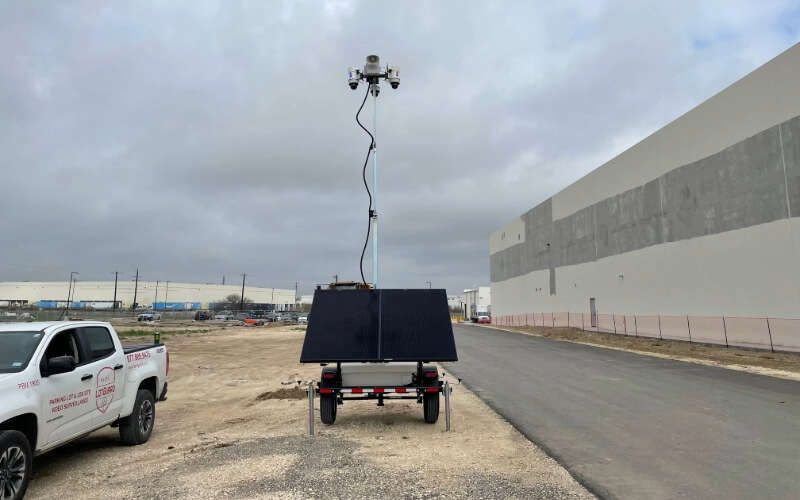
Our Solar Surveillance Trailers provide continuous coverage of active work areas without relying on permanent power or wiring, which suits jobsites that change and expand as a project moves through its phases.
Because these Trailers can be rented rather than purchased outright, teams can scale coverage up or down as a job moves through different phases, or across multiple sites, without carrying equipment they don't need for the full project length.
Our Pole Cameras offer an alternative for permanent jobsite features that need consistent coverage over the lifecycle of a project. This includes jobsite entrances, material yards, perimeter fence lines, and other high-risk zones, where uninterrupted footage of one critical vantage point is needed for the full duration of the project.
Every recorded event across these systems, whether it's a safety flag or vehicle log, routes into the same cloud-based management platform to give project leads a single, centralized place to pull records from. This is true up to 81 camera feeds per platform, giving project leads a single view even across multiple jobsites.
Read more:
- The Growing Expectation of Tech-Enabled Compliance in Construction
- The Hidden Costs of Legacy Systems on Modern Construction Jobsites
Ensure Compliance on California Construction Jobsites With Smart Surveillance
California's compliance requirements are always changing, which is why treating them as a fixed checklist is where many projects run into a wall. Rules change between jurisdictions, and documentation expectations keep climbing. Deadlines also constantly move, as SB 1455's phased-in workers' compensation timeline shows.
The projects that can manage these compliance requirements are the ones with comprehensive reporting and monitoring built into their daily operations. So, if you're planning a project across California and want a mobile surveillance solution that's designed for changing jobsite conditions and flexibility, get in touch with our team today to talk through what your jobsite needs.
