
Smarter rail project planning in 2027 means giving every crew, contractor, and project manager the same clear, up-to-date view of safety, security, and progress across the entire project lifecycle.
If you manage rail work, you’ll know how quickly a well-planned job can slip. A missed track access window, copper cable left at a remote yard disappears overnight, and a near-miss on the night shift may go unrecorded until it happens again, all of which can push work back by weeks.
These problems usually start in the gaps between teams, shifts, and systems, where information is recorded differently or not recorded at all.
This guide is for U.S. railroads, transit agencies, and contractors planning work in 2027. It covers 6 practical priorities, from protecting roadway workers and securing remote yards to managing dust and noise near communities, standardizing incident reporting, and connecting your project data so you can act on problems before they cause delays.
6 Rail Project Planning Priorities for 2027
Below, we discuss 6 areas you should prioritize when it comes to effective rail project planning:
1. Plan around track access and changing site conditions
Rail project maintenance and construction often need to fit into short track access windows, and if work overruns, the next opportunity could be days or weeks later. Materials, equipment, and labor also all need to be in the right place at the right time, often across multiple sites.
Access requirements add another layer to the planning process. Depending on the railroad authority, scope of work, and jurisdiction, agreements and contract specifications may require advance notice before work on railroad property, near active tracks, or involving cranes.
Some major railways might call for 30 working days' notice (Right-of-Entry (ROE)) before work on Railroad Property and 10-15 working days' notice before personnel or equipment come within 25-50 feet of a track. Missing these deadlines can delay work before crews even arrive on site.
Good project planning means accounting for these requirements alongside on-site realities. Map out each key phase, identify the activities that depend on track access, and agree in advance who makes decisions when conditions shift. Then review the plan as work progresses, rather than setting it once at the start.
Before your next project in 2027 begins, check that you have:
- Defined milestones/key activities, track access windows, and critical-path activities
- Assigned clear responsibilities across railroad teams and contractors
- Communicated design drawings/design changes clearly
- Engaged stakeholders throughout all key phases
- Identified likely bottlenecks, such as permits, utilities, power supply, and material deliveries
- Agreed on realistic KPIs and how and when progress is reported to project leaders
Being able to see a site without driving to it helps teams react faster when plans shift. Through 24/7 remote monitoring, temporary security cameras, and mobile surveillance trailers give project leaders a live view of railway projects from a phone or desktop, reducing the need to travel between locations.
2. Build worker safety plans into every phase
Rail crews face risks that go beyond those of a typical construction site. They may be working beside live tracks, around heavy maintenance equipment, near live electrical systems, or at height on bridges.
According to the Fatality Analysis of Maintenance-of-way Employees and Signalmen (FAMES) Committee, 96 roadway workers died in accidents between 1997 and 2022, accounting for roughly 22% of railroad employee fatalities during that period.
The Federal Railroad Administration (FRA) enforces Roadway Worker Protection (RWP) rules for railroads, and the Federal Transit Administration (FTA) introduced its own RWP rule for rail transit agencies in 2024. Both set minimum safety standards to protect workers who need track access to do their jobs.
Worker safety needs to be part of the plan from day one. That means making sure contractors follow consistent on-track safety procedures, crews have and use the right personal protective equipment (PPE), and equipment movements are properly controlled.
Weather needs attention, too. Extreme heat, heavy rain, high winds, and lightning can all force work to pause. Crews also need a clear process for reporting hazards, incidents, and near-misses before problems escalate.
Your 2027 safety planning should include:
- Consistent on-track safety procedures across all contractors
- Defined and enforced PPE requirements for each work area
- Severe weather procedures for outdoor crews
- A straightforward process for reporting and escalating incidents and near-misses
Technology can help supervisors spot risks early and respond before problems happen. PPE detection uses AI analytics to flag missing hard hats, high-vis clothing, gloves, or safety glasses in high-risk zones. These systems send automatic audio warnings to workers in real-time, while timestamping every incident so managers can follow up quickly.
Weather monitoring stations track local atmospheric conditions such as wind, rainfall, temperature, and lightning, giving teams site-specific data to support decisions about whether conditions are safe for crews. Both weather and PPE data can be stored in the same cloud-based platform for later review, helping to support investigations, claims, and reports.
Read more:
- How Extreme Weather Impacts Jobsite Schedules
- AI PPE Detection: Enforcing Compliance at Your Jobsite
3. Protect assets, materials, and temporary worksites
Rail projects often leave equipment, cable, fuel, and materials in remote and temporary locations overnight, with no one on-site to notice a problem until crews return.
Metal and copper wire are common targets in the rail industry. In September 2025, Denver's Regional Transportation District (RTD) ran a bus shuttle between Denver Union Station and Central Park Station after copper wire theft forced 4 crossing gates on its A Line into automatic safety mode.
But the cost of theft, arson, and vandalism goes much further than replacing materials. Incidents can disrupt service, delay schedules, and create new hazards for crews and the public. This means security plans must move with a project and surveillance needs to adapt to wherever the current risk is highest.
Before work starts in 2027, check each site for:
- Laydown yards, compounds, and equipment left exposed after hours
- Copper, cable, and other high-value materials along the route
- Unsecured access points, crossings, and vehicle entry routes
- Fire risks from hot works, stored fuel, or vandalism
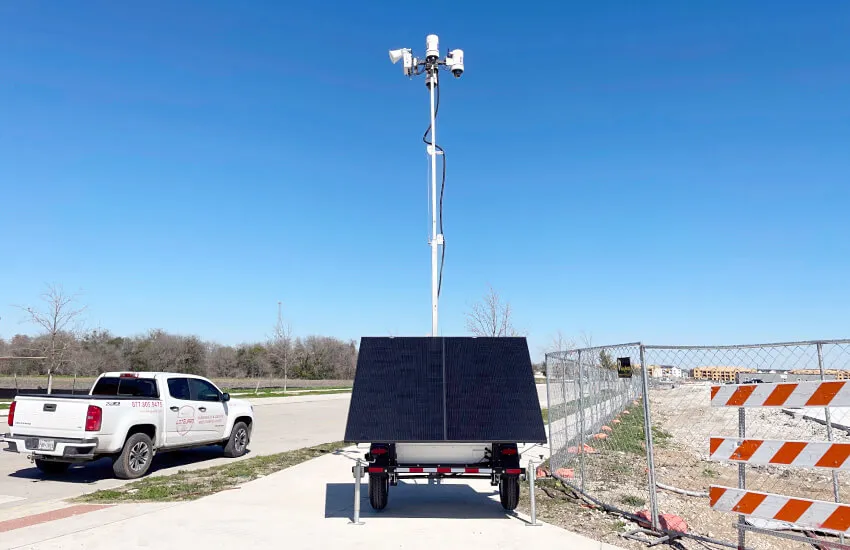
Mobile surveillance can cover worksite areas that crews can't watch consistently. Our Solar Surveillance Trailers, for instance, stand up to 20 feet and provide visible, 24/7 coverage in remote locations without power or fixed infrastructure, using near-360° PTZ (Pan-Tilt-Zoom) cameras with infrared (IR) night vision.
Add-on Intrusion Detection technology uses AI to flag unauthorized movement while filtering out wildlife, weather, and passing vehicles. Detection zones can be configured around high-risk areas, such as copper storage, to help prevent theft. Smoke and Fire Detection cameras can also be set up to monitor specific zones for early signs of visible smoke or flames, allowing teams to respond before an incident escalates.
Add-on License Plate Recognition (LPR) cameras record contractor trucks, deliveries, and suspicious vehicles entering rail yards and access roads, capturing plates and vehicle details (make, model, color) so teams can check arrivals against approved lists and flag unauthorized access.
Through live video monitoring, trained operators verify alerts, issue live audio warnings, and escalate genuine incidents before the situation gets worse. Every incident is logged and stored remotely for quick review.
Read more:
4. Manage environmental impact near communities
Rail projects often run close to homes, businesses, schools, and waterways. Ballast work and earthworks create dust, heavy equipment adds noise, and runoff can carry sediment into nearby streams, all of which can lead to complaints, delays, or penalties when regulatory compliance isn't met.
In the U.S., the Environmental Protection Agency (EPA) enforces the Clean Air Act (CAA) and the Clean Water Act (CWA), among others. The Occupational Safety and Health Administration (OSHA) also limits construction noise exposure to 90 dBA averaged over an 8-hour day and respirable crystalline silica to 50 µg/m³ over the same period, while local ordinances often restrict working hours near residents.
These risks are easier to manage when monitoring is in place before work starts. Decide what needs to be measured, where readings should be taken, and who is responsible for managing them. That way, if a neighbor raises a concern or a regulator asks for evidence, you have actual site data to work with.
Your 2027 environmental plan should cover:
- Local noise rules and night-work restrictions along railway projects
- Dust and air quality during earthworks, ballast work, and demolition
- Stormwater and runoff controls near waterways
- A named owner for collecting and filing environmental records
Manual spot checks can miss changes between readings, but continuous monitoring gives project managers consistent readings throughout the working day.
Environmental Monitoring Systems can be mounted on surveillance trailers to continuously monitor air quality (PM1, PM2.5, PM10), noise (30-130 dB), and weather conditions in real-time.
When readings exceed set thresholds, the system alerts designated contacts so they can investigate and take corrective action. All readings are timestamped and stored in a cloud-based platform, giving rail managers a record of site conditions to review trends, investigate complaints, and support compliance reporting.
Read more:
5. Standardize evidence collection and reporting across portfolios
When each contractor or rail team uses different monitoring tools and reporting systems, it's nearly impossible to get a clear picture of an incident. Inconsistent reporting makes it harder to spot recurring portfolio-wide issues and provide clear updates to stakeholders.
Railroads also have formal reporting duties, regardless of the funding source. Under 49 CFR Part 225, for example, they must report certain accidents, injuries, and occupational illnesses to the FRA, and contracts often add reporting requirements of their own. Missing information or inconsistent records can create compliance issues and make audits, insurance claims, and disputes harder to resolve.
The solution is for every team and railway site to follow the same reporting process and capture evidence as events happen, rather than after the fact.
Your 2027 reporting standard should define:
- Which incidents and site activities need to be captured through video monitoring or automated detection
- Who receives alerts, reviews footage, and escalates incidents
- How timestamped video, images, and incident records are stored and retained
- How evidence is retrieved and shared for investigations, audits, and compliance reporting
Smart detection systems help build a more consistent record, logging alerts automatically with timestamped video that teams can review during investigations and audits. This reduces the time teams spend manually compiling reports, chasing missing information, and reconciling records across sites, while making it easier to share consistent updates with stakeholders.
Read more:
6. Connect your data in one place
Rail projects benefit from having reliable systems in place to capture data from cameras, sensors, safety alerts, and progress reports. Without consistent monitoring and reporting processes, project leaders may miss emerging risks, struggle to track progress across sites, and spend more time gathering updates than acting on them.
Smarter system integration and coordination create the foundation for an efficient rail project plan. Bringing data from multiple sources into one platform gives project leaders a clearer view of overall performance, changing site conditions, emerging challenges, and opportunities for better collaboration across teams and locations.
Your 2027 plan should make it possible to:
- See security, safety, environmental, and project oversight in one place
- Get urgent alerts to the right people so they can respond promptly
- Check conditions at any railway site in real-time
- Generate reports using automatic timestamps rather than manual notes
Cameras and sensors on each site send footage, AI alerts, and readings over 4G/5G to our cloud-based software, where events are timestamped and stored for review.
The platform supports up to 81 cameras in one interface, giving project managers a central view of activity across multiple sites. Instead of switching between systems or traveling between locations to check what's happening, teams can see all relevant site information from one place.
More Connected Rail Project Planning in 2027
Smarter rail project planning in 2027 means connecting the people, processes, and technology needed to keep projects safe, secure, and on schedule. Bringing site monitoring, safety alerts, environmental readings, and incident records into one platform gives project leaders a clearer view across locations and helps teams respond to problems before they disrupt work.
We help railroads, transit agencies, and contractors monitor remote worksites, protect valuable assets, and manage site conditions throughout the project lifecycle. To discuss the security, safety, and monitoring needs of your next rail project, contact our team today.

