
A construction manager overseeing several active jobsites can't be on every site when conditions change. A wind advisory in one county and a heat warning in another can hit on the same afternoon, and a crew may already be exposed to a safety risk before either reaches the manager's attention.
Although weather patterns are some of the few variables construction teams can't control, they can be measured and planned around.
Real-time weather data turns an unpredictable factor into a manageable one, and the ROI is easier to calculate than most safety or compliance spend. When a manager can show weather data alongside broader security services and safety management coverage, the result is a fuller, more useful view of project risk and site performance.
This article breaks down how weather monitoring delivers a measurable return, what a weather station tracks, and how the same hardware supports safety, scheduling, and reporting across an entire portfolio of construction projects.
Why Weather Remains a Costly Blind Spot on Construction Projects
A single missed forecast can lead to a concrete pour that has to be redone, a crane lift pushed back a day, a crew standing idle while conditions clear, or equipment left exposed to weather conditions it wasn't meant to handle. These outcomes are common across construction projects rather than isolated incidents.
The National Oceanic and Atmospheric Administration (NOAA) has recorded a 5-year annual average of $149.3 billion in U.S. weather and climate disaster costs between 2020 and 2024. This is more than double the 45-year average, and construction jobsites sit directly in the path of that trend given how much of the work happens outdoors and on a fixed schedule.
For a manager splitting their attention across multiple jobsites, a missed weather window on a jobsite 40 minutes away isn't just a scheduling issue; it's a decision made without the manager's input and one that's harder to explain to ownership after the fact.
Extreme heat also carries its own distinct risk. The Occupational Safety and Health Administration (OSHA) is developing a heat-specific standard under its General Duty Clause obligations.
The Bureau of Labor Statistics (BLS) data cited in that rulemaking shows environmental heat exposure caused an estimated 33,890 heat-related injuries and illnesses involving days away from work between 2011 and 2020, which is an average of roughly 3,389 injuries each year.
Construction crews, who spend entire shifts exposed to changing temperatures, wind, heat, and precipitation, carry a disproportionate share of that risk.
Read more:
- The Overlap of CPRA, OSHA, and Federal Rules: What Construction Leaders Need to Know
- Construction Jobsite Compliance Failures and Lessons Learned
- 7 Costly Compliance Mistakes US Construction Firms Can't Afford
The Weather Hazards Jobsites Need to Monitor
A weather monitoring station tracks the conditions that most directly affect construction work, including temperature, humidity, wind speed and direction, and precipitation. Paired with real-time alerts, it becomes a tool that flags a hazard or a compliance risk before it becomes an incident.
High winds
OSHA's scaffold standard, 29 CFR 1926.451(f)(12), prohibits work on or from scaffolds "during storms or high winds unless a competent person has determined it's safe and workers are protected by a personal fall arrest system or wind screens".
A separate standard governing hoisting personnel, 29 CFR 1926.1431(k)(8)(i), requires work to stop once wind speed exceeds 20 mph at the personnel platform, unless a qualified person determines otherwise.
Wind speed and direction data, tracked continuously rather than checked sporadically over the day, gives a superintendent the lead time to ground crews before conditions cross either threshold.
Extreme temperatures
Extreme temperatures create a different kind of risk, which OSHA addresses through its General Duty Clause under Section 5(a)(1) of the Occupational Safety and Health Act.
Prolonged exposure to high heat can lead to heat exhaustion or stroke, while cold weather introduces its own hazards around dexterity, footing, alertness, and equipment performance. Monitoring temperature and humidity together gives a more accurate read on worker risk than temperature alone, since humidity affects how effectively the body cools itself.
Heavy rain and stormwater compliance
Weather monitoring also supports compliance obligations that are not directly linked to worker safety. Under the Clean Water Act, any construction jobsite that disturbs 1 acre or more of land requires a National Pollutant Discharge Elimination System (NPDES) permit covering stormwater discharge. This permit is designed to manage heavy or sustained rainfall.
A weather station tracking rainfall alongside wind and temperature gives a jobsite manager the same visibility as being there in person, without the drive.
It also creates a time-stamped log of actual rainfall conditions on-site, giving a manager documented evidence that stormwater controls were monitored and site decisions were made in line with the permit's requirements, rather than having to reconstruct that record after the fact.
Air quality
The Environmental Protection Agency's (EPA) National Ambient Air Quality Standards set the annual limit for fine particulate matter (PM2.5) at 9.0 micrograms per cubic meter, with a 24-hour limit of 35 micrograms. Coarse particulate matter (PM10), which is the dust generated by grading, excavation, demolition, and material handling, is capped at 150 micrograms per cubic meter over 24 hours.
Our Air Quality Sensors track both PM2.5 and PM10 alongside other airborne pollutants, giving jobsites continuous visibility into conditions that otherwise may only surface during a scheduled inspection.
Noise
OSHA's construction noise standard, 29 CFR 1926.52, sets a permissible exposure limit of 90 dBA averaged over an 8-hour shift, with a hearing conservation action level at 85 dBA.
Our Noise Monitoring Sensors track decibel levels across a jobsite in real-time, giving a manager the same kind of continuous record for noise exposure that a weather station provides for wind and temperature. This is useful both for protecting crews and for managing noise complaints from neighboring properties.
Read more:
- Air Quality Data Management: Turning Sensor Data Into Actionable Insights for Jobsites
- How IoT Improves Both Safety and IT Overview on Construction Jobsites
- Why Cybersecurity and Safety Tech Must Work Together on Jobsites
How ROI Is Calculated for Weather Monitoring
Building a credible case for weather monitoring starts with the same formula used across most safety and operational technology investments.
ROI = (Total Annual Benefit - Annual Investment) / Annual Investment x 100
The annual benefit for weather monitoring typically comes from 4 categories:
- Reduced downtime: Fewer unplanned stoppages, since crews and equipment are redeployed ahead of a forecast rather than caught out by one.
- Improved planning: Better scheduling accuracy across multiple active projects, using historical data and weather patterns alongside real-time data.
- Reduced rework: Fewer failed pours, damaged materials, and redone tasks caused by proceeding in weather conditions that should have paused work.
- Commercial protection: Documented, time-stamped weather records that support delay claims, insurance documentation, and stakeholder reporting, alongside fewer worker claims tied to weather-related injuries or fatalities when conditions are caught and managed early.
Annual investment covers the cost of deploying and maintaining the monitoring hardware itself, typically priced per jobsite or station. According to industry estimates, the typical return for weather monitoring systems in construction between 3 and 10 times the initial investment. This range is consistent with the returns reported for other automated site-monitoring technologies.
Read more:
Example ROI: Single Jobsite vs. Regional Contractor
Although these figures reflect the ROI for a single jobsite, most managers usually oversee more than one location. Once weather monitoring extends across every active jobsite in a portfolio, the same benefits scale with it.
The table below sets out example annual savings, comparing a single jobsite against a regional contractor running weather monitoring across 20 jobsites.
|
Benefit Area |
Single Jobsite (Annual) |
Regional Contractor, 20 Jobsites (Annual) |
|
Reduced Downtime |
$10,000 |
$200,000 |
|
Improved Planning |
$3,000 |
$60,000 |
|
Reduced Rework |
$5,000 |
$100,000 |
|
Commercial Protection |
$12,500+ |
$300,000+ |
|
Total Benefit |
$30,500 |
$660,000+ |
|
Annual Investment |
$2,500 |
$50,000 |
|
Net Benefit |
$28,000 |
$610,000+ |
|
Estimated ROI |
1,120% |
1,220% |
Where a single avoided loss is significant on its own, for example, a $100,000 rework or liability claim avoided against a $15,000 investment (can vary in cost), the return works out to 567%.
The pattern also holds across scenarios: the more jobsites a manager brings onto the same monitoring setup, the better the ROI becomes, since one integrated system is consistently covering every site rather than each one being managed separately.
Read more:
5 Ways Weather Monitoring Strengthens Construction Site Performance
An ROI percentage is easy to present, but harder to trust without knowing what's behind it. For a manager deciding whether to bring this to stakeholders, it helps to see exactly where that return comes from rather than taking the number at face value.
The 5 areas below are the specific, day-to-day changes that add up to the figures shown above, each tied to a decision a manager would otherwise be making with less information.
1. Earlier intervention
Real-time alerts on wind speed, temperature, humidity, and severe weather give supervisors the lead time to pull crews back before conditions become dangerous, rather than reacting after a near miss. When a manager can't be at every jobsite to notice a shift in conditions firsthand, this closes a gap that would otherwise depend entirely on a superintendent catching it and calling it in.
2. Reduced downtime
Hyperlocal, site-specific data on weather conditions supports better operational decisions than a general regional forecast. This allows teams to reschedule high-risk activities around accurate weather forecasts instead of losing an entire day. A regional forecast might call for rain across an entire county, while conditions on one specific jobsite clear an hour earlier or later than a crew would assume.
3. Protected operations
Crane lifts and material deliveries can be timed around actual jobsite conditions rather than guesswork, reducing the disruptions that come from proceeding (or not proceeding) at the wrong moment. A pour started just before a temperature drop or a lift attempted just before a wind gust both carry costs that are easier to avoid with continuous data rather than with a single daily check.
4. Commercial protection
Historical weather logs give a documented, defensible record to support delay claims and disputes over project timelines, replacing a manager's memory of what the weather was like with a verifiable log. When a delay dispute arises weeks or months after the fact, a time-stamped record carries more weight than a recollection of what conditions were like on a given day.
5. Stakeholder confidence
A manager who can pull weather, safety, security, and compliance data straight from our project insights dashboard is bringing proof to a conversation with owners and investors who would otherwise rely on a verbal update. That change matters most when a manager is simultaneously reporting on multiple jobsites and can't speak to firsthand observation for all of them.
Bringing documented data to a stakeholder meeting positions a manager as someone bringing evidence to the table rather than reassurance.
Read more:
- Five Myths About Smart Systems Debunked
- The Benefits of Integrating Your Security and Communications Systems
Weather Monitoring as Part of a Connected Jobsite
Weather monitoring delivers the most value when it isn't managed as a standalone tool. Our Environmental Monitoring Solutions, including Weather Monitoring Stations, sit alongside our wider safety management and security services offering. These solutions are built to work together rather than as separate systems.
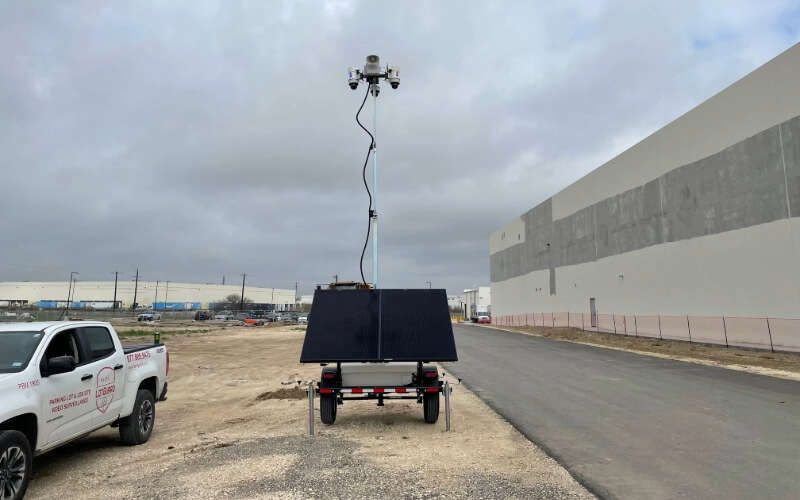
A Solar Surveillance Trailer or Pole Camera already watching a jobsite for security and visual evidence purposes can integrate weather sensors as an added layer of data. The same principle extends to our Air Quality and Noise Monitoring sensors, which can be integrated with our systems deployed for security. This gives a manager weather, air quality, and noise data from one centralized dashboard.
Where safety compliance is also a priority, our cloud-based platform brings weather readings, safety alerts, and live camera footage together in one place. A manager can check conditions, review reports, or pull up live footage from a jobsite from a phone or laptop, wherever they happen to be, allowing them to make crucial safety decisions without needing to be on-site.
Read more:
- The Rise of Smart Construction Jobsites: How Tech Is Transforming the Industry
- Vendor Sprawl in Construction IT: Why Consolidated Monitoring Matters
Building Your Own Business Case for Weather Monitoring
A stakeholder pitch for weather monitoring doesn't need to be complicated, but it does need real, site-specific numbers behind it.
Here's how you can build a business case for weather monitoring stations on your jobsite:
- Estimate current weather-related costs. Pull together what downtime and rework have cost across active jobsites over the past year, along with any delay disputes tied to weather.
- Compare that figure against the investment required. Weather monitoring is typically priced per jobsite, with the per-site cost likely to drop as more locations are added under the same vendor.
- Apply the ROI formula. Converting both figures into a single percentage makes the case easier for owners, lenders, or insurers to evaluate.
- Bundle it with existing jobsite technology. Adding weather monitoring stations to the same proposal as the surveillance trailers and cameras already on-site keeps the ask consolidated rather than spread across separate requests.
Get Reliable Data and Measurable ROI from Weather Monitoring
For a manager responsible for multiple active jobsites, weather is one of the few risks that can disrupt a schedule, put a crew at risk, or trigger a dispute without any warning.
Real-time weather data, combined with historical patterns specific to each site, gives a project manager the confidence to make scheduling, safety, and resource decisions without needing to be physically present to judge conditions for themselves. That's the difference between reacting to a problem after it's already cost time and money, and getting ahead of it before it does.
If you're interested in reducing weather-related risk across your projects, get in touch with our team to talk through how weather monitoring stations can be built into your surveillance and safety setup, whether you're adding to an existing system or starting from scratch.

