
On modern jobsites, the biggest risks often emerge quietly while you're dealing with more immediate challenges. You may be filling a labor shortage for a complex new build, and in the meantime, near misses, important regulatory changes, and environmental issues are slipping under your radar.
These overlooked issues often trace back to the same root cause: unreliable systems producing unreliable data. When the information you're working from is flawed, so are the decisions that follow. The unfortunate consequences can be unplanned downtime or inefficient resource allocation, hitting the bottom line hard.
Smart monitoring technologies are making it easier to uncover and mitigate these risks before they impact your profitability. In this article, we highlight 6 hidden costs that derail project success and explore smart solutions that help you keep performance and budgets on track.
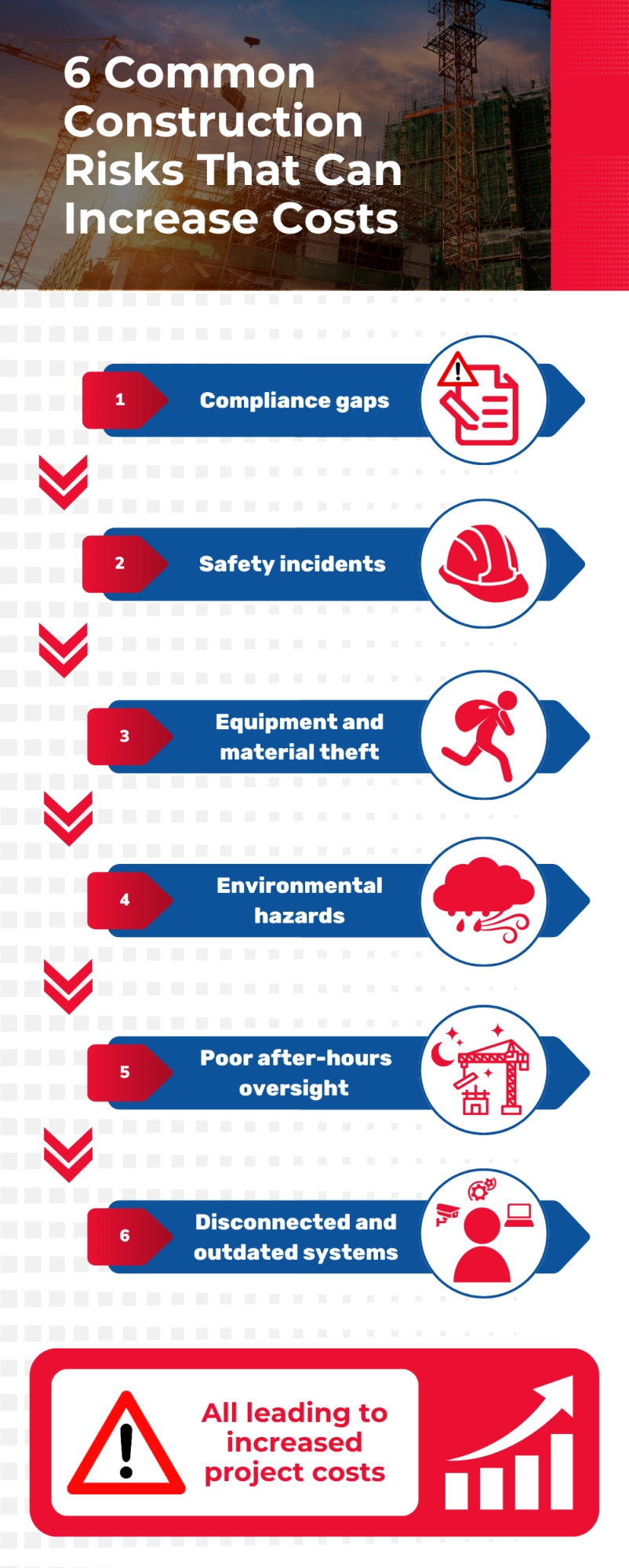
6 Common Construction Risks That Can Increase Costs
Here's a rundown of 6 hidden jobsite risks that leaders must control to ensure they don't impact costs and profitability.
1. Compliance gaps
When discussing hidden construction costs on US projects, compliance failures often top the list. Construction businesses with weak regulatory standards directly threaten project schedules and the company's reputation.
Regulators like OSHA and the EPA want to see documented due diligence. This means that even if a jobsite appears compliant, if you can't produce verifiable records (sensor logs, dust mitigation activity reports, etc.), officials may deem your systems inadequate.
This can have severe financial consequences:
-
Work stoppage orders: OSHA and EPA can halt operations until violations are corrected, causing delays and potential overtime costs.
-
Financial penalties:
-
OSHA fines can reach $165,514 per violation for breaches like noise exposure or air pollution.
-
EPA penalties can exceed $100,000. Civil penalties under the Clean Air Act can climb to $472,901 per violation.
-
-
With 150,000 jobsite injuries recorded each year, regulators enforce compliance laws strictly in the sector, increasing the likelihood of inspections and enforcement actions.
The most common compliance violations include:
-
Lack of PPE enforcement: Construction workers without proper protective equipment (helmets, gloves, respirators) expose projects to immediate OSHA citations.
-
Fall protection failures: Many contractors fail to implement proper safety equipment (guardrails, harnesses) for working at height, resulting in thousands of OSHA violations every year.
-
Environmental hazards: Poor pollutant controls, improper handling of hazardous materials, or excessive noise levels trigger EPA agency and OSHA inspections.
-
Record gaps: No documentation of high-risk events can be seen as a rule breach. For instance, if you can't produce sensor logs to prove noise levels remained below thresholds or that you used dust suppression measures during high winds, you may have problems with the authorities.
Read more: The Overlap of CPRA, OSHA, and Federal Rules
2. Safety incidents
Safety incidents are among the most expensive risks on US construction projects, threatening both worker well‑being and project timelines. Safety-related accidents inflate overall construction costs by driving up insurance premiums, workers' compensation claims, damage/repairs, and regulatory fines.
Numerous safety hazards can derail progress and increase bills, including:
-
Falls from height (scaffolding, ladders, unfinished structures)
-
Shortage of PPE (workers lacking helmets, gloves, or harnesses)
-
Fires and explosions (caused by flammable materials, welding sparks)
-
Struck‑by accidents (involving moving equipment, falling materials)
-
Electrical exposure (live wires, faulty electrical installations)
These safety risks not only endanger lives but also disrupt project timelines through investigations, site evacuation, injuries to key personnel, and repair work. Severe incidents can trigger regulatory shutdowns; for example, OSHA and other authorities may halt operations until they are satisfied that the workplace is safe and compliant.
A strong construction site safety culture starts with consistent training and clear communication around protocols and standards. Toolbox talks and visible leadership reinforce safe practices, while proactive hazard monitoring and strict enforcement of rules, such as PPE compliance, encourage responsible behaviors on the job.
OSHA shows that employers who implement effective safety programs significantly reduce injuries and associated costs, including workers’ compensation, medical expenses, and lost productivity.
Read more: Top Strategies for Ensuring Jobsite Safety
3. Equipment and material theft
Every year, theft and vandalism cost the US construction industry over $1 billion and substantial disruption. The list of assets critical to your build, and commonly targeted by thieves, includes:
-
Lumber and steel
-
Diesel (with fuel prices soaring due to current conflicts)
-
Specialized tools and equipment – from generators to power tools, surveying instruments, and vehicles.
Besides the financial loss, stolen materials disrupt workflows and can stall projects while replacements are sourced and insurance claims processed. Insurers expect contractors to protect assets against theft, so if you can't demonstrate proper security safeguards, your claim may be delayed, reduced, or denied.
Global supply chain pressures and inflation make rising material costs one of the top 3 sector challenges, highlighting the importance of vigilantly protecting everything on-site. A weakly guarded perimeter with poorly controlled sectors inevitably means more losses and work disruption than a well-controlled environment.
The message is clear: Preventive measures such as secure storage, controlled access, surveillance systems, and advanced monitoring solutions are essential to protect construction profit margins against crime.
4. Environmental hazards
A sweep of environmental hazards can drive up total project costs if not controlled. In this context, critical risks that construction managers must grapple with are as follows:
-
Noise must be responsibly managed to avoid safety and compliance transgressions. Excessive noise exposure poses health risks to workers, from temporary hearing loss to permanent deafness.
-
Various airborne hazards cause workers short-term discomfort (headaches, fatigue) and long-term health complications, including lung damage. Harmful contaminants include excessive dust, volatile organic compounds (VOCs), silica dust, and carbon monoxide (CO).
Like excessive noise, jobsite air pollutants can incur regulatory penalties and even shutdowns if they are not properly managed.
-
Weather risks disrupt construction jobs in several ways. Strong winds endanger crane operations and working at heights. Dangerous sleet and icy conditions may force you to suspend work for a period, while unexpected storms and flooding often damage completed structures, requiring rework and inflating job costing.
-
Rising summer temperatures increase the danger of heat-related illnesses, such as exhaustion, dehydration, and heat stroke. OSHA's NEP for Heat-Related Hazards expects employers to schedule water and rest breaks for crews, which can lead to project delays.
Successful project managers treat environmental monitoring as important as tracking progress on operations and performance. Fortunately, advanced modern solutions make this job easy for you. Today's automated environmental tracking systems operate 24/7 to help leaders address stakeholders' concerns around this priority area (both for internal ESG and external compliance).
Inquire About Environmental Monitoring Today
5. Poor after-hours oversight of jobsites
Construction sites are most vulnerable when they’re unattended. Major risks such as fire and flooding often occur overnight, causing extensive damage.
Common risks of weak after-hours oversight:
-
Flooding: Burst pipes or heavy rain can cause water damage before anyone notices.
-
Fire hazards: Electrical faults, overheated equipment, or improperly stored flammable materials often ignite overnight.
-
Vandalism and theft: Poorly secured jobsites attract both targeted and opportunistic crime. Either way, you suffer a loss.
-
Regulatory exposure: Environmental damage (e.g., chemical runoff from flooding) or fire hazards can prompt official investigations and fines.
24/7 monitoring systems with AI-powered cameras and sensors play a vital role in overseeing jobsites outside of working hours. These systems identify threats, including fire, unauthorized vehicles, unscheduled equipment use, excess water, and intrusions, and generate real-time alerts to designated contacts and/or emergency services
Continuous monitoring is important to prevent threats from escalating and running up repair and damage bills. Of course, surveillance must be supported by documented emergency response plans that detail escalation paths and drive swift, effective responses to crises.
6. Disconnected and outdated systems
Many construction projects use several disconnected systems to manage operations, safety, and compliance. This vendor sprawl results in wasted time, duplicated effort, and increased operational costs.
Managers and teams spend too much time switching between platforms, slowing communications and making information hard to find. Based on studies, around 10% of each work week is wasted searching for necessary information. In US construction, it's estimated that $177 billion a year is lost to data hunting, conflicts, and rework.
The negative financial impact is felt sharply by companies that still rely on outdated processes, such as paper logs, spreadsheets, email threads, and physical inspections.
Most companies that use manual reporting systems suffer from inefficient administration and poor reporting. Office teams spend hours consolidating field updates, correcting spreadsheet errors, and chasing missing information. By the time the update reaches everyone who needs it, the data may be too outdated to have value.
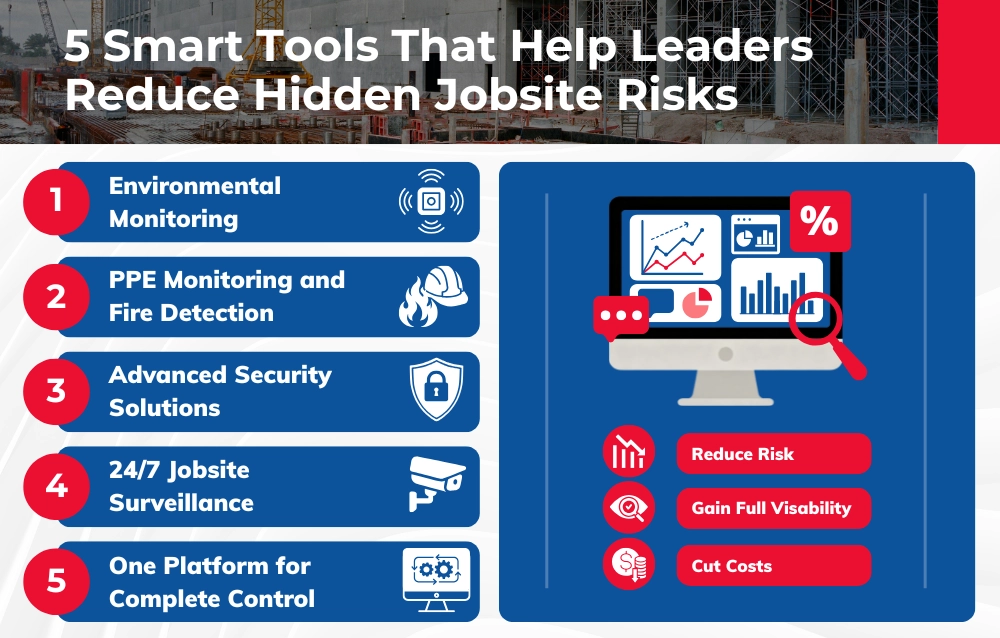
5 Smart Tools That Help Leaders Reduce Hidden Jobsite Risks
As digital transformation in construction accelerates, contractors are moving away from inefficient project management processes and legacy systems that expose safety, security, and compliance gaps. Instead, they are adopting smart digital tools that upgrade oversight through continuous monitoring, real-time reporting, and detailed compliance records.
Let's explore 5 smart digital tools that help leaders manage safety and operational risks more effectively.
1. Environmental Monitoring: Managing compliance and hazards
Environmental hazards are responsible for thousands of jobsite compliance violations annually. Our environmental monitoring sensors and connected cameras track air quality, noise levels, and weather conditions in real time.
Live eco data helps leaders manage hazards, ensuring they don't endanger workplace and public safety, or bring inspectors to your gate. Logged environmental records can be pulled at the push of a button for compliance checks and analysis.
-
Air Quality Sensors: IoT sensors measure dust, gases, fumes, and chemical emissions in real-time. The system automatically alerts managers before jobsite conditions reach permitted thresholds to avoid fines and work stoppages.
-
Noise Monitoring Sensors: Precision devices continuously track noise levels in all work zones. Alerts are auto-generated if unsafe/illegal limits are approached, protecting worker safety and keeping inspectors and the local community on side.
-
Weather Monitoring: Environmental sensors track temperatures, humidity, winds, and rainfall, affecting your jobsite. This data helps you plan workflows around weather risks to minimize downtime.
Environmental monitoring sensors deliver the air quality and noise data you need to keep jobsites safe and compliant and avoid shutdowns.
Read more:
2. PPE Monitoring and Fire Detection: Reducing safety incidents
Smart detection tools with connected cameras identify unsafe conditions such as PPE lapses and fire threats, allowing you to take swift corrective action.
- PPE Monitoring checks that workers adhere to personal protective equipment requirements (hard hats, high-vis vests, safety boots, etc.).
This reduces accidents, injuries, and fines by notifying leaders near-immediately of missing PPE. The system can even issue a real-time voice warning to non-compliant workers. Timestamped incident reports and video records help to satisfy OSHA's demands for documented due diligence.
-
Smoke and Fire Detection catches the earliest signs of smoke and fire dangers, protecting employees and assets. The smart system auto-generates immediate warnings, including timestamped images and video clips, to assist investigations and compliance inspections.
-
License Plate Recognition (LPR) uses AI-imaging to track and log all vehicles entering and exiting jobsites, strengthening access control and supporting post-incident investigations. By ensuring only authorized vehicles are on site and encouraging safer driving, LPR reduces accidents that lead to liabilities and claims.
Unlike human checks, digital tools record and report all safety near-misses. This is important because close calls often provide valuable insights that guide better future safety practices.
Read more: AI for PPE, Fire, and Intrusion Safety
3. Advanced Security Solutions: Reducing theft
Our security solutions replace security guards and manual reporting with intelligent jobsite surveillance that is all-seeing and responds to threats in seconds.
-
Intrusion Detection systems continuously scan jobsites using AI tools trained to recognize suspicious activity and alert you immediately, with live audio warning capabilities that can be activated in real time. They proactively prevent breach attempts, vandalism, and/or trespassing to protect equipment and valuable assets 24/7.
-
Live Video Monitoring strengthens controls by connecting security surveillance to a remote monitoring center where operators sit 24/7 to respond to security incidents. They take immediate action to deter unauthorized access or suspicious behavior spotted and flagged by AI-powered detection.
-
License Plate Recognition rounds out your security plan by strengthening vehicle access and driver accountability.
Read more: The Future of Construction Security: From Guards to AI-Powered Smart Systems
4. 24/7 Site Surveillance: Safeguarding your jobsites day and night
24/7 remote monitoring ensures your project is protected even when no one's on-site. Our high-definition infrared PTZ camera systems provide wide area coverage of all your locations, no matter how large or complex.
Trusted by law enforcement, our camera systems are installed via rapid deployment poles or Mobile Solar Surveillance Trailers. These versatile solar-powered trailers work with 4G/5G connectivity, providing continuous surveillance even in areas without power or internet. Standing up to 20 feet tall, they capture high-quality oversight footage for investigations and reviews in all light conditions.
Streamlining security surveillance with this cost-effective solution has helped many contractors reduce their security costs by up to 88%.
We also supply temporary video surveillance cameras purpose-designed for jobsites that can be quickly and easily deployed whenever and wherever you break ground.
Read more
5. One Platform for Complete Control: Eliminating vendor sprawl
A smart integrated platform brings maximum efficiency to operational oversight by unifying project data and compliance reporting in one place, eliminating system sprawl.
Our cloud-based platform consolidates surveillance footage, environmental data, smart detection alerts, and incident reports into centralized dashboards. Instead of manual data entry fed into disconnected systems, events are automatically captured and centrally stored. This allows you to quickly access relevant documentation in a single interface from any connected device.
Automated reporting generates OSHA, EPA, and industry-specific records in seconds, substantially faster than legacy systems. This efficiency reduces costly manual errors and administration expenses, and ensures audit readiness at the click of a button.
With every alert logged with a timestamp and linked video evidence, you have an airtight audit trail that protects your project from liabilities and often reduces insurance premiums.
Backed by NDAA-compliant infrastructure, our platform employs AES-256 end-to-end encryption for high-grade data security.
Read more: Stellifii: Our New Smart Platform Transforming Surveillance, Safety, and Compliance
Reduce Costly Risks with Complete Jobsite Oversight
As a construction superintendent, part of controlling the project budget is limiting low-key risks, such as environmental threats, compliance lapses, and equipment theft, that increase expenses and shrink margins.
Smart monitoring systems deliver the real-time visibility needed to spot issues early, enabling you to intervene quickly and decisively to avoid budget overruns. Automated solutions also provide actionable intelligence to help you make strong data-driven decisions to guide project performance and success.
With these tools, proactive professionals can confidently protect timelines, quality standards, profitability, and their company's reputation. Reach out before your next project and get ahead of the competition.