
Jobsite managers overseeing several active projects at once carry the compliance risk themselves, even for jobsites they haven't visited that week. When an incident happens or an audit lands, it's the manager who explains the gap between what was reported and what happened, not the superintendent who filed the last update.
PPE non-compliance carries real quantifiable costs. Fines from the Occupational Safety and Health Administration (OSHA), injury claims, project delays, and reputational fallout all show up on a balance sheet, and it's the manager who has to account for them rather than the on-site crew.
That gap is why the ROI of Artificial Intelligence (AI) Personal Protective Equipment (PPE) detection in construction comes in, replacing guesswork with evidence and incident reporting that managers can stand behind.
Introducing AI PPE detection gives a manager measurable proof that compliance is happening, along with a calculable return on the investment. Each violation caught early never gets the chance to escalate into costly fines or into a manager being questioned about where the wrongdoing lies.
This article breaks down the true cost of non-compliance, how ROI of PPE is calculated, example figures for single jobsites and regional portfolios, and how automated detection creates that value for workplace safety day-to-day.
The Cost of PPE Non-Compliance
A systematic review and meta-analysis published via the National Institutes of Health found that an AI-assisted audit of construction sites identified PPE violations in nearly a third of monitored shifts. This points to a broader construction safety problem, and the cost of getting it wrong rarely stops at a single fine.
Under the 2025 OSHA penalty adjustment, a serious or other-than-serious violation now carries a maximum penalty of $16,550, while willful or repeated violations can reach $165,514 per incident. This is because OSHA's gravity-based penalty structure, which is part of a set of strict regulatory requirements, ties those fines to how severe the hazard was and how avoidable it appears during inspection.
A missed PPE violation is also a starting point for broader safety compliance failures, and can escalate into an injury claim or a stalled project. In some cases, it may lead to a legal dispute, with each escalation carrying its own cost on top of any regulatory penalty.
The table below lays out how those costs compare, moving from a routine citation through to the most severe outcomes a jobsite can face.
|
Non-Compliance Event |
Potential Cost |
|
OSHA Serious Violation |
Avg. $16,550 |
|
OSHA Willful or Repeated Violation |
Avg. $165,514 |
|
Minor Recordable Injury |
$10,000 - $30,000 |
|
Lost-Time Injury |
$40,000 to $100,000+ |
|
Serious Injury |
$100,000 - $500,000+ |
|
Fatality |
Potentially $1,000,000+ |
|
Project Delay |
Up to $50,000+ per day |
|
Liability Claim |
$42,000 avg. injury claim |
Nationally, labor statistics show work injuries cost the US economy $181.4 billion in 2024, and the average workers' compensation claim now sits at $47,316, rising to $54,499 for falls.
Prevention pays off, too. OSHA's own business case for safety and health points to a Cal/OSHA study of safety audits, which shows a 26% average reduction in workers' compensation costs in the 4 years following a safety inspection, saving inspected firms an estimated $355,000 on average.
For a manager, lower costs also mean less personal liability. High workers' compensation costs tend to prompt questions about how a jobsite was being run, and it's the manager who has to answer for that, along with whatever reputational damage follows.
PPE Regulations at a Glance
Every cost outlined above sits against a regulatory backdrop that construction managers are expected to navigate across every active jobsite, and most PPE-related citations trace back to a handful of standards and safety protocols.
|
Regulation/Standard |
Why It Matters |
|
OSHA 29 CFR 1926.28 (PPE Requirements) |
Sets the baseline requirement for employers to ensure PPE use wherever hazards exist on a jobsite. |
|
OSHA 29 CFR 1926.501 (Fall Protection) |
Covers the fall-protection standards tied to the most frequently cited hazard category in construction. |
|
OSHA 29 CFR 1926.95 (Criteria for PPE) |
Defines when and how PPE must be provided and maintained, and how its use is enforced across a jobsite. |
|
OSHA 29 CFR 1926.100 (Head Protection) |
Requires that hard hats are worn wherever there's a risk of falling or flying objects, one of the easiest violations for a walkthrough to miss. |
Fall protection remains OSHA's most-cited violation across the construction industry, with 6,307 citations recorded in 2024 alone. This is exactly the kind of gap that continuous PPE monitoring is built to close.
Costs also compound quickly once a violation is confirmed, since OSHA's instance-by-instance citation policy allows a separate penalty for each worker or location found in violation rather than a single blanket fine.
It's a small distinction with a real payoff: catching a fixable gap early costs far less than an expensive violation later on. It also strengthens a manager's ability to keep a jobsite within regulation before a citation escalates into a work stoppage or an increased penalty, the kind of outcome stakeholders tend to trace straight back to whoever was responsible for the site.
Read more:
- 7 Costly Compliance Mistakes US Construction Firms Can't Afford
- Construction Jobsite Compliance Failures and Lessons Learned
Why Manual PPE Inspections Fall Short for Multi-Site Teams
Manual PPE checks depend entirely on whichever superintendent happens to be responsible for site safety that day.
If one jobsite gets a thorough walkthrough every morning, and another gets a glance between meetings, the resulting compliance picture is never consistent enough for a manager to stake their own credibility on. Verifying it in person often means another drive across town, which is time that could go toward higher-value work instead of confirming what a camera could already show.
Automated detection replaces that work with a proactive safety approach; namely, a continuous, time-stamped record that's centrally accessible across every jobsite in a portfolio, with alerts a supervisor can act on in real-time.
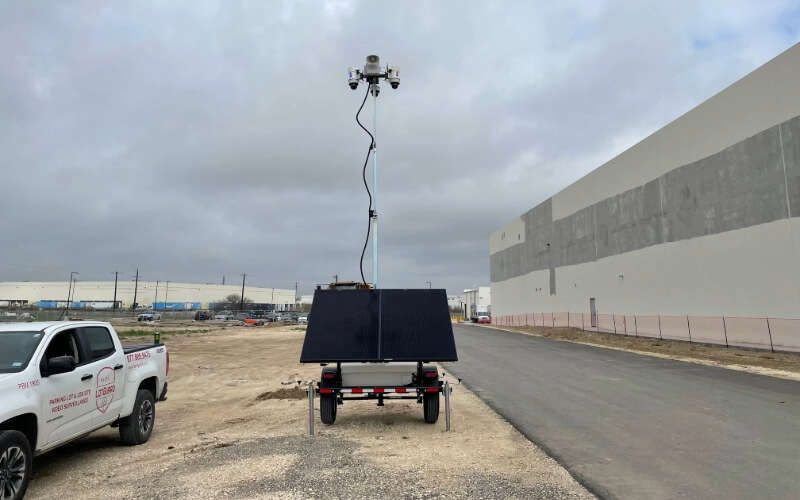
This is where our Smart Detection Systems come in, not as a standalone solution, but as an AI-powered video analytics layer built into any of our cameras already covering a jobsite, whether that's a Solar Surveillance Trailer watching the yard or a Pole Camera covering a fixed access point.
Built on a form of vision AI that processes visual data in real-time, the system flags missing safety glasses, hard hats, safety vests, and other required gear as workers move through the jobsite.
This gives safety teams a live view of compliance rather than a retrospective one. Coverage can also be configured to a restricted work zone rather than an entire jobsite, so the setup is customizable to how a jobsite is actually laid out rather than one-size-fits-all approach.
The pivot to automated detection reflects safety trends across the industry. The global market for PPE detection technology was valued at $70.56 billion in 2024 and is projected to reach $112.91 billion by 2030.
Construction accounted for roughly 29% of that market in 2023, a higher percentage than any other end-user industry, as construction companies increasingly build PPE detection into a broader safety management approach. Framed this way, to the team on the ground, it reads less like oversight and more like the company investing in a safety culture everyone benefits from.
Because that detection layer rides on hardware we've already deployed for security, extending it to PPE compliance means no new cameras or a separate system to manage. Paired with live video monitoring, a flagged PPE violation can also trigger a real-time response rather than sitting in a report for a later review.
How ROI Is Calculated for AI PPE Detection
Building a credible business case starts with a formula that construction and jobsite managers can apply directly to their own sites, using figures pulled from current inspection schedules and admin hours, alongside incident history.
ROI = (Total Annual Benefit - Annual Investment) / Annual Investment x 100
The total annual benefit is built from 4 separate categories, each tied to a cost most multi-site teams are already carrying:
-
Reduced Inspections: Fewer manual PPE walk-arounds needed per week, since continuous monitoring covers ground a superintendent would otherwise have to check in person.
-
Reduced Administration: Less time spent by managers and their teams compiling manual compliance reports, because automated, time-stamped records replace hours of manual note-taking.
-
Improved Compliance: Fewer violations and repeat citations, as consistent monitoring closes the gaps that periodic walkthroughs tend to miss.
-
Reduced Incident Risk: Fewer injuries and claims, along with the downtime that tends to follow them, since violations get flagged before they turn into incidents.
Annual investment covers the cost of running the detection system itself, and it's usually a smaller add to hardware already on-site rather than a brand-new purchase. That makes it easier to work into a wider security budget instead of pitching it as a stand-alone cost, and once both figures are in place, the formula turns them into a single percentage that's easier to present to investors or insurers.
On a single jobsite achieving over 95% consistent or proper PPE compliance after implementation, these 4 categories combine into a $12,125 total annual benefit against a potential $3,000 annual investment.
Run through the formula, that works out to an estimated 304% return, meaning ROI ratios for AI PPE systems range from 3:1 to 5:1.
Example ROI: Single Jobsite vs. Regional Contractor
The math above works for a single jobsite, but the real value becomes clearer once it's applied across a portfolio, which is closer to how most regional managers operate.
The table below places both example scenarios side-by-side.
|
Benefit Area |
Single Jobsite (Annual) |
Regional Contractor, 20 Jobsites (Annual) |
|
Reduced Inspections |
$3,125 |
$62,500 |
|
Reduced Administration |
$4,000 |
$80,000 |
|
Improved Compliance |
$5,000 |
$100,000 |
|
Reduced Incident Risk |
$2,500+ |
$50,000+ |
|
Total Benefit |
$12,125 |
$292,500 |
|
Annual Investment |
$3,000 |
$60,000 |
|
Net Benefit |
$9,125 |
$232,500+ |
|
Estimated ROI |
304% |
387% |
5 Ways AI PPE Detection Systems Create This Value
The ROI figures are the outcome rather than the mechanism. Behind that 304% return are 5 specific operational changes, and understanding each one makes it easier to see why the return holds up across jobsites of any size.
Early intervention
AI systems built for real-time detection catch a missing hard hat or vest the moment a worker enters a high-risk zone, rather than during a scheduled walkthrough. For a manager splitting time across several active jobsites, that closes the gap left by inconsistent superintendent updates without requiring someone to stand there and watch every access point.
Improved compliance
Every worker across every covered jobsite is monitored to the same standard, giving safety managers one consistent PPE compliance monitoring benchmark rather than scrutiny that varies by crew or shift. That consistency closes much of the gap between what's reported and what's actually happening on the ground.
Reduced administration
Automated, time-stamped detection logs replace hours spent compiling reports from scattered notes and phone calls. Instead of scrambling before a stakeholder meeting, a manager can pull a verified compliance record straight from the system's project insights dashboard on a phone, and walk in with proof rather than a verbal update.
Stronger safety culture
Continuous monitoring supports the safety procedures already in place rather than replacing them, and the biggest benefit shows up for the workers themselves. A missed piece of PPE gets caught and corrected before it turns into an injury, which is what lets a crew finish the day and go home safely. This matters more to most workers than any record whilst capturing the necessary evidence for inspections and insurers.
Reduced financial risk
Every incident avoided removes a claim and the delay that follows it, and the saving compounds through insurance, since experience-modification ratings apply across an entire portfolio.
The same trailer or camera that covers PPE compliance can also watch for theft and intrusion, and extends to smoke and fire detection or environmental monitoring where relevant. That means the return shows up through more than one operational channel, and preventing even one serious incident can offset several years of the detection system's own cost.
Read more:
- 5 Myths About Smart Systems Debunked
- What Integrated Security Looks Like in Action
- The Future of Construction Security: From Guards to AI-Powered Smart Systems
Building Your Own PPE Detection Business Case
Getting stakeholder sign-off doesn't require a complex financial model, but it does require real numbers rather than a general safety pitch. After all, owners and lenders, as well as insurers, respond to a documented case far more readily than an appeal to safety culture alone.
PPE compliance is just one part of what the same camera hardware and live monitoring setup can deliver. This strengthens the wider protection of a jobsite and its assets as well, which broadens the return beyond safety alone.
Here's how to build your own PPE detection business case:
-
Estimate the current annual cost of PPE non-compliance. Pull together what inspections, admin hours, incidents, and claims are costing across your active jobsites currently.
-
Compare that figure against the annual investment required. Detection costs are typically priced per site or per system, and the cost per jobsite tends to fall as more jobsites join the same monitoring setup.
-
Apply the ROI formula to calculate the net benefit. Running both figures through the formula turns your numbers into a single percentage return, which is easier and quicker for a stakeholder to evaluate.
-
Bundle it with the rest of the jobsite's security setup. Rolling security, such as trailers and pole cameras, into one proposal alongside PPE detection, paired with live video monitoring, gives a manager a single line item to include in a budget proposal rather than several competing for the same budget.
Get Measurable ROI from Smarter PPE Detection
Construction companies typically see compliance improvements of 30 -50% within 3 months of implementation, though exactly how fast PPE detection pays for itself depends on the jobsite, its current incident rate, and how compliance is being managed. The ROI only gets stronger once it's rolled out across a portfolio rather than a single jobsite.
For a manager, that's a stronger position to bring to stakeholders than a compliance report alone, since it reframes safety spend as a documented business case rather than a cost center to justify every budget cycle. It also avoids a cost that's harder to put a number on: the strain a preventable incident puts on a manager's reputation and on a team's morale, long after the direct costs are settled.
If you're interested in improving your jobsite's operational efficiency through AI detection, get in touch with our team today to talk through how PPE detection can be built into a WCCTV trailer or camera on-site, or built into a new setup from the start.

