
With so many safety risks on a typical jobsite, it's unsurprising that near-misses happen worryingly often. A worker forgets their hard hat and avoids falling bricks by inches, or a crew member without a high-visibility vest is almost struck by a truck in low light. Nobody gets hurt, so the day carries on.
But if these personal protective equipment (PPE) violations aren't recorded and acted upon, they will be repeated. Next time, the lapse could lead to a serious injury or OSHA penalty.
AI-powered PPE detection turns these incidents into valuable intel, helping leaders to prevent workplace accidents instead of reacting to them. Automated alerts flag unsafe behavior instantly, while visual snapshots and timestamped records give managers clear proof to address issues early.
As enforcement becomes consistent and visible, compliance rises naturally. Crews hold one another accountable, and close calls become preventable. Our article explains the role of AI PPE detection in creating a stronger safety culture and how to integrate a smart system into your management strategy.
The Costs of PPE Compliance Gaps
According to the US Bureau of Labor Statistics, 1 in 5 worker fatalities occurs in the construction industry, and around 150,000 people are injured on jobsites every year.
Many of these injuries can be tied to workers not wearing personal protective equipment as required by regulatory and jobsite rules. Examples of common PPE-fail incidents include:
-
A worker not wearing a hard hat is struck by falling objects or a collapsing structure.
-
Crew without appropriate respirators inhale silica dust during a demolition job.
-
An employee not wearing safety glasses suffers an eye injury from flying shards while cutting steel.
-
A contractor working without insulated gloves or arc-rated PPE during electrical work suffers severe burns.
OSHA's PPE standards (29 CFR 1926.95-106) make safe, properly fitted protective equipment a mandatory part of jobsite safety. Required protective equipment includes hard hats, high-visibility vests, goggles, protective boots, hearing protection, gloves, and respiratory masks.
To ensure worker safety in construction, OSHA scrutinizes this high-risk sector particularly strictly. As an indication of the regulator's oversight, in 2024, it issued:
-
6,307 citations for fall protection violations
-
1,814 citations for eye and face protection violations
OSHA can penalize transgressing companies as follows:
-
Serious/other-than-serious violations: $16,550 per violation
-
Willful or repeated breach: $165,514 per violation
-
Criminal charges are possible for severe violations
Read more: The Hidden Costs of Legacy Systems on Modern Construction Jobsites
Understanding PPE Near-Misses
Near-misses on jobsites are close calls that, fortunately, don't result in any injury or harm. The incidents may not cause injury today, but they expose gaps in your safety controls.
It's easy to understand how these seemingly minor issues go unnoticed until they result in a serious injury or accident. Manual PPE enforcement leans on periodic checks and walkthroughs, which delay incident reporting and responses. For managers supervising multiple jobsites, this creates blind spots where contractors may work unsafely for long periods.
Why do construction workers fail to use PPE?
In most cases, crews are aware of project PPE rules, but this doesn't mean they always follow them. In fact, based on a recent industry study, 54% of leaders cite consistent PPE use as a major challenge.
These are some of the many reasons construction crews neglect this crucial worker safety regulation:
-
Busy employees take shortcuts to speed up work and complete urgent tasks.
-
Wrong-sized equipment makes it impractical or uncomfortable to use.
-
Workers' judgment is compromised by heat, fatigue, chemical exposure, or other factors.
-
Substance abuse is a factor that contributes to bad judgment and reckless behavior.
-
Some subcontractors have weak safety standards and/or supervision.
-
Employees remove PPE because of the heat or general discomfort.
-
Supply issues mean there is a shortage of certain items, like respiratory masks.
Safety professionals understand the multi-pronged challenges of ensuring consistent PPE use. Aware of the limitations of manual oversight, leaders now favor continuous automated monitoring and alerts supported by visual evidence.
Integrating AI insights, this modern approach greatly reduces the risk of missing unsafe behavior. Further than that, AI PPE detection turns close calls into early intervention opportunities, improving workplace safety while reducing awkward confrontations with crews.
Read more: Top Strategies for Ensuring Jobsite Safety
What is AI-Powered PPE Detection
Modern PPE detection technology leverages:
-
Artificial intelligence and machine learning to help safety officers confidently track PPE usage across every jobsite they oversee.
-
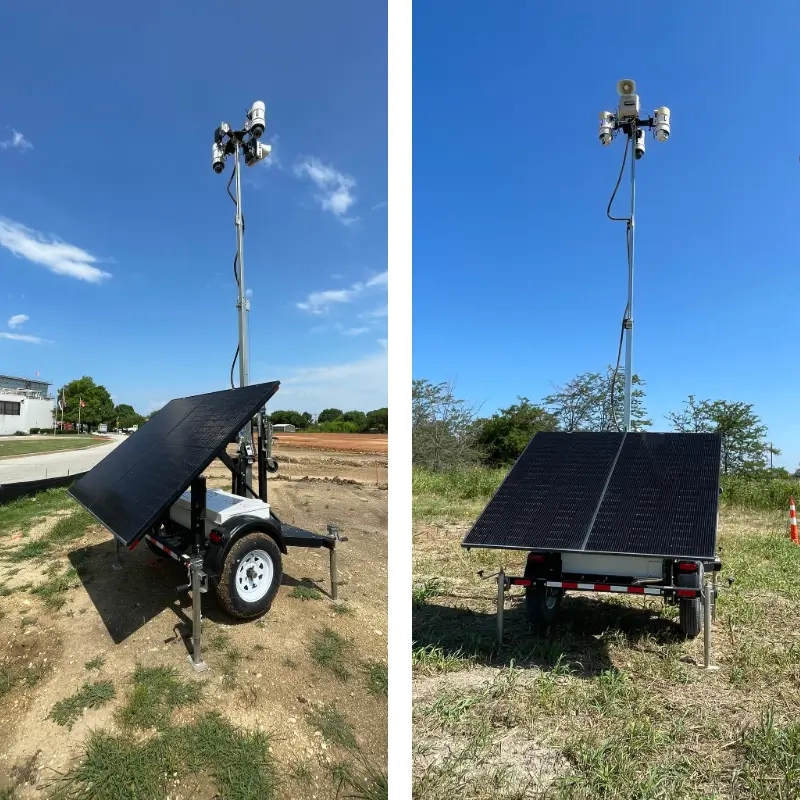
Surveillance monitoring using PTZ (Pan-Tilt-Zoom) HD cameras that run effectively indoors and outdoors at all hours. This network of "eyes" is deployed on Surveillance Trailers or as Pole Cameras.
AI PPE Detection monitors work zones 24/7 using AI video analytics to ensure that workers are using proper safety gear. The AI is trained on thousands of hours of real-world data to understand genuine PPE violations and filter out false alarms.
The system provides continuous oversight across even the largest, most complex jobsites, regardless of shift or lighting conditions. When it identifies a crew member not wearing a hard hat, face mask, or goggles, it sends you an immediate alert with video evidence.
Even if you're reviewing safety measures on a new Houston project and the worker is in San Antonio, you're fully up to speed and can initiate action. Advanced systems offer live audio warnings directly to the non-compliant worker, prompting them to correct themselves without you doing anything.
Centralized dashboard management
In leading AI-powered solutions, all detection and reporting run through a central cloud platform. Our cloud-based monitoring platform, Stellifii, brings PPE data from every tracking camera across every jobsite into an information-rich central dashboard. These are PTZ (Pan-Tilt-Zoom) HD units that operate effectively indoors and outdoors at all hours, day and night.
You can view up-to-the-minute PPE issues from anywhere on a desktop or mobile app. Real-time monitoring, multi-site visibility, instant alerts, and actionable insights not only reduce workplace injuries but also save safety professionals countless hours in travel and manual inspections.
PPE detection works together with other monitoring tools to provide comprehensive visibility into all hazard conditions and high-risk operations across locations:
-
Smoke and Fire Detection: Fire detection cameras with AI analytics spot the earliest indicators of fire faster than traditional smoke alarms.
-
Environmental Monitoring Systems: These IoT setups track the following environmental conditions:
-
Air Quality Sensors automatically detect and warn of harmful emissions and air quality breaches (dust, PM1, PM2, PM10, CO₂, and VOCs).
-
Noise Monitoring Devices continuously measure and report site sound levels and trigger alerts if limits are breached (measuring across 30-130 Decibels and 20 Hz–12.5 kHz frequency ranges).
-
Weather Monitoring Stations track and record weather conditions (heat, winds, storms, humidity) in real-time. The system can activate a temporary shutdown or reschedule work to protect the construction site and crew from extreme weather events like heat.
-
Read more:
-
How AI-Video Analytics for PPE, Fire, and Smoke Detection Ensures Jobsite Safety
-
Air Quality Data Management: Turning Sensor Data Into Actionable Insights for Jobsites
How AI Turns Near-Misses Into Preventable Events
Analytics-driven PPE monitoring upgrades workplace safety by replacing irregular spot checks and inconsistent manual processes with continuous, proactive oversight. An AI-powered system quickly and automatically spots and flags crew members not wearing appropriate PPE, enabling prompt intervention before a minor lapse turns into something far more serious.
A preventive approach treats near misses as actionable data. If a jobsite records an average of 15 PPE issues daily, your KPI might target a reduction to 10. The following automated features help ensure PPE compliance and continuous improvement in standards.
1. Instant automated alerts
A Smart Detection System pushes an immediate notification when it spots missing PPE, like "Safety Alert: No Hi-Vis Detected – Zone A". Supervisors can take immediate action to prevent an incident from occurring. The trigger can also issue an audio warning in real-time to individuals not wearing proper PPE.
2. Timestamped evidence
Stellifii provides timestamped visual evidence of non-compliance. This lessens the tension of conversations around transgressions, where safety officers are often seen as the "bad cop". Managers can now address the situation calmly and objectively with facts rather than accusations.
Timestamped documentation is stored securely in Stellifii. You can pull detailed reports with a few clicks when requested by inspectors or investigators.
3. Stronger data insights revealing trends
By logging and documenting every PPE non-compliance event as a data point, you can spot safety trends. The data may show that crew members removing their hard hats in Zone A is a recurring issue, highlighting the need for additional training, supervision, or perhaps stricter discipline.
Read more: The Rise of Smart Construction Jobsites: How Tech Is Transforming the Industry
Proving Compliance to OSHA and Stakeholders
When a serious incident happens, OSHA and stakeholders (owners, insurers, authorities) want answers. You don't want to be trying to stitch together compliance trails from scattered files when facing a grave inquiry. AI-powered records help ensure you are always audit-ready and able to demonstrate due diligence and proper safety protocols.
When you can quickly produce a digital log of automated alerts and swift interventions, you prove that a reliable safety system is in place and actively managed. Regulators and stakeholders can see that you take your responsibility to protect workers seriously through proactive, continuous oversight, including PPE compliance.
AI PPE Detection vs Traditional Methods
It's useful to contrast AI-enabled systems with traditional safety methods to show how intelligent detection achieves stronger safety compliance through positive, proactive enforcement.
|
Traditional Inspection |
AI PPE Detection |
|
Periodic checks: Safety audits occur at scheduled intervals, leaving gaps where risks go unnoticed. |
Continuous monitoring: Real-time detection flags potential hazards immediately, supporting proactive risk management. |
|
Reactive approach: Issues are often addressed only after an incident or non-compliance is observed. |
Proactive risk management: AI systems help safety managers to anticipate risks before they escalate, reducing accidents and improving compliance. |
|
Paper-based reporting: Documentation is delayed and difficult to analyze for trends. Files are often inaccurate and sometimes missing. |
Digital compliance dashboards: Centralized, automated reporting enables better, faster decision-making and long-term safety insights (predictive analytics). |
|
Human-dependent oversight: Relies heavily on inspectors and form-filling. Prone to inconsistency, oversight, subjectivity, and human error. |
Automated alerts: AI minimizes human error by detecting PPE violations automatically, driving consistent, objective enforcement on construction sites. |
Read more: How Can Construction Jobsites Adapt To Digital Transformation
Tips to Introduce AI Detection in Your Company
Use these proven strategies to successfully implement AI PPE detection in project environments.
Gain crew buy-in
A system that constantly monitors employees may cause some anxiety and suspicion. The crew may be concerned that their privacy rights are being violated or that the more surveillance means more punishment.
To manage these concerns:
-
Transparency is vital. Clearly explain the system's reasons and benefits, stressing that monitoring is targeted at detecting PPE gaps and improving safety, not micromanaging crews.
-
Ensure proper training for employees who work with the system, highlighting how the tools reduce manual workloads. This is also an opportunity to reinforce PPE training.
-
Invite crew feedback during rollout and incorporate suggestions where possible. This shows crews they are partners in building a safe workplace and encourages them to take responsibility for their environments.
-
Manage security and privacy concerns by using encrypted platforms and limiting data collection to relevant PPE safety information. The Stellifii platform is end-to-end AES-256 encrypted (Advanced Encryption Standard with 256-bit keys) to safeguard project and worker data, including personal details captured for incident reports.
Practical implementation
Here's a quick 4-step guide to the practical implementation of PPE monitoring on your jobsite:
-
Camera network: AI PPE detection works through our easily deployable surveillance trailers, pole cameras, and temporary cameras. These are Pan Tilt Zoom HD units that scan work zones around the clock, not missing a thing.
-
Configure detection zones: Define the zones to be monitored based on your safety rules. Set the PPE requirements for each zone (e.g., insulated boots and gloves for live electrical work) and designate the time periods during which monitoring will take place.
-
Setting up alerts: Configure how and who receives incident alerts and define the escalation process. Consider setting up the immediate audio warning to non-compliant personnel, in addition to notifying their supervisors.
-
Record keeping and access: Each event is recorded in Stellifii with timestamped footage and alert metadata. Set up permissions and access controls for personnel to view and work with this documentation. Safety teams and other authorized users can review, tag, or export violations to support compliance monitoring, audits, and employee accountability.
Intelligent integrations
To prevent trespassing and theft, and extend broader jobsite safety, companies also integrate AI security solutions such as:
-
Security Systems and Intrusion Detection: These use AI analytics to automatically detect and report intrusions and jobsite security breaches, while keeping detailed incident logs.
-
Live Video Monitoring: Security surveillance connects to a monitoring center where trained operators respond to safety and security alerts by issuing an audio voice down or activating sirens and light warnings.
-
License Plate Recognition (LPR): LPR is an automated system that tracks and logs all vehicles entering and exiting jobsite(s) to improve access control and vehicle safety in and around work zones.
-
WCCTV offers security systems with live monitoring included. To expand surveillance and risk management further, this system can integrate the additional tools we've discussed - PPE, fire, LPR, and environmental tracking.
Read more:
-
The Future of Construction Security: From Guards to AI-Powered Smart Systems
-
What Does System Integration Really Mean and Why Does It Matter?
Make PPE Incidents Preventable with AI Tools
PPE detection technology enhances workplace safety by automatically identifying whether employees are properly equipped with protective gear. By integrating practical AI tools with established safety protocols, the system helps ensure compliance and reduces incidents and claims.
Real-time monitoring and consistent visible oversight go a long way to changing work behaviors. When non-compliant contractors are consistently corrected in the moment, with proof of their transgression, crews become more safety aware. Individuals take ownership, teams "police" each other, leaders face fewer confrontations, and ultimately, a stronger safety culture takes shape.
If you are a safety manager trying to prevent incidents before they happen and build safer, more efficient work environments, contact us today. Our experienced team is standing by to support you with the best PPE monitoring and other smart detection and security solutions.

