
A construction manager overseeing several active jobsites often has to rely on someone else to notice what a vehicle was doing there in the first place.
A superintendent's walkthrough only catches what's happening in that moment, so a pattern of the same unfamiliar vehicle returning, a delivery that arrived hours late, or a contractor who clocked in well past their scheduled start can all pass by unnoticed until they've already caused a delay.
Jobsite theft costs the construction industry up to $1 billion each year, and fewer than a quarter of stolen items are ever recovered, but theft is only one part of what poor vehicle visibility costs a project. Missed deliveries and late contractor arrivals carry their own weight against a project timeline, since a manager who can't confirm when a vehicle actually showed up has no way to hold a delay to account.
This article breaks down the true cost of poor vehicle visibility, how ROI for license plate recognition (LPR) is calculated, example figures for a single jobsite and a regional portfolio, and how that data works alongside the rest of a jobsite's security services, safety management, and project oversight.
The Cost of Poor Vehicle Visibility on Construction Jobsites
Every vehicle that moves through a jobsite gate carries some risk if nobody is recording their movements.
Deliveries, subcontractor arrivals, equipment transport, and crew arrivals occur daily at multiple access points, and a single unrecorded vehicle entry can lead to a theft, a disputed delivery, or an unresolved insurance claim with no record to settle it.
The table below breaks down where that cost typically shows up for jobsite managers.
|
Challenge |
Potential Annual Cost |
Where the Cost Comes From |
|
Construction theft |
$5,000 - $100,000+ |
|
|
Delivery disputes |
$5,000 - $50,000+ |
|
|
Contractor attendance disputes |
$5,000 - $100,000+ |
|
|
Unauthorized vehicle access |
$1,000 - $50,000+ |
|
|
Investigation time |
Thousands annually |
|
Each of these categories tends to compound. A theft investigation takes longer when there's no vehicle record to follow, and a disputed delivery without a timestamp often becomes a standoff between 2 accounts.
An LPR system works by capturing a vehicle's plate the moment it passes through a jobsite's designated coverage zone, then pairing that plate with a timestamp and the location where it was read. Put together, those 3 details give a construction team a fixed record of exactly which vehicle was on-site and when, rather than a version of events pieced together after the fact.
Read more:
- Understanding Metal Theft: The Costs, Impact, and Tips to Prevent It
- 7 Costly Compliance Mistakes US Construction Firms Can't Afford
The Blind Spots in Manual Vehicle Logs
A paper sign-in sheet or a verbal note from a superintendent depends on someone remembering to complete manual data entry and ensuring that their memory is accurate.
One jobsite may get a strict gate check every morning, while another may wave vehicles through when the day gets busy, so the record is never consistent enough to rely on when an incident actually happens. A vehicle circling a site more than once, for example, is easy to miss entirely on a manual log, since nobody is cross-checking one pass against the next.
Checking it in person usually means a drive to the jobsite, and that's time better spent on work that moves the project forward over administration that could simply be automated.
How License Plate Recognition Systems Read and Record Vehicle Data
An LPR camera is typically mounted at entry and exit points, positioned to reliably capture plates as vehicles pass through, with minimal disruption to traffic flow even during peak hours. The license plate recognition camera captures clear images of the plate, and Optical Character Recognition (OCR) converts that image into readable, searchable license plate data.
Peer-reviewed testing of an OCR-based license plate recognition pipeline found accuracy above 90% for plate extraction and character recognition under normal conditions, with camera placement and image quality among the biggest factors affecting accurate identification.
Every vehicle movement is logged automatically, with no manual sign-in step involved. That plate data feeds directly into a searchable database, so a specific vehicle can be located by plate, date, or time window instead of a manual review through hours of general footage.
The same system can also flag suspicious vehicles or unauthorized vehicles against an approved list, triggering an alert the moment a vehicle is read in the designated camera zone. Since most jobsite theft happens after hours, these alerts catch the kind of activity a daytime walkthrough would miss.
When that system is paired with AI-video analytics already running on the same cameras, a flagged vehicle can prompt security teams to respond immediately instead of reviewing a report on the next jobsite visit.
Read more:
- The Rise of Smart Construction Jobsites: How Tech Is Transforming the Industry
- What Integrated Security Looks Like in Action
How ROI is Calculated for LPR Technology
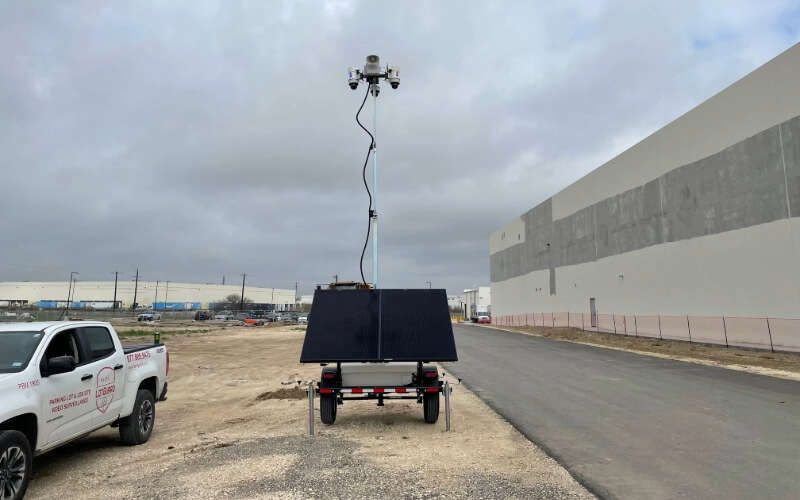
LPR is typically added to a solar surveillance trailer or pole camera covering a jobsite's entry point, rather than installed as a standalone system.
That matters for ROI, since the cost of the LPR layer sits on top of hardware a jobsite would need regardless, rather than representing an entirely new line item. Those cost savings compound further once a construction team accounts for the manual data entry and administrative hours the system replaces.
Building a credible case for LPR on construction projects starts with the same formula used across most jobsite technology investments.
ROI = (Total Annual Benefit - Annual Investment) / Annual Investment x 100
The total annual benefit can be drawn from 4 main categories:
-
Theft investigation support: Identifying a vehicle involved in a theft speeds up recovery and reduces the time an investigation takes.
-
Reduced unauthorized access: Flagging vehicles that don't belong on-site cuts down on trespassing and the losses that follow it.
-
Contractor accountability: A logged arrival and departure time settles attendance disputes without relying on anyone's memory.
-
Claims and dispute resolution: A time-stamped record gives insurers and stakeholders something concrete to review, rather than a verbal account.
Example ROI: Single Jobsite vs. Regional Contractor
A single-site figure only tells part of the story, since most contractors will likely look after multiple sites, meaning they will each require an automatic number plate recognition system. The table below shows an example of how the benefits add up for a regional contractor running 20 active jobsites at once and the potential ROI related to this.
|
Benefit Area |
Single Jobsite (Annual) |
Regional Contractor, 20 Jobsites (Annual) |
|
Theft Investigation Support |
$10,000 |
$200,000 |
|
Reduced Unauthorized Access |
$5,000 |
$100,000 |
|
Contractor Accountability |
$5,000 |
$100,000 |
|
Claims and Dispute Resolution |
$10,000 |
$200,000 |
|
Total Benefit |
$30,000 |
$600,000 |
|
Annual Investment |
$3,000 |
$50,000 |
|
Net Benefit |
$27,000 |
$550,000+ |
|
Estimated ROI |
900% |
1,100% |
ROI improves at scale mainly because of how the investment side is priced. Adding LPR to 20 jobsites at once typically costs less per site than buying a single system, since suppliers quite often price multi-site deployments at a lower rate per unit.
The benefit side grows in step with each new jobsite added, since every site carries its own theft risk and its own dispute potential, but the investment side doesn't grow at the same pace. That gap between the 2 is what pushes the overall percentage higher as more sites are added.
ROI for LPR on any given project ultimately depends on the project size and the volume of vehicle traffic moving through it, so these figures serve as a starting benchmark rather than a fixed outcome.
5 Ways LPR Strengthens Jobsite Security and Accountability
Each figure in the tables above trace back to a specific change in how vehicle activity gets handled day to day. Here's where that return actually comes from.
1. Support theft investigations
A recorded plate identifies the vehicle involved the moment a theft is discovered, rather than leaving investigators with vague vehicle identification or a gap in the timeline. That head start improves recovery odds, since a plate and a timestamp give law enforcement something concrete to act on.
2. Reduce unauthorized vehicle access
Every unrecognized vehicle gets identified by the LPR camera instead of blending in with legitimate traffic. Flagging unknown vehicles as they arrive, rather than noticing them during a later walkthrough or missing them completely, narrows the window they have to cause damage, remove materials, or scout the site for a later return.
3. Improve contractor accountability
Tracking attendance through a vehicle record resolves disputes at the source, since arrival and departure times are captured automatically. That cuts down on arguments over hours worked and gives a project team something firm to point to if a contractor's presence on-site is ever questioned.
4. Verify deliveries
A delivery vehicle's entry and exit time builds an audit trail that shows what actually arrived and when. When a supplier's paperwork and the jobsite record don't line up, the vehicle data shows which one is accurate, so neither side has to take the other's word for it.
That distinction also matters for explaining a delay, since a project team can point to the exact time a delivery arrived rather than guessing at where a schedule slipped.
5. Support claims and disputes
An objective, timestamped vehicle history protects revenue by giving insurers and stakeholders something concrete to review, rather than a description recalled from memory. This carries the most weight when a claim or dispute comes up weeks after the fact, when nobody can be expected to remember the details firsthand.
Read more:
LPR as Part of a Connected Jobsite
LPR adds the most value when it's layered with the other tools already protecting a jobsite, including live video monitoring, smart detection systems, and environmental monitoring.
Vehicle records, video, detection alerts, and site condition data from every active jobsite all sit inside our cloud-based management platform, so a manager reviews everything from one place instead of switching between separate systems for each type of data.
For a manager overseeing multiple jobsites at once, that single view matters more than it would at a single site.
Rather than logging into a different system for each location, every jobsite's vehicle data, alerts, and footage sit in the same dashboard side by side. A flagged vehicle at one site and a contractor's arrival time at another can both be reviewed in the same session, without treating each jobsite as its own separate task.
Where smart detection systems are also running, the same cameras covering vehicle entry can flag intrusion or smoke and fire risk too, so a project's wider safety management approach draws on the same connected setup as its vehicle records.
If a jobsite also runs environmental monitoring, that data integrates into the same platform as well, so vehicles, safety, and site conditions are all managed together rather than as separate tools.
For a portfolio that changes as construction projects start and finish, our temporary surveillance options bring LPR onto a site for the length a project requires it. That means coverage can grow or shrink with the portfolio instead of calling for a fresh hardware purchase every time a new site opens.
Read more:
- The Benefits of Integrating Your Security and Communications Systems
- How IoT Improves Both Safety and IT Overview on Construction Jobsites
Building Your Own LPR Business Case
A stakeholder pitch for LPR works best when it's built around a jobsite's own figures rather than a general pitch about security technology. Here's how you can put your own together:
- Estimate the current cost of poor vehicle visibility. Look at theft, disputed deliveries, and hours spent on investigations across active jobsites over the past 12 months.
- Set that number against the estimated LPR cost. Typically priced per camera or trailer, and available on a rental basis, so a construction team can add it across multiple sites with a predictable, scalable cost rather than a large upfront purchase.
- Turn both figures into a single return using the ROI formula. A percentage return is easier for an owner, lender, or insurer to weigh up than 2 separate dollar figures.
- Fold it into whatever's already being proposed for the jobsite. Pairing LPR with a surveillance trailer or pole camera at your jobsite means one system to approve instead of several competing requests.
Get Measurable Vehicle Data Across Every Jobsite
A recorded plate settles a dispute in minutes that might otherwise depend on someone's memory of what happened months earlier. This gap between a verified record and a recollection is where most of LPR's return lives. The figures in this article show what that looks like at a single jobsite, and how much further the return extends once the same coverage runs across a full portfolio.
None of that requires new hardware or a separate system to manage. LPR integrates with our Solar Surveillance Trailers and other temporary surveillance solutions, feeding straight into the same management platform that already stores data.
Get in touch with our team to talk through adding license plate recognition to your jobsite's existing trailer or camera setup.
