
To improve government project delivery in 2027, agencies and their delivery partners need clear governance from day one, earlier risk warnings, and reliable information from every site.
That matters more as scrutiny of public projects grows. The Government Accountability Office (GAO) keeps a High Risk List of federal programs and operations with serious vulnerabilities to waste, fraud, abuse, or mismanagement. As of February 2025, 38 areas were on it, including acquisition and program management at the Department of Energy's National Nuclear Security Administration (NNSA), NASA acquisition management, and Department of Defense (DOD) weapon systems acquisition.
That same pressure reaches every level of government, from a county stormwater upgrade to a federal facility spread across several locations, or a regional road improvement project. Agencies, contractors, project delivery professionals, and civil servants are expected to deliver on time and within the planned budget while showing the public where its money goes.
This article is for U.S. government agencies and the teams that deliver their projects. We'll cover the stages of government project delivery, 6 practical ways to improve outcomes in 2027, the connected technology that supports them, and how AI and automation could take more of the reporting load off project teams.
The Stages of Government Project Delivery
Government project delivery typically follows a structured lifecycle of initiation, planning, procurement, execution, and evaluation, with formal decision gates between stages. At the Department of Energy, for example, capital projects move through Critical Decision (CD) milestones that track progress from early development through construction and completion.
Public projects also have different priorities from private builds. They're judged on socio-economic value and public accountability rather than profit, and they have to plan for long-term operations and maintenance, so that a new bridge, road, water plant, or public building keeps working for decades after handover.
The early stages carry the most weight. Decisions made during initiation and planning set the scope, budget, schedule, and risk profile that every later stage inherits. Weak foundations at this point resurface later as delays and overruns.
Read more:
6 Ways to Improve Government Project Delivery in 2027
To improve government project delivery in 2027, these are the areas to focus on:
1. Set clear goals and governance from day one
When goals are vague, or nobody owns a decision, scope drifts, approvals stall, and budgets get stretched to cover work that was never planned. Clear governance and strategic alignment give every project a stable direction, and federal agencies already have a framework for this.
The Program Management Improvement Accountability Act of 2016 (PMIAA), backed by guidance from the Office of Management and Budget (OMB), sets out how federal programs and projects should be managed.
It also requires the 24 agencies covered by the Chief Financial Officers (CFO) Act to name a Program Management Improvement Officer, who leads program management policy and strategy within the agency.
At the project level, good governance starts with 4 steps:
- Define goals in measurable terms
- Align stakeholders before work begins
- Name who's accountable for each decision
- Agree how benefits will be measured at completion
Keeping the scope under control matters just as much, since every unplanned addition draws on the same budget and schedule. Experienced leadership keeps these calls consistent and carries knowledge and expertise from one project to the next.
2. Build risk management into every phase
Strong risk management starts with identifying risks early and backing each one with a contingency plan. When risks go unmanaged, the costs can grow quickly. GAO found that NNSA's cumulative cost overrun on major projects in the execution phase rose from $2.1 billion in 2023 to $4.8 billion as of June 2025, while cumulative delays grew from 9 years to 30 years.
GAO linked those overruns to inadequate contractor project management, poor vendor performance, and rising equipment and material costs. Each of these risks can be flagged well before they reach the budget.
These 4 practices help teams catch deviations while they're still small enough to fix:
- Rigorous cost estimation
- Regular reviews against baselines
- Clear escalation routes
- Transparent performance tracking
Monitoring and control should also be continuous rather than quarterly, because a problem spotted early costs far less in capacity and resources than one found at the next decision gate.
3. Tighten procurement and vendor oversight
Effective procurement and vendor management are critical to project success. Transparent, rigorous contracting helps prevent both corruption and cost overruns, and it makes each decision easier to justify when it's reviewed later.
Before awarding contracts in 2027, check that each one includes:
- Clear specifications and a defined scope
- Competitive bidding with documented evaluation criteria
- Performance clauses with measurable outcomes
- Equipment that meets federal procurement rules, including Section 889 of the National Defense Authorization Act (NDAA)
Teams that use separate providers for security, safety, environmental monitoring, and reporting often end up with disconnected data and duplicated costs, a problem known as vendor sprawl. Consolidating everything during project phases, where possible, means fewer contracts to manage and a clearer view of performance.
Our fully-managed service brings surveillance, smart detection, environmental monitoring, and project insights together through one provider and a single cloud-based platform, with agencies able to buy our systems through the GSA Schedule.
Read more:
4. Protect workers, the public, and project sites
Worker and public safety are vital for accountable delivery. According to the Bureau of Labor Statistics, construction and extraction workers suffered 1,032 fatal work injuries in 2024, and 370 of those deaths were caused by falls, slips, and trips. On public projects, a serious incident often results in investigations, legal consequences, and reputational damage for the agency involved.
Site conditions can raise these risks quickly. Heavy rain, high winds, lightning, and extreme heat make routine tasks more dangerous, and workers without the right personal protective equipment (PPE) are more exposed when something goes wrong.
Fire is another risk, particularly where hot work and stored fuel are involved. Because many public projects sit beside live traffic, sidewalks, and homes, these hazards can also reach members of the public.
Project sites need protecting, too. Remote, temporary, and multi-site projects are more vulnerable to theft, vandalism, trespass, and illegal dumping, particularly after hours. Copper wire stripped from a transport or utility project, materials taken from a public works yard, and fuel siphoned from vehicles and generators can all delay work and add unplanned costs.
Your 2027 safety and security plan should cover:
- Fall prevention, PPE rules, and severe weather procedures for every crew
- Fire risk from hot work and stored fuel, especially on empty sites
- Access control for compounds, laydown yards, and public works yards
- After-hours protection for copper, fuel, equipment, and materials
- Incident reporting and escalation routes
Connected site technology can help teams spot these risks before they turn into incidents or losses.
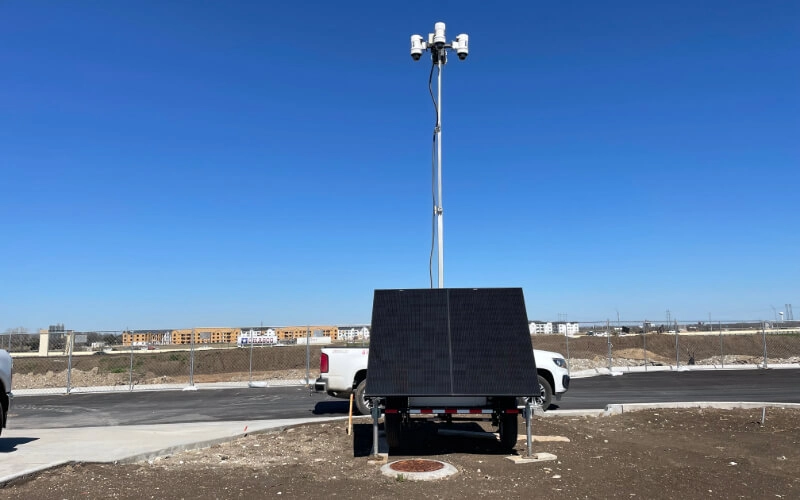
Solar Surveillance Trailers give remote and temporary sites visible 24/7 coverage without fixed power, with infrared night vision PTZ (Pan-Tilt-Zoom) cameras providing a near-360° field of view from up to 20-feet high. Live remote monitoring gives site managers remote access to everything that happens on-site as it unfolds, with trained operators verifying alerts and issuing live audio challenges before damage can be done.
Add-on Smart Detection Systems add another layer of safety monitoring to our Surveillance Trailers, helping teams identify potential hazards before they become serious incidents. Intrusion Detection alerts teams when someone enters restricted zones, while PPE Monitoring identifies workers entering high-risk areas without the required protective gear. Smoke/fire Detection provides early warnings of smoke or flames, giving site teams more time to respond and limit potential damage. Together, these systems provide 24/7 monitoring of key safety risks, even when site personnel aren't physically present.
License Plate Recognition (LPR) can help detect unauthorized vehicle incursions and identify vehicles traveling above site speed limits, giving teams greater visibility into vehicle activity and potential safety concerns across the site, while Environmental Monitoring Sensors track site conditions continously.
Every incident, from intrusions to weather readings, is timestamped and stored in our cloud platform, building an audit trail to help support investigations and insurance claims and allowing supervisors to generate reports quickly.
Read more:
- How Can Government Agencies Use Solar Surveillance Trailers?
- How Government Agencies Enhance Security with WCCTV
5. Stay ahead of environmental responsibilities and compliance
Environmental responsibilities run through the whole life cycle of a public project, from early earthworks to handover. Dust, noise, vibration, runoff, and severe weather can affect nearby communities, trigger complaints, and put permits at risk if they aren't managed.
The Environmental Protection Agency (EPA) enforces the Clean Air Act (CAA), and construction that disturbs 1 acre or more generally needs stormwater permit coverage and a Stormwater Pollution Prevention Plan (SWPPP).
Worker exposure also counts, and the Occupational Safety and Health Administration (OSHA) requires employers to protect workers from excessive noise, among other hazards. State and local permits often add their own conditions, such as noise limits, permitted working hours, and dust controls.
Before work starts in 2027, confirm:
- Which federal, state, and local permits apply to each site
- Noise limits and permitted working hours near occupied buildings
- Dust, air quality, and runoff controls for earthworks and demolition
- Who reviews environmental readings and keeps the records
Continuous monitoring makes these duties easier to manage and helps agencies show due diligence.
Environmental Monitoring Sensors mount to our Solar Surveillance Trailers and send alerts when readings exceed predefined thresholds, while building a timestamped record that agencies can use for audits, community complaints, regulatory inspections, and public/ESG reporting.
- Air Quality Sensors measure PM1, PM2.5, PM10, carbon monoxide, carbon dioxide, and TVOCs, logging up to 180,000 timestamp records in our cloud platform for reports and later review.
- Noise Monitoring Sensors continously track decibel (30-130 dB) and frequency (20Hz to 12.5kHz) levels in real-time, helping to reduce noise exposure and demonstrate compliance with regulations.
- Weather Monitoring Stations track wind speed (0-110 mph), rainfall (hourly), temperature (-4° F to 122° F), humidity (10-99%), lightning, and extreme heat, with alerts that help teams pause work before conditions turn unsafe.
Read more:
- Integrating Environmental Monitoring Sensors on Construction Jobsites
- Air Quality Data Management: Turning Sensor Data Into Actionable Insights
6. Report transparently and bring communities with you
Public trust in government is built through consistent, accurate communication, and it's currently low. In Pew Research Center's September 2025 survey, just 17% of Americans said they trust the federal government to do what's right "just about always" or "most of the time."
Some local governments are responding by publishing project progress on public dashboards:
- Cedar Park, Texas, runs a capital projects dashboard with project maps, timelines, funding breakdowns, and construction status.
- Northlake, Texas, tracks around 18 capital projects on a shared dashboard. Town staff say it answers council questions faster than spreadsheets and manual reports, and residents can now find updates they previously had to request.
Shared views like these support collaboration because project teams, finance staff, council members, and residents all work from the same information.
Early stakeholder engagement helps too. Talking honestly with residents and other stakeholders before work starts prevents friction later and gives the community a sense of ownership over the project.
Agencies should also track whether a project delivers the benefits it promised and share the results with the public. When a project introduces a new system or service, staff and residents need support to adopt it, because the benefits only arrive once people use it.
Visual records can support this reporting. Time Lapse Video captures a project from start to finish in images of up to 4K, giving agencies a clear record of progress to share with residents, council members, and other stakeholders. These videos can also be shared on social media to showcase the finished project, highlight positive changes, and demonstrate how public investment has improved the local area.
Read more:
- How Digital Tools Ease Audit Prep and Cut Reporting Time in Half for Your Jobsite
- The Growing Expectation of Tech-Enabled Compliance in Construction
How AI and Automation Change Government Project Delivery
AI adoption is now a federal priority, and OMB's Memorandum M-25-21, issued in April 2025, directs agencies to speed up their use of AI and to develop AI strategies. It also sets governance expectations, such as Chief AI Officers and minimum risk management practices for high-impact AI.
For project delivery, the near-term value lies in automating routine work. AI-powered security already flags intrusions and PPE breaches as they happen. The next step is using that same data to:
- Draft daily site reports
- Summarize incident logs
- Spot patterns across programs at scale
- Highlight deviations before review meetings
Automation won’t replace accountability, though. The strongest results will come from pairing faster analysis with human oversight, consistent methodology, documented approvals, and transparent records.
Read more:
Building Better Government Projects in 2027
Government projects rarely fail because of one bad decision. Instead, problems build up through unclear goals, unmanaged risks, scattered vendors, and reports that arrive too late to act on. On public projects, every delay holds back services people are waiting for.
In 2027, agencies and partners that combine strong governance with live information from their sites will be better placed to protect workers and sites, meet environmental duties, control costs, and show the public what's been delivered. That investment is modest in comparison with the cost of a single overrun or serious incident.
Speak to our team today to find out how site technology can support your next government project.
