The cost of traditional monitoring methods is starting to take a measurable toll on the US construction industry. Construction projects commonly exceed budgets by 20-30% due to delays and cost overruns, creating both financial strain and reputational risk. When you add increased material costs, tightened compliance obligations, and weather disruptions, the impact only grows more severe.
The issue with traditional monitoring methods for surveillance and compliance is that they're fragmented and disconnected, meaning jobsite data is often siloed in individual platforms that can't communicate with each other. Delayed information sharing and manual processes simply can't keep pace with the speed and complexity of modern construction projects, often creating more problems than they solve.
These risks make it incredibly difficult for project managers who are responsible for multiple jobsites, especially when project timelines and professional reputations are on the line.
A shift toward digital transformation is the only way forward. By moving from disconnected legacy systems to integrated, cloud-based monitoring and security platforms, construction companies can strengthen cybersecurity, simplify OSHA and EPA compliance, reduce vendor sprawl, and gain real-time visibility across multiple jobsites from a single interface.
This article dives deep into why you should consider digital tools, why they matter, and how to embrace the digital transformation in construction with WCCTV as your partner.
6 Reasons US Contractors Should Consider Digital Solutions
Traditional monitoring methods no longer serve the construction sector effectively, which is why more and more construction companies are turning to integrated digital solutions. Here are the main reasons for making the switch:
1. Real-time visibility
Project managers overseeing several jobsites simultaneously can't be everywhere at once. Without real-time visibility, they depend on manual reports that may arrive hours or days later. Digital monitoring platforms offer instant access to live video feeds, environmental data, and progress metrics from any device, eliminating unnecessary jobsite visits and significantly cutting back on travel time.
2. Rising theft and vandalism risks
Construction jobsite theft costs the industry between $300 and $1 billion each year. With metal prices fluctuating and equipment values rising, criminal activity continues targeting vulnerable jobsite locations. Advanced surveillance systems with AI-powered detection capabilities identify genuine threats faster than traditional patrols, serving as both a psychological deterrent and an active prevention system.
Read more:
- Construction Site Thefts Continue to Rise in North Texas
- Complete Guide to Construction Jobsite Security
3. Fragmented monitoring systems
Managing separate vendors for security surveillance, environmental sensors, access control, and fire detection leads to coordination nightmares. There's no single, verifiable source when security footage lives in one system, compliance data in another, and safety alerts somewhere else. This vendor sprawl not only wastes time but also increases costs and creates gaps in both security and compliance, leaving you exposed to regulatory infringements or worse, project suspensions or shutdowns.
Read more: The Importance of Aligning IT and Safety Leaders on Jobsites
4. Project delays and cost overruns
Each year, 45% of global construction jobsites experience project delays due to inclement weather, resulting in billions of dollars in additional expenses and lost profitability.
When setbacks occur onsite, stakeholders want answers. When you're relying on traditional monitoring or manual spot-checks, you can't anticipate weather-related work stoppages accurately, nor provide verifiable evidence that directors, insurers, and clients require, leaving you scrambling to explain delays and justify cost overruns.
5. Financial impact of non-compliance
The Bureau of Labor Statistics reports that over 145,000 people are injured on construction jobsites annually. To mitigate these risks, the Occupational Safety and Health Administration (OSHA) sets safety standards for construction firms to follow. The cost of non-compliance? OSHA violations can reach more than $16,000 per violation, while willful or repeated infringements can cost upward of $160,000.
Then there are Environmental Protection Act (EPA) fines to consider:
-
Clean Air Act (CAA) violations can result in a maximum daily penalty of up to $472,901 per violation.
-
Infringements of the Toxic Substances Control Act (TSCA) can cost nearly $50,000 per day and/or carry up to 1 year imprisonment.
-
Repeated Clean Water Act (CWA) violations can cost $50,000 daily.
Without a smarter approach, project managers often rely on manual inspections and irregular spot checks to track environmental factors. Unfortunately, these traditional methods cannot provide continuous monitoring, leading to compliance gaps or resource-heavy patrols that drain time, labor, and your bottom line.
Read more: 7 Costly Compliance Mistakes US Construction Firms Can’t Afford
6. Sustainability goals
There's increasing pressure worldwide for construction jobsites to adopt greener practices and reduce their environmental impact. Construction companies need to accurately track emissions, energy use, and waste generation to help achieve the nation's 2050 Net Zero targets and demonstrate their commitment to a greener future.
IoT-based environmental sensors set a new benchmark by monitoring your jobsite's carbon footprint in real-time. Embracing this digital transformation demonstrates due diligence and supports EPA compliance with minimal effort. This continuous jobsite data also gives construction firms a competitive advantage when bidding for eco-friendly contracts.
Read more:
- Why Smart Surveillance Systems Are the Future of Business Security
- How Smart Monitoring Saves Construction Jobsites Money
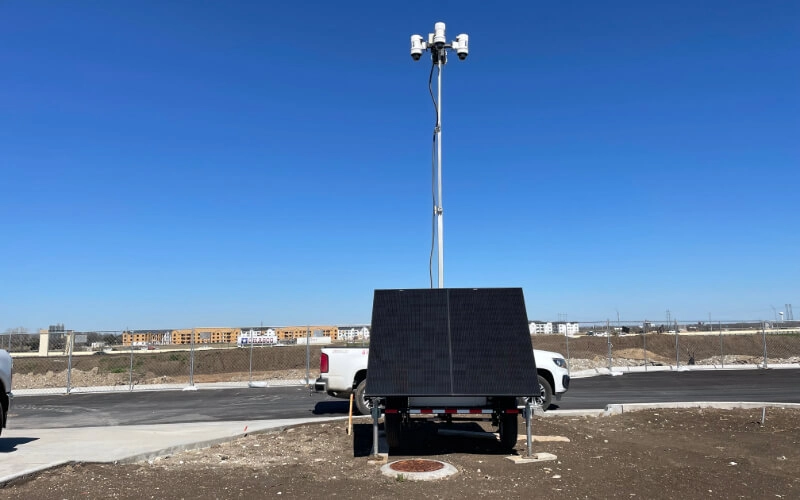
The cost of legacy systems for modern jobsites
Before diving into the digital solutions transforming the construction industry, here's a quick overview of why outdated monitoring methods cause more problems than they solve:
| Problem | Description |
| Vendor sprawl | Coordinating multiple suppliers for different security and monitoring needs creates administrative burdens and increases costs. |
| Compliance gaps | Manual tracking of OSHA and EPA requirements can lead to missed inspections, incomplete documentation, and regulatory violations. |
| Security blind spots | Traditional guard patrols can't provide 24/7 coverage across large, complex jobsites, and record-only surveillance cameras offer no real-time value. |
| Manager burnout | Driving between 3-6 jobsites to verify conditions, chasing updates late at night, and managing disconnected systems drains mental bandwidth and decreases productivity. |
| Reputational damage | Project delays, numerous safety incidents, increased insurance premiums, and compliance failures reflect poorly on your professional capabilities, causing stakeholders to lose trust. |
Read more:
- The Hidden Costs of Legacy Systems on Modern Construction Jobsites
- Vendor Sprawl in Construction IT: Why Consolidated Monitoring Matters
3 Reasons Why Modern Construction Jobsites Are Skeptical of Adapting New Technologies
Despite the advantages of digital tools, many construction companies still question their capabilities and hesitate to adopt new technology. Here are some of the main reasons why:
| Skepticism | Reason | Reality |
| High initial cost | Many believe they'll need to shell out a lot of money for digital platforms that require expensive hardware, software, and training. | Integrated monitoring systems can reduce your costs by nearly 88% compared to traditional methods, with no IT expertise or lengthy setups required. |
| Integration challenges | Those in the construction industry worry that new technologies are risky and time-consuming and may disrupt workflows. | Modern solutions such as Stellifii, our cloud-based platform, integrate seamlessly with our Mobile Surveillance Trailers and Pole Cameras, which are designed for rapid deployment with basic setups operational in just 20 minutes. |
| System inefficiencies | Many project managers are concerned that digital technologies are unreliable and error-prone. Will AI-powered systems actually work in construction environments? What about false alarms and extreme weather conditions? | Advanced technology with AI-video analytics achieves near pinpoint accuracy while filtering out false alarms caused by dust, weather, and/or debris.Night vision PTZ (Pan-Tilt-Zoom) cameras work in complete darkness, dust, and fog without human oversight, ensuring 24/7 protection even when the lights go out. |
Read more: Five Myths About Smart Systems Debunked
9 Digital Technologies Transforming the US Construction Industry
Most modern construction professionals combine multiple digital tools and smart security systems to create modern, safer, and more efficient jobsites.
Here's how 9 key technologies work in action:
1. Advanced surveillance cameras
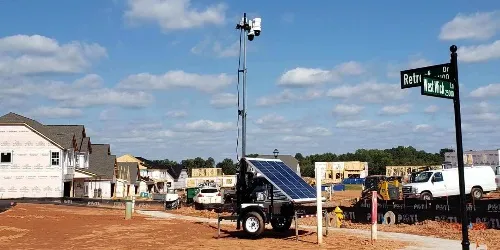
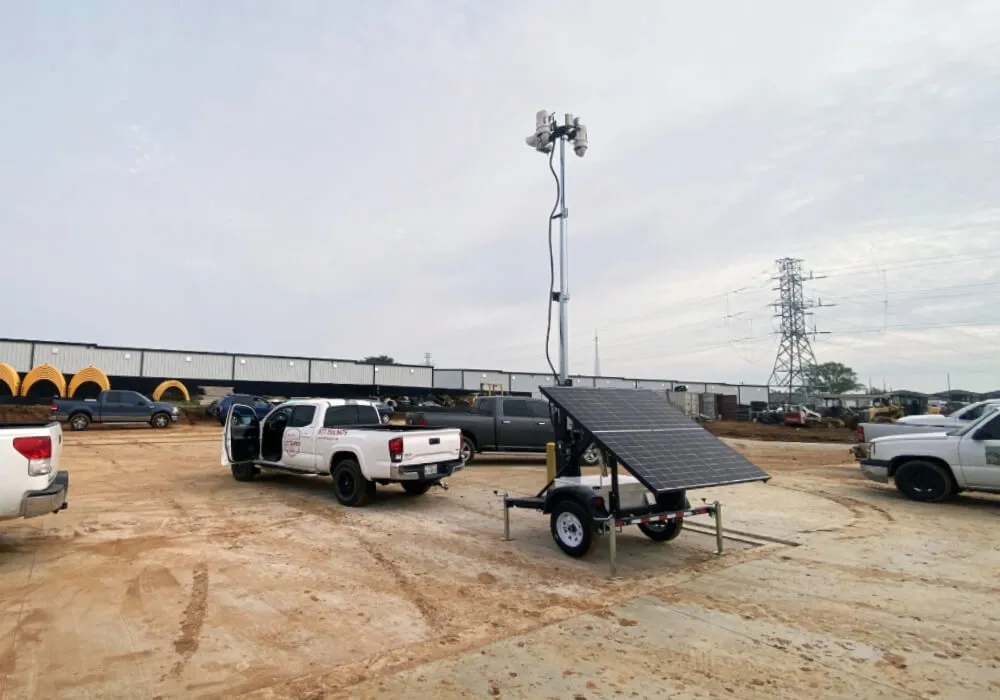
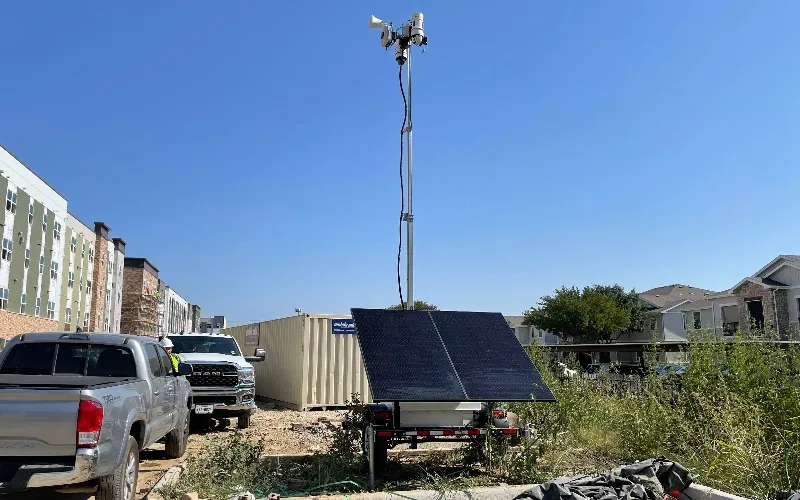
High-definition PTZ surveillance cameras deliver near-360° coverage with 40X zoom capabilities and capture details up to 650 feet away. Our near-20-foot-tall Surveillance Trailers are purpose-built for the construction sector and help security teams protect assets, deter threats, and respond to incidents in real-time.
Featuring infrared (IR) night vision technology, they detect movement and heat signatures in total darkness or poor visibility, making them a powerful tool for protecting high-risk or hard-to-reach locations across all lighting and weather conditions.
Read more: How Do Solar Surveillance Trailers Deter Crime?
2. Artificial intelligence (AI) and machine learning
Surveillance Trailers with in-built AI-video analytics constantly monitor jobsites for environmental risks and security threats. Using predictive analytics and machine learning (trained on historical jobsite data), these systems identify patterns and filter false alarms caused by wildlife or harmless movement.
Simply put, they can distinguish between someone scaling a perimeter fence and motion caused by swaying branches with near pinpoint accuracy.
Beyond security, AI also helps you tick compliance boxes, detecting missing PPE, smoke/fire hazards, and unauthorized access faster than traditional detection systems. When systems notice something isn't right, they alert jobsite managers and live monitoring teams with time-stamped evidence, enabling instant corrective action.
Read more: The Convergence of AI and Security: What’s Coming Next for Smart Systems
3. Internet of Things (IoT) tech
IoT-based environmental solutions keep tabs on various factors across building work zones where it matters most: air quality, noise, and weather.
To remain compliant with EPA standards and optimize resource allocation, construction managers require continuous monitoring logs to prove workers and surrounding communities are protected from prolonged noise exposure and other construction-related disruptions.
-
Air quality monitoring: Monitor airborne pollutants such as particulate matter (PM1, PM2.5, PM10), CO₂, dust, humidity, and volatile organic compounds (VOCs) with real-time alerts and continuous data logging while storing up to 180,000 time-stamped records for trend analysis. They also support multiple protocols, including Modbus RTU/TCP and MQTT, for easy integration.
-
Noise monitoring: Prolonged noise exposure is dangerous for construction workers and may lead to reduced concentration, fatigue, and hearing loss. Noise monitoring solutions help you stay within legal noise limits, reliably measuring (and logging) a wide decibel (30-130dB) and frequency range (20Hz-12.5kHz) throughout all project lifecycles. This smart approach demonstrates regulatory compliance with easy-to-access data and automated reports.
-
Weather monitoring: Project delays caused by adverse weather can increase costs, reduce efficiency, and harm your reputation. Intelligent weather stations help keep construction projects running smoothly by tracking temperature (-4° F to 122° F), wind speed (0-110mph), rainfall (hourly), and humidity (10-99%) in real-time, at transmission distances of up to 328 feet.
To put this into perspective: Intelligent environmental monitoring solutions might have helped prevent a tragic heat-related fatality in 2023 at a Huntsville jobsite in Alabama, when a concrete finisher collapsed and later died due to severe heat illness.
Read more:
- How IoT Improves Both Safety and IT Overview on Construction Jobsites
- Air Quality Data Management: Turning Sensor Data Into Actionable Insights for Jobsites
- Integrating Environmental Monitoring Sensors on Construction Jobsites
4. Live remote monitoring
Remote live monitoring transforms passive surveillance into proactive construction management, providing teams with valuable insights into what's happening on-site.
Trained personnel at monitoring centers watch live surveillance feeds in real-time. When something suspicious is caught on camera, they initiate immediate actions, such as:
-
Live audio voice-down challenges
-
Blue light siren activation
-
Mobile response dispatch
-
Law enforcement notification if/when needed
The benefit of mobile surveillance with live monitoring services leads to:
-
Faster crime prevention
-
Reduced false alarms
-
Less reliance on physical guards
-
Cost savings due to fewer monitoring platforms/vendors
5. Smart detection systems
Advancing digital transformation a step further, smart detection systems bring multiple safety and security functions into a unified solution that keeps business operations and project outcomes moving:
-
Intrusion detection identifies genuine human movement and sends instant notifications to project owners in real-time. This stops potential security breaches before they start, reduces false alarms, and speeds up response procedures far quicker than traditional foot patrols or basic surveillance cameras, which often don't catch or report incidents until hours or even days later.
-
PPE detection and monitoring support workplace safety and regulatory compliance by delivering real-time alerts and audit-ready documentation through Stellifii. Intelligent algorithms immediately flag missing protective gear (safety goggles, hi-vis vests, hearing protection) in predefined zones and provide time-stamped video logs for inspections and audits.
-
Smoke and fire detection systems use AI analytics to recognize the earliest signs of smoke or flames across infrastructure projects, alerting management teams before a small issue escalates. They analyze jobsites continuously and can distinguish between dust caused by excavation and movement patterns, flickering light, and/or subtle color changes that signal early-stage smoke or fire, all in real-time.
Read more: Why Video Analytics is Best for Smoke and Fire Detection
6. 4G/5G Connectivity and autonomous operation
Jobsites in the construction and infrastructure sector generally lack reliable internet connectivity and mains power.
Solar-powered surveillance systems with 4G/5G connectivity operate completely independently of mains power or fixed Wi-Fi, while battery back-ups last up to 20 weeks between charges. This ensures continuous, day-to-night protection, even in remote locations or during power outages.
Our Mobile Solar Surveillance Trailers are purpose-built for the construction industry. Through rapid deployment and autonomous operation, they combine HD cameras, solar power, battery backup, 4G/5G connectivity, live monitoring, and remote access without relying on fixed infrastructure. They deliver far superior coverage and protection than traditional surveillance systems and can reduce your security costs by nearly 88%!
7. Automated compliance
When you're scrambling to verify weather-related delays or provide evidence for PPE inspections, you look more reactive than in control of your jobsite. Advanced technology automatically compiles all compliance monitoring data and reporting in one centralized platform, so nothing slips through the cracks.
Each of our surveillance products feeds directly into Stellifii over 4G/5G networks, giving you instant access to video, data, and alerts in real-time. The platform generates OSHA and EPA audit documentation in just a few clicks, creating an audit trail that satisfies numerous regulatory requirements.
When every jobsite activity, from PPE violations to intruder alerts and weather reports, is time-stamped, AES256-encrypted, and stored securely, you naturally spend less effort on time-consuming and mundane admin tasks. This frees jobsite managers to focus on what really matters on-site: project management and delivery.
Read more: How Digital Tools Ease Audit Prep and Cut Reporting Time in Half for Your Jobsite
8. Smart integrations
Other advanced tools driving digital transformation in construction include:
-
License Plate Recognition (LPR) solutions: Monitor vehicle flows and automatically logs vehicle entries/exits, creating verifiable access control records.
-
Time Lapse Video: Documents project progress from start to finish in high-definition detail.
-
Construction project management software: Designed to help construction companies plan, organize, manage, and track all aspects of building projects from start to finish.
Read more: A Day in the Life of a Connected Site: What Integrated Security Looks Like in Action
9. Cloud-based consolidation
Unifying all security, compliance, and monitoring into a single dashboard has transformed the construction industry.
With Stellifii, our cloud-based platform, you get:
-
Faster access to video footage with exports up to 5X quicker than legacy systems.
-
Easy search filters to find incidents instantly.
-
Complete remote control of cameras and IoT-based environmental sensors.
-
Real-time system diagnostics with alerts and connectivity checks.
-
Clear dashboard views for compliance, environmental data, security, and more.
-
Scalable cloud storage even after projects end.
There’s no software to install and no need for IT involvement; it's a true rapid deployment solution that scales with you.
Read more: Stellifii: Our New Smart Platform Transforming Surveillance, Safety, and Compliance
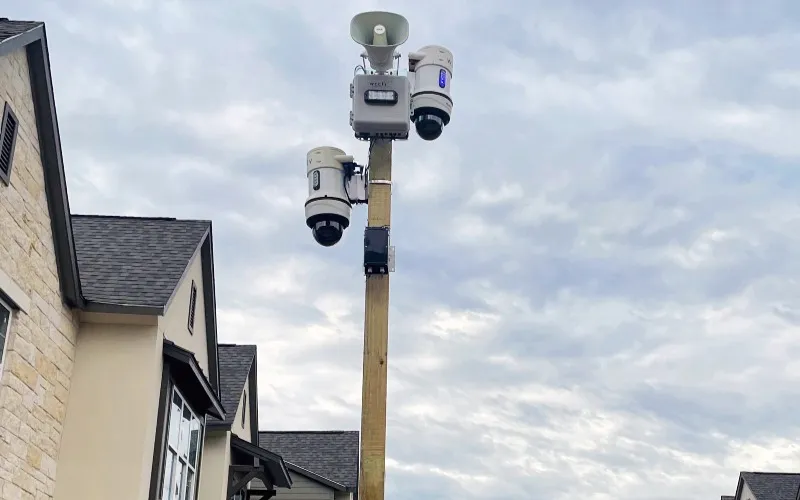
8 Reasons Why Digital Transformation in Construction Matters
Let's take a quick look at 8 reasons why digital transformation in construction matters in the US:
-
Streamlines projects: Centralized platforms connect all project data, allowing for better coordination, increased productivity, and resource allocation while reducing communication delays.
-
Strengthens cybersecurity: End-to-end AES256-encrypted platforms protect sensitive project information, financial data, and client details from unauthorized access.
-
Simplified compliance: Automated regulatory reporting reduces the risk of infringements and creates clear audit trails that demonstrate due diligence.
-
Mitigates operational risks: Real-time monitoring of weather conditions, environmental patterns, and security threats shows you're managing risks responsibly, not reactively.
-
Less vendor sprawl: Integrated platforms consolidate multiple tasks into one dashboard, eliminating the headaches of managing several platforms and reducing admin overload.
-
Clear audit trails: Time-stamped reports for all jobsite activities provide concrete records for compliance audits, insurance claims, police inquiries, and dispute resolution.
-
Cost-efficient solutions: Up to 88% in cost savings compared to traditional security and monitoring methods, with the benefit of reduced theft, fewer violations, and lower insurance premiums.
-
Competitive advantage: Innovative digital solutions provide significant value when US contractors bid for competitive tenders.
Read more: The Benefits of Integrating Your Security and Communications Systems
How to Adopt Digital Transformation in Construction in 5 Steps
Ready for a construction digital transformation? Follow these 5 easy steps:
-
Clarify goals: Get clear on the problems you want to solve. Are you addressing theft losses? Compliance reporting? Multi-jobsite visibility? Having clear objectives will help you determine what you actually need.
-
Select a monitoring partner: Find a US-specific monitoring partner with proven construction experience. Generic security providers won't cut it here. Look for providers with US support, rapid deployment capabilities, NDAA-compliance, and autonomous operations.
-
Select appropriate digital tools: Match digital technologies to your operational needs. Large jobsites with multiple access points need comprehensive surveillance coverage, whereas building works in residential areas call for noise monitoring compliance solutions.
-
Develop a phased road map: Don't try a complete digital transformation all in one go. Start with one jobsite and/or one digital solution at a time. Once your construction team is up to speed and the new technologies prove their value, you can then scale across your entire operations.
-
Integrate systems and processes: Connect new technologies with existing processes. Cloud-based platforms simplify integration and help data flow smoothly between systems.
For more information, explore our online brochures today. Whether you work in construction, government, critical infrastructure, or property management, you’ll find detailed information on how our mobile surveillance systems meet your needs.
Embrace the Digital Transformation in Construction with WCCTV Today
Digital transformation is reshaping the construction industry by reducing security threats, improving compliance, and delivering actionable insights through centralized data management platforms.
When project delays and compliance violations are kept to a minimum, project managers gain control and peace of mind knowing that every aspect of their jobsite is covered.
With over 20-years of wireless surveillance expertise, we understand how important it is to adopt this digital transformation in construction. That's why we offer innovative solutions to construction jobsites of any size, from small residential projects to large commercial developments.
If you're ready to see how digital technologies can take your operations to new heights, contact our team to discuss your monitoring needs today.