
Construction superintendents are expected to balance safety and productivity while maintaining clear communication and keeping projects on schedule.
In complex build environments, this is difficult without the help of technology, or more specifically, smart platforms and project management apps that provide real-time alerts and accurate reports managers can act on from anywhere.
Manual and paper-based processes remove leaders from their teams and the field. By contrast, mobile-enabled platforms help construction leaders manage risk and compliance on their projects by substantially streamlining reporting and strengthening on-site visibility.
The article highlights tools that allow superintendents to monitor jobsite activity, review alerts, and manage incidents directly from mobile devices. It also explores how our smart monitoring solutions deliver high-value reporting and simplify record-keeping without interrupting daily operations.
Why Mobile-Friendly Reporting Matters in Construction
Construction professionals managing high-pressure projects and field operations need quick access to real-time data reflecting jobsite conditions. When threats like fires, weather risks, safety violations, and perimeter security breaches occur, it's vital to intervene swiftly to prevent damage, harm, and downtime.
Traditional reporting systems don't provide the live visibility and intelligence that 21st-century project management demands. Systems tied to office networks and involving manual reporting pull superintendents away from their site, creating oversight gaps and slowing response times. Incident alerts and important updates often reach decision-makers too late to head off problems.
Mobile-enabled automated reporting systems work where construction happens - on the jobsite. They enable construction managers to monitor build activity and view alerts directly from their handheld devices and respond without delay.
By providing instant access to time-critical data, mobile tools/field reporting apps improve safety processes and risk mitigation, while making it easier to track progress and prevent project delays.
Key features of mobile reporting tools
One of the most advanced capabilities in smart reporting is AI-powered analytics. AI analytics are trained on large real-world datasets to interpret the risks they track (e.g., unauthorized access) and raise alerts in the reporting tool in real time.
Other key features include:
-
Mobile apps (for iOS and Android devices)
-
Real-time reporting
-
Automated incident alerts, reports, and timestamped logs/records
-
Centralized dashboards that simplify management
-
Cloud storage
-
Integration with surveillance systems
Together, these features replace spreadsheet processes with proactive, real-time oversight that transforms site compliance and safety.
Read more:
8 Trusted Mobile-Friendly Reporting Tools for Jobsite Managers
We spotlight 8 smart mobile-ready tools that construction professionals use to manage projects easily and more effectively.
1. Unified management platforms
Centralized project management platforms have become an indispensable tool for overseeing multiple safety and security responsibilities on complex construction projects.
A smart platform combines all your working tools in one place. Project managers can view real-time information on safety, environmental, security, and access-control operations in structured central dashboards.
Our cloud-based smart platform connects a range of tools to help you effectively oversee these crucial functions. Tracked data flows into the platform's unified dashboards, and analytics transform it into actionable insights to help you improve:
-
Project safety
-
Compliance standards
-
Regulatory and stakeholder reporting
-
Overall project performance
Built for construction companies, the platform's mobile app makes access as convenient and immediate as possible. Instead of waiting for daily progress and safety reports, you receive near-immediate reports and site intelligence. Cloud connectivity lets you access project data from wherever you are: head office, traveling, or supervising a demolition job on the far side of the site.
Our cloud-based solution is end-to-end AES-256 encrypted to protect all project data both in storage and transit. The platform and tools are built with NDAA-compliant hardware, making them suitable for federal contracts.
2. Intrusion Detection Systems
With the US construction industry losing over $1 billion annually to theft and related disruptions, mobile-ready security solutions have become a priority. Our Intrusion Detection System uses AI analytics to detect unauthorized access around your project borders or within designated zones, protecting your site 24/7 from:
-
Perimeter infiltration
-
Theft attempts (materials, tools, metal, copper, and equipment)
-
Unauthorized access to restricted sectors
-
Trespassing and vandalism
AI tools detect suspicious behavior and trigger immediate warnings, improving response times and reducing reliance on on-site security guards.
If you connect through our dedicated cloud platform, you can check your phone to verify the alert and understand the intrusion. Advanced analytics distinguish real threats from false alarms (animals, weather, debris, etc.), meaning you aren't continuously distracted by non-existent threats. The system retains detailed documentation and video evidence for further reporting and investigations.
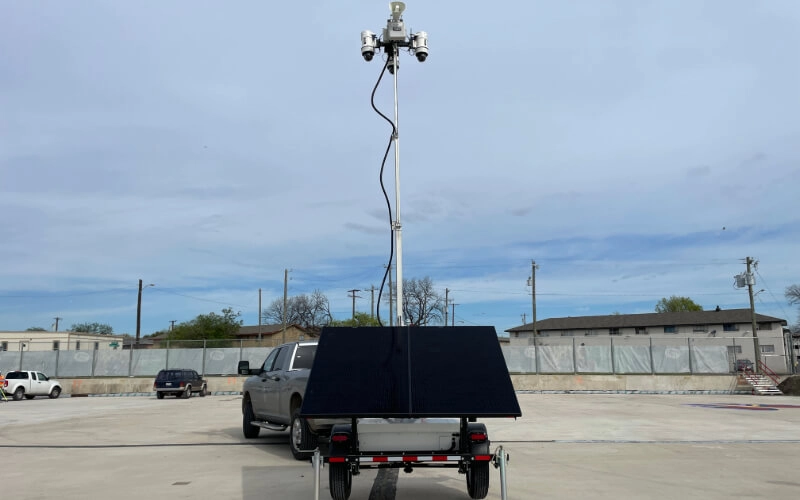
The backbone of an intrusion detection system is a surveillance footprint of high-definition PTZ cameras with infrared and night-vision technology. This law enforcement-trusted system is rapidly deployed for as long as your project requires it. Our 4G/5G Mobile Solar Surveillance Trailers offer a flexible, quick-setup solution for temporary or longer-term sites lacking power or internet connections.
Once security surveillance is in place, you have the foundation to integrate additional tools for remote monitoring, including:
-
Weather, fire, PPE, noise, air pollution, access control, and other risks.
-
Live Video Monitoring: all surveillance cameras link to a control center, where security professionals respond immediately to alerts with blue-light or live voice warnings (calling law enforcement if necessary).
Read more: The Benefits of Integrating Your Security and Communications Systems
3. PPE Detection and Monitoring
According to a 2025 industry study, 54% of leaders say that inconsistent PPE use is a top safety challenge on jobsites. This highlights that proper protocols aren't always followed, even though personal protective equipment is a central element of construction site safety.
PPE monitoring and mobile reporting help project managers enforce consistent PPE use on construction projects. AI-powered cameras with detection analytics scan work zones throughout the workday to check for missing safety gear, including:
-
Hard hats
-
High-visibility vests
-
Goggles
-
Hearing protection
-
Safety boots
-
Respiratory masks
When an employee steps into a designated zone without the proper protective equipment, the system instantly records a timestamped image and sends an alert to relevant managers. It can also issue a live voice reminder to the employee in question.
The incident, along with corrective measures taken, is automatically documented in our centralized platform, creating a reliable record of compliance and enforcement.
Visible, active PPE enforcement has proven much more effective at creating a healthy jobsite safety culture than sporadic, inconsistent spot checks. It goes a long way to limit violations, reducing accidents, compensation claims, legal liabilities, and downtime.
Read more: AI for PPE, Fire, and Intrusion Safety
4. Noise Monitoring Sensors
IoT-enabled sensors and connected cameras have replaced periodic sound readings, paper forms, and daily logs, giving team leaders much better insight into jobsite noise levels and potential risks.
Besides safeguarding the crew from hearing damage, remote noise monitoring systems help general contractors stay compliant with local ordinances and federal regulations, including OSHA's Permissible Noise Exposure Limits.
Integrating directly into the platform, noise monitoring devices continuously monitor jobsite sound levels across:
-
30-130 Decibels
-
20Hz to 12.5kHz frequency
The system auto-generates instant notifications when sound levels approach allowed limits and records violations, such as spikes from heavy machinery or blasting.
Connected cameras link the data to current work activities. For instance, you can see on your smartphone that concrete and steel cutting is taking place simultaneously, impacting crews' hearing and creating a compliance issue. You can also track corrective actions, including introducing ear protection to affected workers.
Given the wide range of noise hazards to control in any project environment, construction firms have invested heavily in mobile tools that deliver real-time data capture and sound-level reporting to keep their sites safe and compliant.
Read more: Smart Noise Monitoring: Protecting Workers and Staying OSHA-Compliant at Your Jobsite
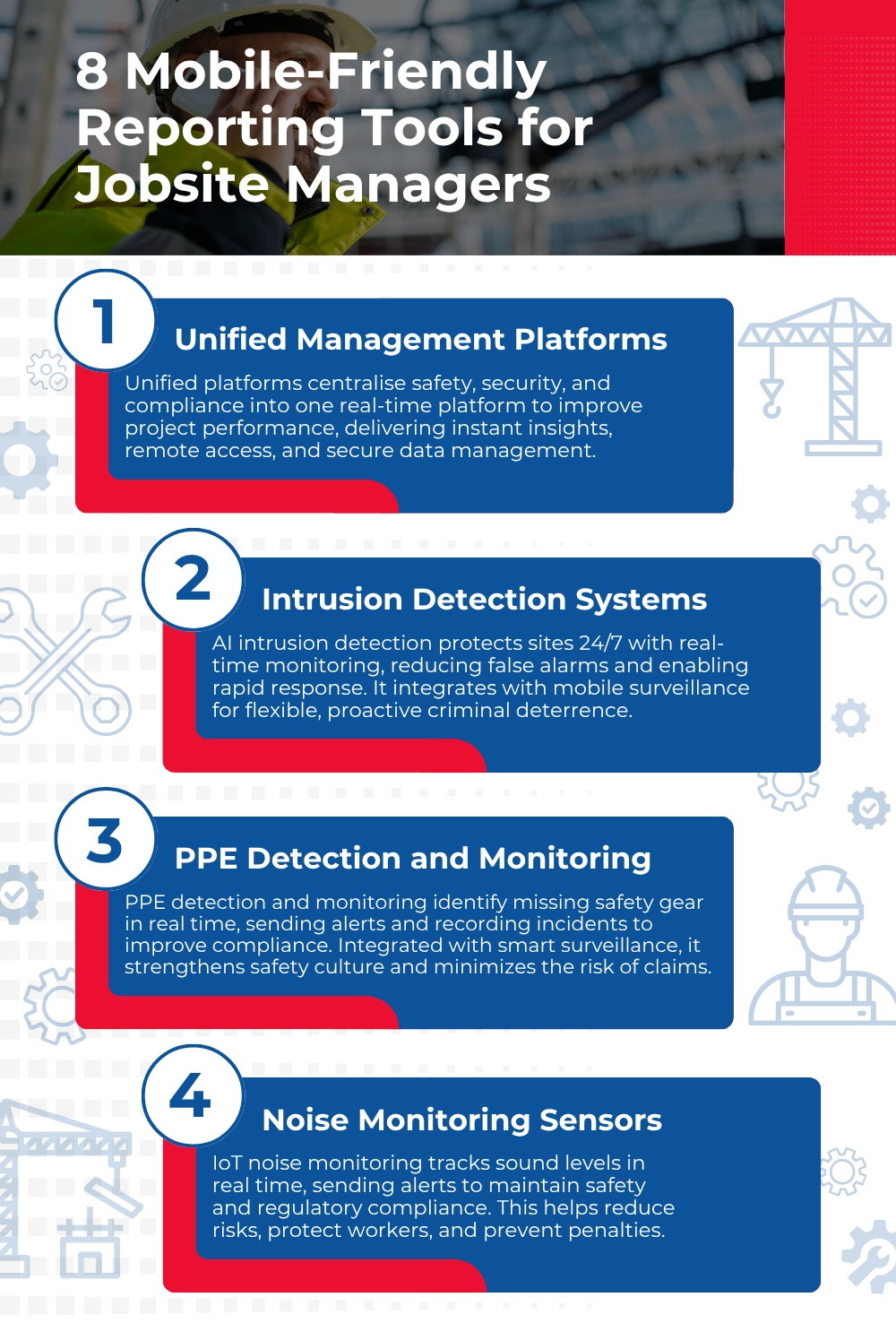
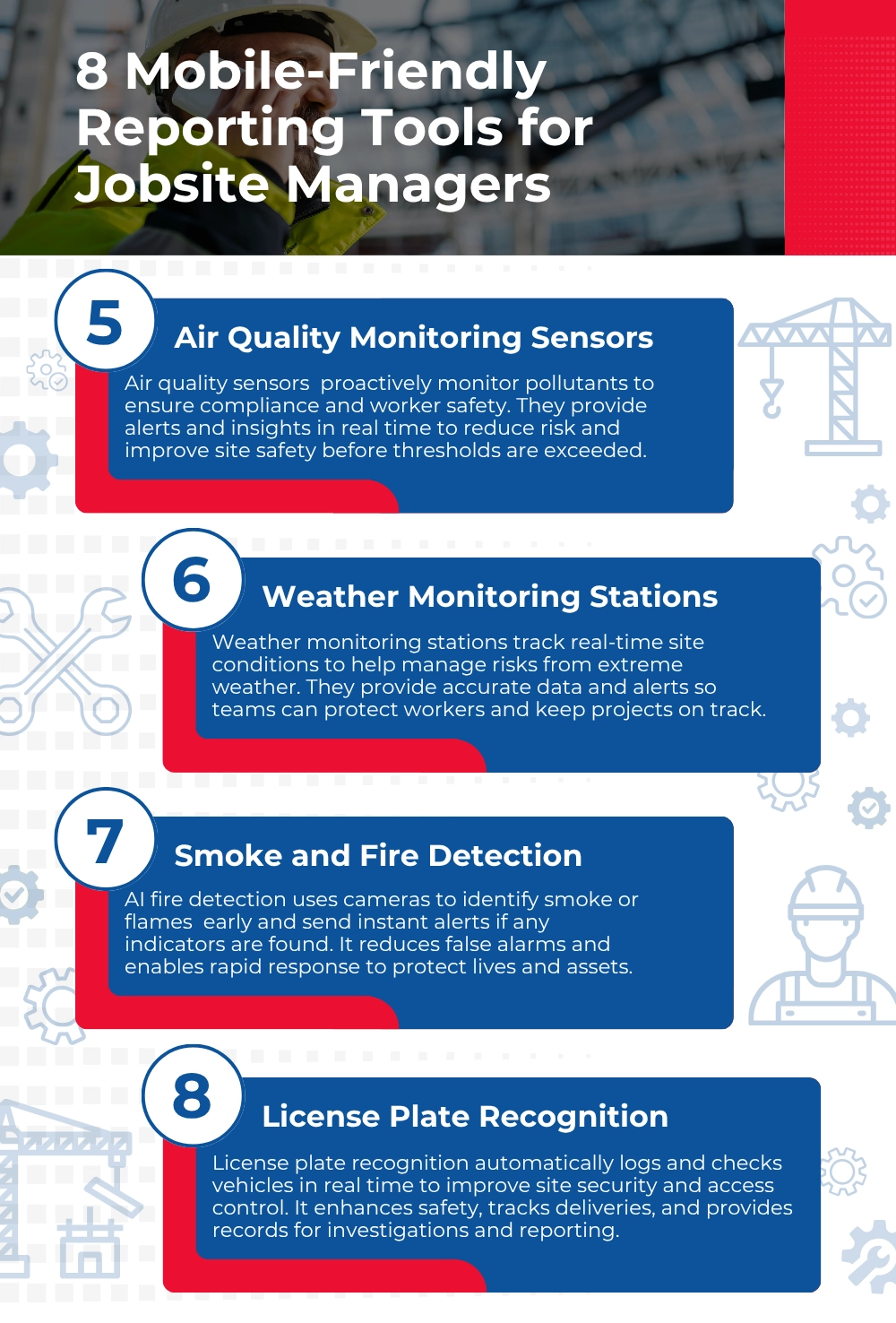
5. Air Quality Monitoring Sensors
Based on reports from the National Council for Occupational Safety and Health (National COSH), thousands of US workers die every year from long-term exposure to hazardous substances. To limit hazardous exposures, contractors are required under OSHA's Permissible Exposure Limits to protect employees from air contaminants produced on-site.
To help managers control airborne hazards on their projects, air quality sensors measure:
-
Volatile organic compounds (VOCs)
-
Chemical fumes
-
Carbon dioxide (CO₂)
-
Carbon monoxide (CO)
-
Dust and PM1, PM2.5, PM10 particulate matter
IoT sensors capture thousands of data points every hour, storing up to 180,000 timestamped records for trend analysis and safety compliance reporting. They notify you immediately if your jobsite's pollutant levels approach unsafe and illegal thresholds, allowing you to adjust operations and take steps to remedy the situation.
These environmental monitoring tools not only protect workers and the surrounding community, but they also bring the company's building and ESG professionals onto the same page.
Read more: Air Quality Data Management: Turning Sensor Data Into Actionable Insights for Jobsites
6. Weather Monitoring Stations
Extreme weather is one of the most damaging disruptions that construction teams and their managers grapple with. Strong winds, heavy rain, snowfall, and lightning strikes can all be disastrous for a construction project. To help you manage workflows around environmental challenges, weather monitoring stations track site conditions 24/7.
These real-time tracking systems provide location-specific field data covering:
-
Temperature (-4° F to 122° F)
-
Wind speed and direction (0–110mph)
-
Humidity (10% to 99%)
-
Rainfall (hourly)
-
Dew point
-
Storm indicators
This data is more precise and up-to-the-minute than local weather forecasts, helping you make fully-informed decisions in the moment to protect field teams and structures from danger.
Live insights on your mobile device enable you to manage activities and resource allocation around threatening weather events to keep project timelines on track.
Read more: Weather Monitoring Tools that keep Construction Projects on Track
7. Smoke and Fire Detection
Mobile-friendly fire detection systems use HD cameras and AI to scan jobsites day and night for early signs of smoke or flames. This smart detection system is trained to quickly identify fire signatures, such as flickering light, smoke trails, color, movement, and heat patterns. The AI filters out false positives caused by normal construction emission fumes, steam, and dust.
When a fire danger is spotted, the system flags it instantly, sending alerts to your response crew and/or fire department, including:
-
A timestamped image of the fire
-
Access to a video clip to help responders understand the size and extent of the blaze
-
The platform stores a record of all fire events for later export, audits, and review
On average, 4,440 construction site fires occur every year, causing $370 million in damage to property, equipment, and other valuable assets. Mobile reporting tools ensure that you're immediately aware of fire dangers, whether you're on the go or at home after hours.
Rapid reporting enables the rapid response that this real danger demands, and the difference of even a few minutes can save lives and millions in losses.
Read more: Why Video Analytics is Best for Smoke and Fire Detection
8. License Plate Recognition
Mobile-enabled License Plate Recognition systems automatically capture and log vehicle registration plates using AI. They read license details in all weather and lighting conditions, at speeds up to 130 mph.
Key features of LPR technology include:
-
Vehicle recognition by plate, make, model, and color
-
AI-assisted imaging for accurate and efficient license plate recognition and logging
-
Cross-referencing, which instantly matches license plates against authorized vehicle lists, warning/restricted lists, and stolen vehicle databases
-
Automated alerts that notify security personnel as soon as suspicious vehicles or anomalies are detected
License Plate Recognition tightens access control, prevents theft, and improves vehicle accountability. It's also used to smooth traffic flow and promote safer driving and machinery operation on site. On top of that, managers can track the arrival of materials and essential equipment via alerts confirming delivery vehicles are at the gate.
With every entry, exit, and vehicle-related incident recorded and timestamped, you can seamlessly access reports to assist investigations, insurance claims, stakeholder inquiries, and security plan reviews.
Read more: Benefits of License Plate Recognition Cameras
4 Benefits of Mobile-Ready Reporting for Project Management
Let's explore 4 real-world benefits of smart mobile reporting appreciated by operations and safety managers, particularly those who oversee multiple sites.
1. Faster incident documentation
With remote monitoring, incidents are captured the moment they occur. This provides you with an accurate, objective record on the spot, ensuring nothing is forgotten or misreported. If a stakeholder requests an update 5 minutes after a security incident, you can send them the report from your smartphone within a minute.
2. Real-time visibility across the jobsite
Mobile-enabled tools provide immediate access to alerts and live data. Whether it’s unsafe noise levels, a high carbon monoxide reading, or PPE violations, smart reporting apps show you what’s happening in real time, wherever you are.
3. Reduced admin burden
Advanced reporting tools capture information at source and automatically generate customizable reports, which are stored and shareable for audits, reviews, compliance, and investigations. With data entry and manual processes lifted from your workload, you can manage workflows rather than battling paperwork.
When leaders and teams are freed to focus on their core objectives and high-value tasks, productivity and project efficiency improve, and that ultimately translates into greater client satisfaction.
4. Improved compliance reporting
Timestamped, data-backed records make compliance reporting quicker and smoother. If an inspector requests details of an air pollution incident or a fire marshal investigates a jobsite blaze, you have a verifiable audit trail of what happened and how you responded (with supporting video footage).
For construction companies that manage their jobsites well, a consistent record of responsible practices builds trust and favor with compliance authorities.
Read more: How Digital Tools Ease Audit Prep and Cut Reporting Time in Half for Your Jobsite
Replace Manual Jobsite Reporting with a Mobile Solution Today
Mobile-friendly monitoring tools put incident recording, activity tracking, and real-time alerts directly in the hands of superintendents. This means no more searching disorganized files or stepping away from the site to chase reports and access project data.
By replacing outdated existing processes with a dynamic reporting system that works around the clock, you gain actionable, real-time information to make high-value project decisions. This way, you unlock efficiencies, protect your crews, and safeguard the company's reputation and bottom line.
Ready to transform how you manage project monitoring, risk mitigation, and reporting? Contact WCCTV today to find smart, user-friendly mobile solutions for your next project.
