
What are the differences between SKIDS and Solar Surveillance Trailers from WCCTV?
In the ever-changing world of technology and security, choosing the right mobile surveillance unit can significantly improve operational efficiency and meet jobsite requirements.
When it comes to mobile surveillance units for jobsite security, two prominent contenders stand out: the SKID Trailer and the WCCTV Solar Trailer.
Each solution offers unique features and capabilities, catering to distinct requirements. Evaluating these different Trailers allows us to identify which unique benefits outweigh the others.
Below, the security experts at WCCTV assess critical factors such as height, versatility, security, deployment ease, and power autonomy to determine strengths, weaknesses, and appropriate applications for each system.
Height, Weight, and Footprint
Being small and light makes a SKID Trailer highly maneuverable.
The reduced dimensions of a SKID Trailer enhance accessibility to areas that may be challenging to reach with a WCCTV Trailer. It can navigate through narrow roads, tight jobsite entrances, or areas with weight restrictions, ensuring efficient access to the desired location.
This agility, with a fixed camera height of 10ft or less, allows for improved accessibility and flexibility, particularly in challenging or confined job sites that only require a small footprint; not much space is needed to be taken up on the job site; the convenience of this surveillance solution is amicable compared to the WCCTV Trailer that stands at 20ft tall.
However, being small and lightweight is as much a weakness as a strength; these units are more susceptible to tipping during bad weather conditions or even by a malicious intruder.
Furthermore, SKID Trailers have reduced visibility when installed on a jobsite, mainly when surrounded by larger vehicles with a small footprint; this can work to the advantage of intruders who can stay out of range.
Their smaller profile also reduces the visual deterrent they provide. The profile of a WCCTV trailer, standing 20ft tall, immediately informs would-be intruders that your site is secured.
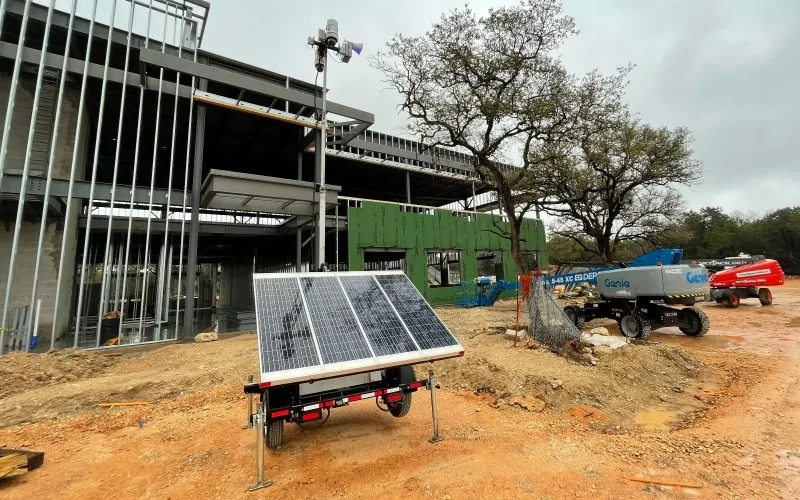
A WCCTV Trailer has a 10ft by 10ft footprint, and although it is a weightier unit, this protects against tipping in adverse weather conditions.
The increased height of a WCCTV trailer means it is much harder for an intruder to tamper with the equipment and provides a much greater range of visibility and detection across your site.
Winner: When it comes to weight, height, and footprint, the advantages offered by a WCCTV Trailer outweigh the SKID Trailer. A small, lightweight function doesn’t cut it for effectively deterring crime at a job site.
Transport and Storage
A WCCTV Solar Trailer is ready to protect from the moment it arrives on the job site. The 20ft telescopic mast, equipped with cameras and a cellular connection, is ready to deploy in less than 20 minutes.
The dynamic nature of most job sites demands adaptability. Vulnerable areas shift over time, requiring equipment and surveillance assets to be relocated. Being able to move a surveillance unit provides immense convenience and flexibility where the security risks are constantly evolving.
However, transporting a WCCTV Trailer can be costly due to its larger footprint and weight. Even though they're easily transportable around the job site with a forklift or the handle, there is a cost to getting them to the site.
The compact size of a SKID Trailer facilitates efficient storage when not in use. It occupies less space, making it easier to store or park away when not in use, which is particularly relevant for companies or individuals with space constraints.
But is it worth having cheaper freight costs and smaller units with the ease of transportability at the cost of losing core surveillance features and the high probability of the hardware being tampered with and having less technological abilities?
Winner: WCCTV Trailer: In a world where theft, intrusion, and jobsite threats are ever-present, the advantages of a self-contained surveillance installation on wheels become increasingly apparent. It offers the convenience of mobility, the flexibility to adapt to changing jobsite requirements, and the assurance of an autonomous power source through solar technology.
Power Autonomy and Technical Features
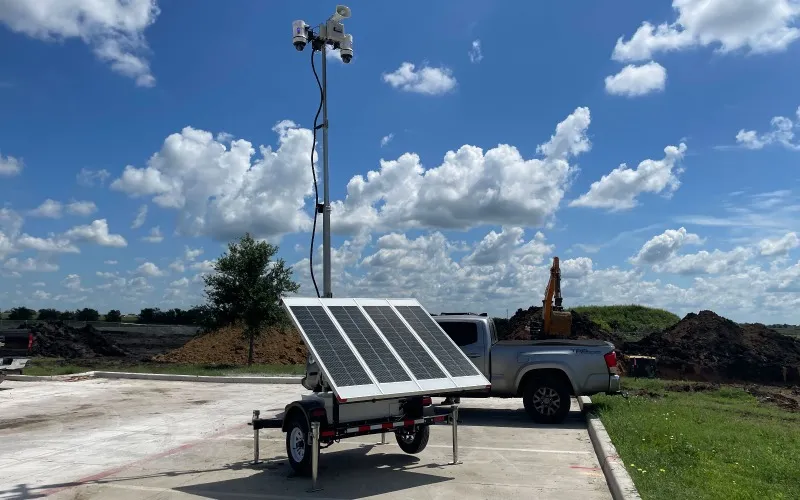
WCCTV’s trailers feature a larger solar array with a higher capacity to generate electricity from sunlight, giving a more substantial power supply. This means it can produce more power, allowing for simultaneously operating multiple advanced security cameras and equipment.
It ensures that the WCCTV Trailer has a continuous and reliable power supply, even during periods of high demand or reduced sunlight.
The WCCTV Trailer operates at optimal performance levels with a larger solar array which gives an uninterrupted operation of cameras to ensure they facilitate increased coverage during nighttime or low-light conditions, providing 24/7 surveillance capability.
This feature is crucial for applications where continuous monitoring and security are paramount, such as high-risk areas or locations with limited access to grid power.
Not only that, the further benefits of having maximum battery and solar panel autonomy on a WCCTV Trailer:
-
Maximum battery and solar panel autonomy
-
Larger panels = faster recharge
-
Larger battery box = more power autonomy
-
Maximum uptime - Minimizes the need for recharging.
-
Enhanced autonomy allows for more features.
-
Flashing LEDs
-
Audio voice down Profile
-
Performance diagnostics
-
Higher profile IR PTZ cameras
-
GPS
-
Longer detection Range
SKIDs can still compete against the larger array, offering battery backups and generator connectivity to cover those working days and allowing power autonomy to be utilized out of hours and weekends alone.
But the disadvantages that come with SKIDs is that when it comes to power autonomy and off-grid applications in this environmentally friendly world are not as advanced as they should be:
-
Less power available during bad weather
-
Frequent recharges required
-
Smaller panels = slower recharge
-
Less autonomy restricts technical features
Winner: In summary, the larger solar array offered on the WCCTV Trailer for surveillance offers increased energy generation, enhanced system performance, extended operating hours, support for additional equipment, flexibility, and scalability.
Final Thoughts: When To Choose WCCTV vs. SKIDS
After comparing the features and advantages of a SKID Trailer and a WCCTV Trailer, it becomes clear that the WCCTV Trailer emerges as the superior choice for jobsite surveillance. SKID trailers offer some benefits, but not at the level required to secure a jobsite.
The WCCTV Trailer is the optimal choice due to its integrated surveillance systems, rapid deployment, technical features, versatility, and power autonomy.
It offers the highest level of security and monitoring efficiency, making it the best option for ensuring the safety and protection of jobsites.
To download a PDF version of WCCTV vs. Skids – Complete Comparison Guide, click the button below.
Managed Security Cameras for Construction Jobsites
WCCTV is the USA's leading supplier of temporary surveillance cameras for construction jobsites.
We provide market-leading security cameras backed by a fully managed service that includes equipment installation, live video monitoring, maintenance, and ongoing technical support.
Our rapid-deployment cameras provide construction sites with multi-application benefits, including security, time lapse video filming, and remote project management.
Our customizable solutions can accommodate any site and efficiently function whether you have power or are dependent on solar energy. Our units contain 4G/5G transmission technology – allowing these solutions to operate autonomously.
No matter the site, we have a solution that we can create for you.
