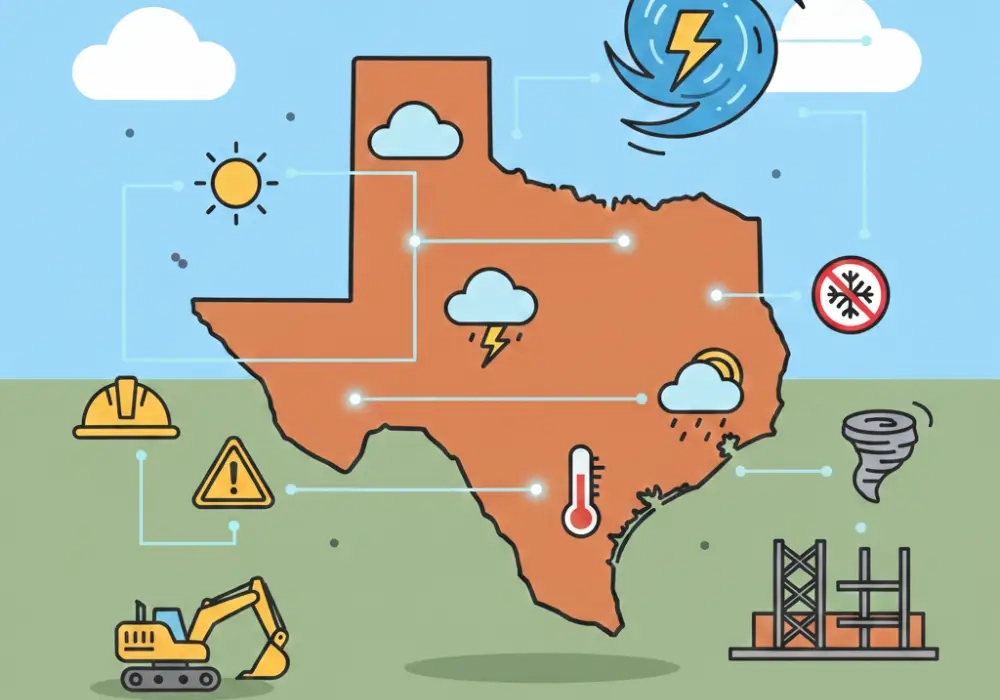
Texas has faced multiple extreme weather events in recent years, including record-breaking droughts, major flooding, storms, and severe heat waves. These environmental volatilities are reshaping how Texas safety standards on jobsites are managed.
Weather-related hazards now demand faster responses to protect crews and projects with stronger documentation to meet OSHA (Occupational Safety and Health Administration) standards. The National Emphasis Program on heat hazards, introduced in 2022, expects employers to prove with objective evidence that they recognized risks and acted quickly to ensure workplace safety.
This article highlights how real-time weather and environmental monitoring help safety leaders anticipate and prepare for weather events, enforce robust safety protocols, and defend their decisions with high-quality data.
Understanding the Challenges of Texas Weather
Weather is one of the most disruptive forces on Texas jobsites, ranging from record-breaking heat to icy winter storms. In 2023, Austin endured a heat wave with temperatures topping 110°F for days, while just 2 years earlier, Winter Storm Uri covered the state in ice. More recently, severe flooding followed months of drought in Central Texas.
Key weather-related factors and volatility affecting Texas construction firms include:
-
Weather Whiplash effect, especially in Central Texas: The "whiplash" refers to a sudden shift between extremes, where a long drought is followed by extremely heavy rainfall and flooding.
-
Increasing tropical cyclone events (storms and hurricanes), especially in South Texas.
-
Intensifying heat waves that push workplace temperatures to unsafe levels.
-
Increased wildfire risk in western and southern Texas, putting workers and equipment in danger.
-
An increase in extreme weather volatility (droughts, floods, wildfires, hurricanes, and storms).
-
Scientific consensus also shows that Texas is warming faster than historical averages, making climate resilience and monitoring critical for safety planning.
6 Ways Texas Weather Heightens Jobsite Safety Risks
Such sudden and challenging weather events bring heightened safety pressures to projects across the state. We spotlight 6 particularly high-risk areas for jobsites in Texas:
-
Heat exposure
Soaring temperatures on jobsites increase the danger of heat-related illnesses, such as exhaustion, dehydration, and heatstroke.
Beyond the physical effect on the body, heat compromises judgment and abilities. This impairment can lead to accidents, such as dropping objects on workers below or operating equipment and machinery unsafely.
OSHA believes that heat is an underreported crisis because heat-related deaths/injuries are often misclassified as heart attacks or other diagnoses. In April 2002, the regulator launched a Heat NEP (National Emphasis Program for Outdoor and Indoor Heat-Related Hazards) to target the dangers.
Under NEP (currently running to April 2026), OSHA protects workers by expecting private sector employers to:
-
Proactively monitor on-site conditions to minimize unsafe exposure to workplace hazards.
-
Provide proper water, rest, and shade breaks.
-
Manage acclimatization: Nearly 50% to 70% of heat-related fatalities occur during the first few days of working in hot environments because the body is shocked by the temperature. Employers are expected to acclimate new hires and returning workers to extreme conditions.
-
Personal Protective Equipment (PPE) failures
In high heat and thick humidity, workers are often tempted to remove protective equipment like gloves, hard hats, high-vis vests, and face protection. Mental exhaustion from heat fatigue may cause some crew members to forget this basic occupational health and safety protocol.
Failure to wear PPE increases work-related injuries from falling objects, impact accidents, chemical exposure, and electrical hazards. While discomfort in stifling temperatures is understandable, OSHA health and safety standards are clear that heat does not excuse PPE non-compliance.
-
Lightning strikes
Lightning strikes introduce the danger of severe electric shocks and electrocution. Crew working on tall structures and scaffolding, or with electrical equipment in open spaces, are especially vulnerable.
Besides causing fatal injuries, lightning also damages sensitive machinery, electrical equipment, and infrastructure. It often disrupts power and can shut down site communications.
-
High winds
Strong winds endanger crew working at heights, especially if proper safety equipment and guardrails aren't in place.
Winds destabilize cranes and scaffolding, make lifts and temporary structures unsafe, increase the risk of tip-overs and dropped loads, and can turn unsecured materials into dangerous flying objects.
-
Fire dangers
Dry conditions combined with gusting winds increase the risk of jobsite fires. Sparks from equipment or welding can easily ignite a small flare-up, which winds can fan into a site-engulfing blaze.
Every year, fires destroy valuable equipment, materials, and property on Texas projects, sometimes resulting in severe injury or fatalities.
-
Air pollutants and dust
Windy, dry conditions on a busy jobsite stir up dust and airborne particles, while industrial emissions add to the risks and irritations.
Poor air quality and airborne hazards lead to a range of issues from short-term nose, eye, and throat irritation to tiredness and long-term respiratory damage. This is why wearing proper face and eye masks and respiratory protection is vital to worker safety.
How to Effectively Manage All Weather-Related Risks
Texas's unique weather-related hazards require faster responses to protect crews and limit workplace injuries, accidents, and workers' compensation claims. Stronger documentation backed by accurate data is also central to complying with occupational safety and health laws.
Texas construction employers are now using smart detection and advanced IoT-based environmental monitoring systems to manage these weather-related risks proactively and meet OSHA regulatory standards every time.
Here's a high-level action plan for intelligent monitoring and reporting of weather-associated threats that many firms are following:
|
|
||||
|
How smart monitoring improves safety and hazard recognition |
Provides real-time alerts on heat, rain, lightning, and wind hazards; prevents accidents, shutdowns, and unsafe operations. |
Detects when workers remove or misuse PPE, reduces injuries, and ensures compliance. |
Identifies sparks, smoke, or rising temperatures early, enabling rapid response to prevent jobsite fires. |
Tracks dust, pollutants, and particulates, protects workers from respiratory issues, and guides the use of masks or ventilation. |
|
How smart data improves regulatory compliance |
Generates accurate records of localized weather conditions to justify work stoppages and support insurance or liability claims. |
Documents PPE usage patterns; proves compliance with OSHA and site-specific safety standards. |
Provides timestamped fire event logs for audits, investigations, and adherence to fire safety regulations. |
Supplies continuous air quality data to meet environmental standards, demonstrates community accountability, and complies with emissions regulations. |
Read more: The Rise of Smart Construction Jobsites: How Tech Is Transforming the Industry
Weather Monitoring Stations
To protect employees' safety and project timelines, our weather monitoring systems track and deliver continuous, precise data on:
-
Temperature (-4° F to 122° F)
-
Humidity (10-99%)
-
Wind speed (0–110mph)
-
Rainfall (hourly)
-
Chill factor
-
Lightning activity
From early lightning warnings to detailed reporting on temperature shifts and wind changes, the system provides safety teams with real-time, site-specific data far quicker than local weather forecasts.
Continuous actionable information helps your site managers to mitigate risks by planning for all weather scenarios, including:
-
Heat exposure: Triggering water breaks, rest periods/shade breaks, and temporary work stoppages to protect the crew when temperatures reach set thresholds, and demonstrating active heat monitoring in line with OSHA’s expectations.
-
Lightning: Ensuring crews aren't exposed to lightning risks and creating safe spaces around tall objects and equipment such as scaffolding and cranes.
-
Winds: Rescheduling crane operations and work at heights if wind speed and direction are unsafe.
-
Work stoppages and rescheduling: Temporarily halting work to avoid extreme weather, rescheduling timelines, and adjusting shifts to minimize project delays.
Read more: How IoT Improves Both Safety and IT Overview on Construction Jobsites
PPE Monitoring
As temperatures rise, workers often remove their protective equipment.
Our PPE monitoring system automatically checks that the required protective equipment is worn and issues immediate alerts when gear is missing. This allows managers to intervene early to encourage consistent compliance and prevent bad habits from taking hold.
All PPE-related incidents are logged through Stellifii, our cloud-based compliance management platform that provides you with solid, verifiable evidence to address non-compliance with workers. It also shows OSHA inspectors that PPE adherence is actively managed on your jobsites, even under challenging circumstances.
Read more: AI-Powered PPE Detection: Eliminating Compliance Blind Spots on Jobsites
Fire Detection
Our smoke and fire detection cameras with AI-video analytics spot heat signatures and the early traces of smoke near instantly, even in large or complex sites where visibility is limited.
After identifying a threat, the system sends an immediate alert to your response crew or partner, allowing for a rapid response. For audit and insurance purposes, Stellifii retains a complete record of every incident.
Early detection and response are especially critical when:
-
Dry combustible materials make the jobsite a potential tinderbox.
-
Winds are gusting, increasing the danger of fires starting and spreading quickly.
Read more: Why Video Analytics Is Best for Smoke and Fire Detection
Air Quality Monitoring
Our air quality monitoring systems track fine particulate matter and other pollutants in real-time, allowing managers to act quickly to protect their crews and meet their legal obligations.
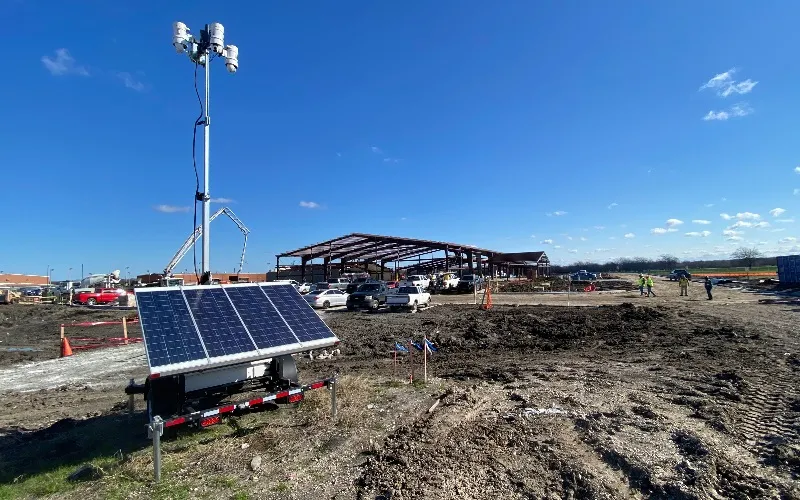
Sensors are mounted on our Solar Surveillance Trailers and connect directly to the Stellifii platform. The IoT devices detect substances more quickly and accurately than human senses or manual processes, delivering precise measurements and automatic alerts to project managers well before site conditions approach threat levels or OSHA's permissible exposure limits.
Read more: Air Quality Data Management: Turning Sensor Data Into Actionable Insights for Jobsites
Centralized Data Management on One Platform
Working with separate apps for weather tracking, PPE, and fire detection tools is inefficient and impractical. Harvard Business Review/Bloomfire confirms this by indicating that employees waste 10% of each workweek (that's half a day) searching for information.
Our Stellifii platform is purpose-built to streamline monitoring and maximize insights by bringing together surveillance footage, environmental data, detection alerts, and incident reports in a single user-friendly dashboard.
The platform provides managers with a vital real-time safety overview they can access on their phone or laptop from any connected location. It secures the evidence you need to show stakeholders and regulators that your company follows safety best practices.
To expand jobsite security and safety beyond weather-related risks, Stellifii also integrates:
-
Intrusion Detection Systems with AI-powered video analytics to detect unauthorized access and monitor defined zones in real-time.
-
License Plate Recognition (LPR) to enhance access control and safe driving by automatically tracking all vehicles entering, exiting, and moving around jobsites.
-
Noise Monitoring sensors that continuously track sound levels across jobsites and issue alerts if noise limits/ordinances are breached, protecting both your crew and the company's image in the community.
Read more: Stellifii: Our New Smart Platform Transforming Surveillance, Safety, and Compliance
How Data-Driven Monitoring Supports Safety Compliance
By combining early warnings with defensible documentation, monitoring systems improve both safety and compliance.
-
Safety: When site leaders can anticipate hazards, they're better placed to prepare for and enforce protocols such as heat and storm procedures, PPE availability, and fire preparedness. Automatic alerts when critical thresholds are reached (e.g., extreme heat, high winds) allow teams to act immediately and either pause activities or adjust operations to work around threats.
-
Compliance: With documented alerts and reactions, leaders can defend their safety decisions with hard data. Time-stamped records provide detailed incident reporting and evidence for insurance or OSHA inspections. Organized centralized digital records make it easy to retrieve vital information to support audits and defend liability claims after the fact.
Read more: How Digital Tools Ease Audit Prep and Cut Reporting Time in Half for Your Jobsite
Other Safety Factors Texas Employers Must Consider
Smart technology enables stronger, more defensible safety operations, but only if systems are backed by strong plans and procedures, including:
-
Emergency Action Plan: OSHA regulations (Standard 1910.38) require employers to have a written emergency safety plan to protect their workers. The Texas Department of Insurance recommends that the plan consider all potential weather/environmental emergencies, including tornadoes, hurricanes, flooding, wildfires, ice, and snow.
-
Documented heat illness prevention plans: This must be site-specific and reviewed and updated seasonally.
-
Clear escalation and dynamic scheduling: The goal is to define when work must slow or shift. Rescheduling protocols must guide how work is adjusted based on environmental factors.
-
Supervisor training focused on spotting and responding to weather-driven hazards.
Additional consideration: With millions lost to theft on Texas jobsites annually, jobsite security cannot be an afterthought. Our Security Surveillance Systems, linked to Live Video Monitoring, detect breach attempts, and trained operators in the control room initiate immediate interventions.
Flexible security coverage can be easily deployed on a temporary or semi-permanent basis on Pole Cameras or other versatile infrastructure.
Read more: What Are Smart Security Systems in Construction Jobsites?
Complete Weather Risk Management with Stellifii
Weather whiplash and other volatile factors in Texas seriously compromise construction security and safety. Real-time weather tracking and risk management are the only way to stay on top of this complex risk area.
Intelligent monitoring, automated reporting and enforcement, and proactive planning position construction professionals to protect their crews and meet increasing regulatory pressures.
By bringing smart data to practical safety strategies, we help Texas organizations meet the demands of a changing climate with confidence.
Reach out to discuss how we can help you protect both your site and workers today.