
A major fire at a construction site is a disaster event for the contractor and client. Fires ignite and spread quickly and can destroy a multi‑million dollar build within minutes. Project managers overseeing several jobsites need a professional fire prevention system to minimize this real and ever-present danger.
The problem with standard smoke detectors is that they often trigger too late, while manual reporting depends on someone being in the right place at the right time. To overcome these weaknesses, contractors have adopted intelligent live monitoring systems trained to recognize common fire risks and raise urgent warnings that prompt response and proactive intervention.
Our article explores modern AI-powered fire detection, explaining how these systems recognize risks and verify them near-instantly, issuing alerts that allow managers to act quickly to protect assets, crews, and project timeliness.
Fire Hazard Risks in Multi-Site Operations
Jobsite fires are a major safety and financial concern for contractors. Based on NFPA statistics, US fire departments respond to over 4,400 jobsite fires each year. These blazes cause an annual average of 5 civilian deaths, 59 injuries, and $370 million in property damage. For construction companies operating several projects simultaneously, this risk multiplies with:
Multiple active locations: Several workplaces across different regions demand effective fire safety training, fire protection systems, and proper storage at every location. The reality is, safety standards across teams and shifts are often inconsistent. It only takes two crew members handling flammable and combustible materials carelessly to spark large blazes at different locations.
More flammable materials: Large contractors working several jobs generally carry more flammable materials, such as timber and fuels. Add in larger quantities of combustible materials (paints, solvents, and gas cylinders) and the potential danger escalates.
Ongoing high-risk activities: Hot works (welding and cutting), temporary electrical systems, and faulty wiring across different jobsites increase the fire threat if not diligently controlled.
Limited visibility and slower response times: Without a monitoring system that gives project managers (PMs) real-time visibility into conditions across every project, potential fire hazards can go undetected until a blaze is out of control.
How Smart Fire Detection Systems Minimize Fire Risks on Jobsites
Modern fire prevention on US jobsites has evolved beyond the legacy system of a smoke-detector-on-a-pole. Today's tech-driven systems use AI-powered video analytics to identify the early indicators of smoke and heat long before a physical sensor is activated.
How smart detection works:
AI detection: Intelligent cameras recognize the specific visual signs and signatures of smoke and fire. The AI is trained on tens of thousands of real-world examples to understand characteristics and patterns (flicker rates, smoke trails, color changes, movement, and heat patterns). It can also eliminate false positives, such as sparks from safely insulated welding or dust.
Instant alerts: The moment a signature is detected, an automated alert is sent to your designated contact, team, or emergency center.
Video verification: Video is a core differentiator of smart systems compared to traditional fire safety measures. When you receive an alert, you can instantly pull up a high-definition video clip on your mobile device to verify the incident. Is it a low smoldering flame that your team can contain with on-site fire extinguishers/fire safety equipment? Or is it a fast-spreading blaze that requires the local fire department?
Read more: What Are Smart Analytical Insights Within Construction?
Reducing Fire Risks with WCCTV's Smoke and Fire Detection Systems
Our Smoke and Fire Detection system is a proven solution for quickly and accurately identifying potential fire hazards in complex project environments. Featuring advanced AI, clear HD video, and real-time alerts, it's trusted on large and small construction sites nationwide.
Given that fires spread rapidly and every second counts when combating them, detection must be quick and proactive. This is exactly what our smart detection delivers: the ability to pinpoint and minimize fire risks fast, at their source.
Here are the key features and capabilities:
Smart setup and configuration
The adaptable solution is configured based on your safety protocols and the specific risks of each project phase. 3 straightforward steps have your "fire watch" up and running.
Define detection zones: Select and set coverage over designated areas. Think high-risk fuel storage, active hot-work zones, and facilities containing flammable and combustible liquids.
Set alert sensitivity: You can adjust sensitivity levels to minimize false positives while ensuring that the faintest smoke trail or earliest flame is flagged immediately.
Configure schedules: Match monitoring to your jobsite’s operational hours. You can increase sensitivity during off-hours or weekends when the location is unoccupied and most vulnerable.
Versatile infrastructure
Some advanced monitoring setups require stable power and/or internet. This is not realistic in the construction industry, where jobsites are often remote and lack supporting infrastructure.
Our smart fire detection system is purpose-built to work completely autonomously. It operates through mobile surveillance equipment, requiring no third-party sensors or local infrastructure.
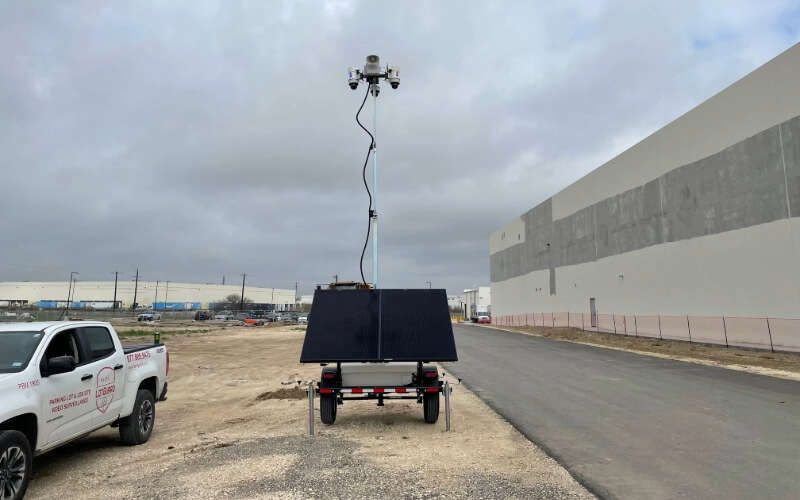
Quick, easy deployment: Systems are deployed as an add-on to our pole cameras or Mobile Surveillance Trailers. These trailers, with built-in 4G/5G connectivity, provide continuous fire protection and surveillance from the moment you break ground. Standing up to 20 feet tall, they deliver wide-area jobsite coverage with clear sightlines and are ideal for temporary or semi-permanent deployment.
Camera system: The video surveillance comprises infrared PTZ (Pan-Tilt-Zoom) cameras that work in all light conditions to "see" the fire faster than a traditional sensor "feels" it.
No third-party sensors: The fire detection intelligence is built directly into the camera system, so you don't need to buy or maintain separate, fiddly sensors.
Central platform management with WCCTV
For ease of management, all fire risk reporting runs through a central platform. Our secure, cloud-based platform provides you and your managers with a complete real-time overview of fire hazards and events across all work zones.
Every event, from a minor heat spike to a smoldering flame, is logged with timestamped video evidence. Real-time alerts allow your team to assess the danger and tackle it before any damage occurs.
For record-keeping, the footage of the incident is time-stamped, AES256-encrypted, and stored in the platform for later review or export. This ensures you have an irrefutable record (data, video, incident reporting) to deal confidently with inquiries from fire marshals, insurers, regulators, or stakeholders.
Read more:
Modern Fire Detection vs Traditional Fire Alarm Devices
Modern smoke and fire detection represents a definite step forward from conventional fire alarms. Traditional fire safety relies on physical contact, as the sensor must "wait" for smoke particles or extreme heat to reach it. On a windy jobsite or a high-ceiling warehouse, particles may not reach the sensor until the fire has already destroyed property and equipment.
This side-by-side comparison shows how intelligent detection warns you of potential fire hazards quickly and accurately, while low-tech devices might let you down.
|
Feature |
Traditional Smoke/Heat Systems |
AI-Powered Fire Detection |
|
Detection trigger |
Requires physical particles or heat to reach the sensor. |
Visually identifies smoke trails and fire indicators from a distance. |
|
Response speed |
Slower; dependent on environmental factors (wind/height). |
Near-instant; recognizes signatures seconds after they appear in the camera's view. |
|
Verification |
Audio only; requires a physical trip to the site to check. |
Immediate video verification via mobile device or desktop. |
|
Infrastructure |
Often requires wiring and localized power. |
Fully integrated into mobile solar trailers; no local infrastructure is needed. |
|
False alarms |
High; triggered by dust, steam, or debris. |
Low; AI filters out harmless disturbances like shadows or blowing tarps. |
Read more: Why Video Analytics is Best for Smoke and Fire Detection
How a Fire Detection System Improves Safety, Insurance, and Investigations
An advanced fire safety system is more than an early warning tool that helps you maintain safer, less disruptive jobsites. It is also a valuable record-keeping library that stores the documentation you need to handle insurance claims, investigations, and audits successfully.
Here's how:
Safer workplaces
As mentioned, fires cause several deaths and dozens of injuries on construction projects every year. By preventing fires from spreading, these systems dramatically reduce the likelihood of worker injuries.
While protecting your people, assets, and operations is vital in itself, it also has positive spin-offs, including happier crews and stakeholders, more favorable insurance, and fewer work disruptions.
Stronger insurance position
When an insurance company argues that jobsite fire damage was caused by your company's negligence, they may be looking to deny your claim. That's why timestamped, high-definition video of the incident is important to show indefensible evidence of exactly where and how the fire started and how your team responded.
Evidencing responsible oversight and swift reaction may be the difference between a quick payout and a costly, prolonged dispute with an insurance company.
Reduced premiums
Many insurance providers look favorably on contractors with proactive, AI-driven monitoring to minimize fire risks. In a large portfolio, this smart investment can mean real savings on your builder's risk insurance.
Better investigations
Incident reports, video footage, and audit trails provide essential information to support quicker, smoother investigations. Instead of relying on conflicting, subjective human accounts, you can pull objective evidence with a click of a button, eliminating guesswork and dispute.
If an investigator looks into whether a subcontractor left a temporary heater on (which the subcontractor might deny), video evidence answers the question clearly either way.
Tips and Strategies for Minimizing Fire Dangers on Jobsites
Protecting workers, jobsite assets, and buildings under construction from fire hazards requires a dual strategy that focuses on prevention and response.
The following 7 tips combine proven practices with modern safety measures:
Train workers and provide firefighting equipment: Regular fire safety training empowers crews to recognize hazards and respond appropriately in emergencies. Training should also focus on the proper handling of combustibles and the use of fire safety equipment (including the right fire extinguisher for different fire types). Be sure that fire extinguishers are maintained routinely and easily accessible.
Fire-resistant barriers: Install fire-resistant barriers around high-risk areas to contain sparks or heat sources and prevent a fire from spreading to electrical or critical equipment.
Proper ventilation: Ensure adequate airflow in enclosed spaces containing combustible materials to reduce the buildup of flammable vapors. Regular inspections of ventilation systems are recommended to maintain healthy air quality.
Emergency plans, including evacuation routes: Create and share an emergency plan to guide workers on how to respond in an emergency. Designate smoking areas and enforce smoking rules strictly, and clearly mark evacuation routes and keep them unobstructed.
Regular evacuation drills: Practice emergency evacuation procedures often so that employees know how to exit work zones quickly and calmly under pressure.
Latest fire safety techniques: Keep up-to-date with the latest fire prevention measures, including early detection systems and monitoring tools that significantly reduce the risk of severe consequences.
Appropriate fire suppression systems: Implement suppression systems suited to the jobsite environment (e.g., automatic sprinkler systems, mist, foam, or gas-based). Ensure these are installed and serviced by certified professionals.
Read more: Top Strategies for Ensuring Jobsite Safety
Other Tools to Combine with Fire Detection to Reduce Jobsite Risk
Besides fire hazard monitoring, project leaders must control a range of other risks on their builds, from jobsite security to PPE compliance. Managing these priorities with separate, disconnected systems creates vendor sprawl and information gaps that can be costly when hazards or accidents occur.
Our dedicated cloud platform seamlessly consolidates critical information from all your projects into a single interface, providing real-time visibility into nearly every safety and security threat affecting work zones.
Let's briefly look at what a smart integrated strategy covers:
Intrusion Detection solutions continuously scan jobsites for suspicious activity, such as perimeter breaches, vandalism, asset theft attempts, and/or trespassing. More vigilant than security guard patrols, AI easily distinguishes real dangers from benign activity, such as weather or wildlife.
Live Video Monitoring strengthens perimeter controls by connecting security surveillance to a monitoring center where operators are available 24/7 to respond to security incidents. They take immediate action to deter unauthorized access or suspicious behavior spotted on the feed.
License Plate Recognition (LPR) tracks and logs all vehicles entering and exiting jobsites, bolstering access control and supporting post-incident investigations.
PPE Monitoring checks that workers adhere to personal protective equipment requirements (hard hats, high-vis vests, safety boots, eye protection, etc.). This smart detection system reduces accidents, injuries, and regulatory fines by notifying teams when protective gear is missing. It can even issue a real-time voice warning/reminder to non-compliant workers.
IoT environmental monitoring sensors provide PMs with real‑time visibility into environmental conditions to help manage hazards and keep workflows running smoothly.
Weather Monitoring Stations track wind, rainfall, extreme heat, and other potential weather risks. Automated alerts warn you when operations like crane work or concrete pouring become unsafe, supported by timestamped evidence and footage.
Air Quality Monitoring Sensors detect dust, emissions, and airborne hazards, triggering alerts before thresholds are approached to protect crews and the local community from building pollutants.
Noise Monitoring Systems measure construction site noise exposure. When levels rise to unsafe thresholds, managers receive instant alerts and incident logs, ensuring accountability and safeguarding workers and the public.
All of these feeds flow into our cloud-based platform, giving you a bird's-eye view of fire and other occupational hazards across multi-jobsite projects.
Read more:
Bring Faster, Smarter Fire Protection to All Jobsites
A large fire at one of your jobsites can destroy valuable equipment and infrastructure in minutes. It endangers construction workers, causes costly downtime, and can entangle you in investigations and legal claims.
Smart fire prevention, integrating detection with real-time video footage, flags fire risks early and enables a fast response to confront dangers before they escalate. By combining technology with a rapid emergency response plan, you ensure that when a spark ignites anywhere on the site, your team springs into action to extinguish it.
Contact us today to see how our AI-powered fire detection provides the real-time oversight and detailed incident reporting that high-stakes projects demand.

