
Modern construction superintendents must manage an increasingly complex set of variables to deliver a project on time and on budget. Rising material costs, tighter schedules, and stricter regulations mean there is no room for inefficiency or unexpected schedule disruptions.
Understanding what is happening on your jobsite minute-by-minute is the only way to effectively limit the many risks that derail budgets and timelines, including theft, safety accidents, environmental hazards, and regulatory investigations.
Smart monitoring and risk management platforms provide deep, real-time data on conditions in every work zone across your site. This insight allows you to respond quickly and decisively to problems before they threaten operations and profits.
The best monitoring systems are strategic tools that not only strengthen jobsite safety but also unlock efficiencies that improve financial performance. Our article explores the return on investment (ROI) that smart monitoring systems bring to construction projects and highlights the ways they deliver measurable, repeatable financial wins.
Why Traditional Monitoring Systems Are Not Cost-Effective
Traditional project monitoring systems are inadequate to meet the demands of today's fast-paced industry. Their inefficiencies expose contractors to operational disruptions and potentially stiff legal liabilities.
-
Blind spot risks: Legacy monitoring systems rely heavily on physical inspections, spot readings, and manual reporting. This means that safety and compliance incidents are often missed, and close-calls go unreported. Failure to flag and correct a minor issue can lead to the problem escalating, resulting in significant loss and damage.
-
Vendor sprawl: Construction management often involves 5 or 6 different monitoring tools for surveillance, environmental tracking, safety compliance, and access control. Separate systems require different logins and navigation, and the reports they generate may be too limited to aid the larger project.
When incidents occur, you have to stitch together information from systems that don't speak to each other and human recollections that don't match. Vendor sprawl and siloed records lead to managers wasting valuable working hours. In fact, according to studies, up to 10% of each work week is spent searching for fragmented information.
- Project and communication inefficiencies: When teams work in silos, information isn't shared, documentation is harder to find, and key performance metrics are unmet.
It's estimated that project inefficiencies cost $177 billion a year. The main reasons are searching for data, resolving conflicts, and doing rework, all of which impact project completion and jeopardize your reputation with clients and stakeholders.
- Weak compliance: Legacy systems typically provide basic, inconsistent reports that fail to meet regulatory and project stakeholder standards. When a safety problem occurs on site, officials and other stakeholders expect managers to explain the situation fully. Compliance inspectors from OSHA and EPA agencies want to see documented evidence of the safety protocols you follow.
If you can't satisfy these requests, your compliance position is immediately weakened, and you may face fines and investigations.
Read more:
What is a Smart Monitoring System in Construction?
A smart monitoring platform is a unified system that tracks jobsite security, safety, compliance, and environmental factors in real-time. It embeds artificial intelligence that detects and alerts you to risks (e.g., missing PPE, security breaches) more quickly, consistently, and accurately than low-tech or manual processes.
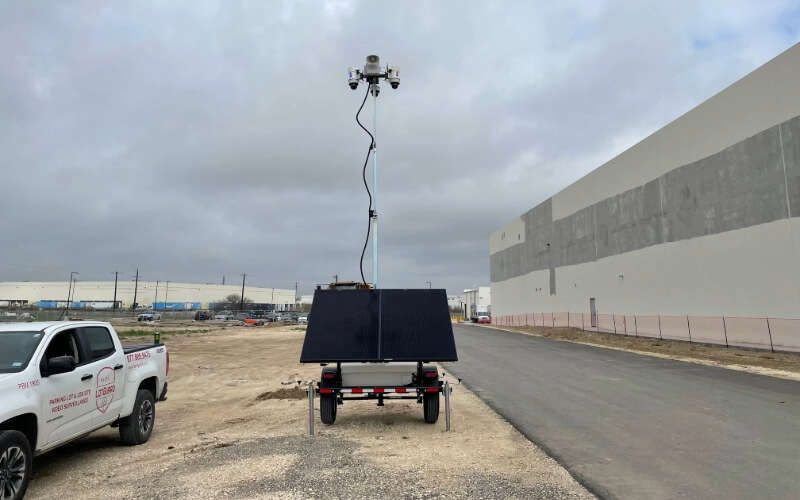
The backbone of smart monitoring is an intelligent surveillance network. Our law enforcement-trusted system features advanced sensors and high-definition, infrared PTZ (Pan-Tilt-Zoom) cameras that act as your eyes on the build 24/7. The camera network is deployed on mobile equipment purpose-built for construction projects.
Let's look at the different deployment options and how they can work for your location(s).
|
Infrastructure/Deployment |
Key Features |
Ideal For |
|
Up to 20-ft tall, solar-powered with 4G/5G connectivity. Provide wide-area surveillance with infrared (IR) night vision and energy savings. Quick and easy deployment and relocation. |
Remote jobsites that lack power and Wi-Fi with little permanent infrastructure. Sites where relocating surveillance for different project phases is important. For targeted coverage needs. |
|
|
Pole Cameras |
Rapidly deployable units featuring infrared night vision and cellular connectivity. Mounted on poles or existing infrastructure, requiring no fixed cabling. |
For sites where visibility and rapid setup are critical, and for targeted investigations. Locations with power but limited solar generation. |
Once deployed, a surveillance network delivers high-level visibility into all your jobsites, supporting stronger overall risk management. To target specific risk areas, contractors integrate specially customized tools.
Our cloud-based platform is an excellent example of this smart risk monitoring in action. The platform integrates tracking tools and surveillance feeds into a single powerful control hub.
Unified dashboards and AI-driven intelligence deliver operational efficiencies and allow construction professionals to manage safety compliance confidently across major risk areas, including:
-
Jobsite security and access control
-
Fire and smoke detection
-
Safety compliance
-
PPE compliance
-
Environmental hazards
Modern smart monitoring is mobile-friendly, automated, and usually cloud-supported. Here's how our dedicated cloud-based platform combines these technologies to deliver ease and efficiency:
-
Cloud connectivity lets you access video, alerts, and reports remotely on any connected device. This means you can react instantly to a problem, whether you're on the far side of the build overseeing a demolition job or off-site, traveling.
-
Automated scanning, detection, and incident records replace spreadsheet reporting, delayed updates, and physical patrols, giving you far greater control over events on the ground.
-
Secure cloud storage, with AES-256 end-to-end encryption, retains all the documentation you need to satisfy regulators and stakeholder demands. Timestamped logs, incident reports, and video evidence can be seamlessly retrieved with the push of a button.
Smart Monitoring vs Traditional Oversight Methods
Here's a side-by-side comparison of automated monitoring vs legacy systems, showing how smart technologies have accelerated operational efficiencies across the board.
|
Smart vs Traditional Features |
Smart Monitoring |
Traditional System |
|
Mobile Apps vs Limited Mobile Support |
Managers access reports and alerts instantly on smartphones or tablets, reducing travel and admin overhead. A desktop app is also available. |
Systems rely on spreadsheet-based records, phone calls, or desktop-only tools. This slows communication and requires more physical inspections. |
|
AI Analytics vs Manual Observation |
AI-powered analytics use algorithms and machine learning to detect risks and guide swift interventions, avoiding liabilities and informing better decisions. |
Manual checks and spreadsheet monitoring are prone to error, often missing early warning signs and delaying important decisions. |
|
Automated Alerts and Logs vs Manual Incident Reporting |
Real-time notifications and timestamped digital records deliver accountability and faster resolution. |
Reports are delayed, inconsistent, and lack accurate timestamps, increasing liability risks. |
|
Centralized Dashboards vs Fragmented Systems |
Consolidates several systems into one platform, simplifying oversight and reducing vendor sprawl. |
Managers must switch between tools, wasting time and creating blind spots. |
|
Cloud Storage vs Local Files |
Secure, affordable storage provides seamless access and protects data with backups. |
Local servers or paper files are vulnerable to loss and cost-inefficient to maintain. |
|
Integrated Surveillance vs Standalone Cameras |
Cameras and sensors feed directly into dashboards, enabling proactive security and safety management, whether the site is temporary or semi-permanent. |
Surveillance systems operate separately, requiring manual checks and higher staff costs. |
6 Smart Monitoring Systems That Support Leaders and Improve ROIs
Our range of detection and monitoring tools helps contractors reduce project costs and achieve significant long-term value across their build portfolios. Here are 6 smart digital tools that continuously analyze your workplace environments, generating data analytics and intelligence that drive real productivity gains.
1. Jobsite security systems
Theft is a billion-dollar problem in the US construction industry. With gas, fuel, and material costs all rising, this threat is currently felt even more sharply.
Our tech-enabled surveillance and automation systems are the foundation for first-class security solutions, including:
-
Intrusion Detection Systems: Cameras with built-in AI analytics detect suspicious activity in real time, preventing unauthorized access, vandalism, and theft. The system triggers immediate alerts to you/monitoring partners when it identifies a threat and supplies detailed documentation for investigations and site security reviews.
-
License Plate Recognition (LPR) is an automation system that records all vehicles entering and exiting the jobsite. Accurate monitoring of vehicle movement improves access control and encourages accountable driver behavior in work zones.
-
Our Live Video Monitoring service connects all surveillance feeds to a control center where security professionals receive alerts and react immediately. The combined AI detection and human oversight enhances surveillance very effectively, deterring up to 90% of crime before it happens.
Read more:
- Benefits of Remotely Monitoring Video Surveillance
- The Future of Construction Security: From Guards to AI-Powered Smart Systems
2. Smoke and Fire Detection
Cameras with AI-powered video analytics catch the early signs of fire. Capable of recognizing indicators as slight as a faint smoke trail or a handful of sparks, they also filter out false alarms such as dust and diesel emissions.
These systems raise alerts faster than traditional fire alarms, which often only trigger after a buildup of heat or smoke reaches a ceiling sensor.
With over 4,400 construction site blazes every year, effective fire detection is an essential tool in the project management arsenal. Proactive prevention reduces worker injuries and protects assets, limiting rework and operating cost overruns.
3. PPE Monitoring
PPE monitoring and detection systems alert managers when crew members are not wearing the required personal protective equipment. This smart detection system can also issue a live warning when workers fail to comply with PPE protocols.
Proactive enforcement reduces preventable accidents and injuries and expensive consequences such as downtime and investigations. The system logs incidents, so you can easily retrieve records for reviews with crews and subcontractors, and insurance claims.
4. Air Quality Monitoring
IoT air quality sensors with connected cameras continuously measure dust, particulate matter (PM1, PM2.5, PM10), and other harmful emissions. This is crucial in an environment where thousands of US workers die each year from occupational respiratory diseases caused by hazardous airborne exposure.
Based on preset thresholds, you can catch air pollution issues before they impact your workers' and the local community's health, with our cloud-based platform also there to store evidence of your responsible environmental practices.
Diligent environmental monitoring demonstrates corporate social responsibility and limits penalties, complaints, and work stoppages.
Read more:
5. Noise Monitoring
Continuous measuring of jobsite sound levels helps ensure compliance with local noise laws. Our IoT sensors and cameras record sound across ranges of 30-130 Decibels and frequencies of 20Hz to 12.5kHz.
Noise can be tracked across all locations, capturing both prolonged exposure (e.g., generators running) and sharp spikes (e.g., blasting and demolition). The system captures and logs thousands of individual data points and records all breach incidents.
By controlling noise hazards, you protect your crew's hearing and avoid complaints, fines, and enforced downtime.
Read more:
6. Weather Monitoring
Natural disasters and weather events, from dangerous winds to lightning storms and flooding, regularly cause severe disruptions to US construction projects.
Delays caused by unplanned weather events can increase costs substantially, while damage to completed structures might require major rework.
To help teams plan effectively for weather challenges, advanced monitoring stations track live environmental conditions. These systems provide up-to-the-minute data on variables such as temperature, winds, humidity, rainfall, and dew risks.
This precise data goes a long way to protect the crew and site from danger (high heat, heavy rain, winds) by alerting managers when conditions become unsafe. Responsible leaders use environmental information to plan around weather risks to keep the project on schedule. For instance, providing a team with rain gear in drizzly, but still safe conditions, so that they can complete urgent steelwork.
How Smart Monitoring Creates Return on Investment (ROI)
Integrating smart technologies is a strategic investment that delivers measurable ROI by cutting direct costs and streamlining the construction process.
Unified risk management reduces expenses, keeps projects on schedule, minimizes fines, and strengthens client trust. Let's explore the ROI and financial benefits of advanced technologies in more detail.
Greater operational efficiencies
A centralized platform unifies multiple systems and brings executives, operational managers, safety, and security teams into the same workspace, sharing the same reliable data. It reduces travel for many site managers, eliminates manual workflows, and cuts administration and vendor costs.
With AI and predictive analytics unlocking valuable insights and trends, efficiencies can boost net profits further. A recent Bloomfire report showed that well-organized information and AI insights can improve team speed and efficiency by 39%.
As another example of efficiencies achieved, some firms that streamlined security operations with smart systems reported security cost savings of up to 88%.
Productivity and headcount benefits
By automating routine tasks, smart monitoring frees supervisors from manual reporting and compliance checks. Instead, you can focus on high-risk issues and initiatives that add financial value, such as reducing waste and intelligent energy management.
By using smart technology platforms to manage safety and security, teams can do more with fewer personnel. Organizations can often expand their oversight across several locations without adding to headcount.
Fewer disruptions
Real-time progress tracking and automated alerts prevent safety incidents from snowballing into work stoppages that affect financial performance. By resolving incidents proactively, you minimize theft-related delays and regulatory stoppages, keeping budgets under control.
Reduced rework costs
Greater jobsite visibility across all trades reduces errors and miscommunication. Smart monitoring catches issues early and so prevents expensive rework, saving both time and money while improving overall build quality.
Lower insurance costs
When it comes to insurance, a safe, well-managed jobsite can translate directly into cost savings. Fewer accidents and injuries mean fewer insurance and workers' compensation claims. On top of that, insurers often reward firms that demonstrate proactive risk management with better premiums and coverage terms.
Fewer penalties and legal liabilities
Strong compliance practices avoid legal disputes and regulatory penalties (that can exceed $165,500 for repeated OSHA violations). By helping you build a consistent track record of legal due diligence, smart monitoring protects financial metrics and puts your company in good standing with authorities.
Read more:
- How Smart Monitoring Saves Construction Jobsites Money
- How Can Construction Jobsites Adapt to Digital Transformation
Maximizing Construction ROI with Smart Monitoring
The case for smart monitoring in US construction is convincing when viewed as an investment rather than a cost. These strategic tools deliver measurable returns by minimizing theft, safety accidents, weather disruptions, environmental hazards, fires, and regulatory investigations.
Smart monitoring platforms combine live data and AI-driven insights into intelligent dashboards that empower managers to lead with confidence. Real-time alerts enable teams to respond earlier to hazards and course correct where necessary to keep productivity on target.
Our cloud-based platform is a best-in-class monitoring solution that safeguards your people and projects today and earns a financial return on every dollar spent in the future. Reach out when you're ready for a demo.

