CPRA (California Privacy Rights Act) and OSHA (Occupational Safety and Health Administration) laws are among the many regulations that construction firms operating in California must manage daily.
The CPRA regulates how larger organizations collect, use, and retain Californians' personal information. OSHA is the compliance framework that governs workplace safety and health across all industries in the US.
Maintaining compliance in these areas is vital to prevent jobsite injuries and fatalities, as well as serious data breaches that can trigger 7-figure fines.
Speed makes all the difference in managing safety and data compliance, but relying on physical visits and manual processes delays reporting and response times. Real-time tracking keeps you fully informed of developing risks, so you can act quickly and take corrective actions before they become bigger problems.
To help you improve regulatory compliance on construction jobsites, we break down how real-time monitoring platforms support CPRA and OSHA adherence, and how continuous tracking closes monitoring gaps and leads to faster responses and stronger incident reporting.
Why CPRA and OSHA Rules Matter in US Construction
The California Privacy Rights Act (CPRA) and the Occupational Safety and Health Administration (OSHA) are two of the most important regulatory frameworks affecting construction firms operating in California.
-
The CPRA, an expansion of the California Consumer Privacy Act (CCPA), sets strict requirements for how organizations must manage personal data in California.
-
OSHA is the primary agency responsible for overseeing workplace safety and health standards in the US.
To understand how CPRA and OSHA impact construction jobs, here is a summarized breakdown of the purpose and key requirements of these regulatory standards, including penalties:
|
OSHA |
CPRA |
|
|
Purpose |
To prevent injuries, illnesses, and fatalities in the construction industry by enforcing safety and health standards. |
To protect California residents’ personal data and privacy rights. To regulate how organizations collect and handle personal information. |
|
How do you know if the regulations apply to your construction company |
Applies to all US construction employers and workers. |
Applies if a construction firm operates in California and has an annual gross revenue over $26.625 million or processes data of 100,000 or more California residents. This includes data from workers, subcontractors, vendors, clients, site visitors, and financial partners. |
|
Key requirements |
- Fall protection: Covers safety practices and equipment when working at heights of 6 ft+ above a lower level (Subpart M regulations). - Fall training records: Fall protection training must be documented (Standard: 1926.503). - Ladder safety: Covers the secure use of all ladders on sites (1926.1053). - PPE: Regulates the wearing of proper safety equipment such as hard hats, hi-vis vests, goggles, hearing protection, footwear, and respirators. - Noise exposure: Sets noise limits that workers can be exposed to, e.g., 90 dB for 8 hours (Subpart D). - Hazard Communication (HazCom): Covers hazardous material labeling, training, and the keeping of safety data sheets. - Scaffolding: Scaffolds must be properly built and maintained (1926.451). - Recordkeeping: Injuries/illnesses must be logged for 5 years. |
- Individual rights: Residents can know, correct, delete, and limit use of their personal data. - Data rules: Data can only be collected for legitimate purposes (e.g., security surveillance). Information can only be kept for a period that is “reasonably necessary”. - Non-discrimination: Organizations cannot penalize individuals for exercising CPRA rights. - Oversight: The California Privacy Protection Agency (CPPA) enforces regulatory compliance. |
|
Penalties |
- Serious/other-than-serious: $16,550 per violation. - Willful or repeated: $165,514 per violation. - Potential criminal charges for severe violations. |
- Unintentional violations: Up to $2,628 each. - Intentional violations: Up to $7,884 each. - Violations involving minors: $7,884 each. - Large-scale incidents: Fines can exceed $1 million in large-scale incidents |
It's important to recognize that CPRA and OSHA often overlap. For example, if you install temporary cameras to monitor PPE compliance or fall hazards (as part of your OSHA compliance program), you must protect worker privacy under CPRA and inform your crew why the surveillance is in place.
Read more:
The Cost of Non-Compliance with CPRA and OSHA
Non-compliance with CPRA and OSHA requirements can result in heavy financial, legal, and operational consequences that can damage projects and companies.
Financial penalties
Organizations that violate these regulations are liable for $1 million+ penalties that can have a devastating impact on project operational costs:
-
OSHA: OSHA violation penalties start at $16,550 per serious violation and can rise to $165,541 for willful or repeated transgressions. In extreme cases, OSHA violations can lead to criminal charges.
-
CPRA: The California Privacy Protection Agency (CPPA) enforces civil penalties of up to $2,628 per unintentional violation or $7,884 for intentional breaches, including those involving minors.
Fines for large-scale incidents can easily exceed $1 million because each affected party may count as a separate violation. If, for instance, sensitive data from 200 employees/partners is wilfully mishandled, the fine could be $1,576,800.
Disputes
Without proactive, real-time monitoring, it's more difficult to defend yourself in disputes and OSHA/CPRA investigations:
-
If a compliance authority investigates a safety or privacy complaint and you cannot easily produce evidence of due diligence, such as a timestamped sensor reading or video footage, your case is weaker.
-
Piecing together retrospective data often leaves you with information gaps, making it harder to resolve the dispute favorably.
Enforcement actions
The Bureau of Labor Statistics reports that about 150,000 people are injured on construction sites every year. This makes construction a high-priority sector for OSHA, and the agency's scrutiny and enforcement can lead to:
-
Project shutdowns: Jobsites can be closed down if safety and compliance efforts don't meet requirements, causing substantial financial losses.
-
Severe Violator Enforcement Program (SVEP): Construction companies that don't take safety monitoring seriously may be placed in OSHA's Severe Violator Enforcement Program. This extra scrutiny brings additional compliance administration and costs.
Read more: Construction Jobsite Compliance Failures and Lessons Learned
How Real-Time Monitoring Ensures Compliance With CPRA and OSHA
The key to consistently meeting regulatory and industry standards is complete, real-time visibility into all your compliance risk areas.
Here's how modern monitoring systems support day-to-day compliance:
1. Real-time PPE Monitoring
Advanced PPE detection and monitoring systems use AI-powered analytics to track PPE adherence across your projects (multiple locations) and identify unsafe behaviors. They flag violations instantly, allowing you to take action such as alerting the subcontractor or halting the task until the necessary gear is adopted.
How it supports compliance: It ensures OSHA PPE requirements are met and creates audit-ready documentation while respecting CPRA privacy laws.
2. Real-time Environmental Monitoring
IoT environmental monitoring tracks jobsite environmental conditions against permitted limits 24/7. Our advanced monitoring sensors are mounted to Solar Surveillance Trailers or Pole Cameras and feed into our secure monitoring platform, Stellifii. Sensors include:
-
Air Quality Sensors that measure fine particulate matter (PM1, PM2.5, PM10) and trigger alerts when work activities near thresholds.
-
Noise Monitoring Devices that record a wide decibel (30-130 dB) and frequency (20Hz-12.5kHz) range, helping to manage compliance with local regulatory standards.
-
Weather Monitoring Stations that track temperature, wind speed, humidity, and rainfall to help protect the jobsite and crew from extreme weather conditions.
How they support compliance:
-
Enables continuous compliance with environmental regulations.
-
Minimize OSHA compliance failures around noise and air quality violations.
Read more: How IoT Improves Both Safety and IT Overview on Construction Jobsites
3. Real-time Smoke and Fire Detection
Intelligent Smoke and Fire Detection cameras with AI analytics spot heat signatures and the faintest trail of smoke almost instantly. Real-time alerts are sent to designated response crews so that flames can be extinguished before major damage occurs.
How it supports compliance: The smart detection system supports OSHA fire prevention and emergency response standards.
Read more: The Benefits of Smoke and Fire Detection on Jobsites
4. Real-time Security Systems and Intrusion Detection
Smart security surveillance systems protect your jobsite's high-value assets and materials. Camera networks with AI analytics send immediate notifications and provide actionable insights that enable rapid responses to security breaches.
How it supports compliance: Intrusion detection can be used to ensure that only authorized personnel enter restricted or high-risk areas in line with OSHA regulations. Security surveillance generally creates a safer workplace.
Read more: The Future of Construction Security: From Guards to AI-Powered Smart Systems
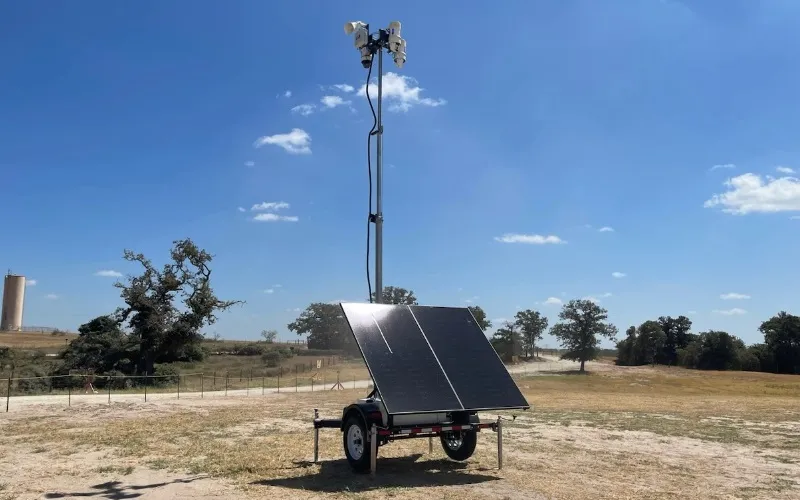
5. Live Video Monitoring
Live Video Monitoring employs PTZ (Pan-Tilt-Zoom) cameras connected to control centers where trained specialists monitor site safety and security 24/7. They can respond immediately to dangerous and unauthorized activities through live voice challenges or by sending a mobile keyholder.
How it supports compliance: Audio warnings and rapid intervention help to manage OSHA safety risks such as fall dangers, unsafe scaffolding and ladders, unauthorized access, and improper equipment use.
6. Other Digital Tools
-
License Plate Recognition (LPR): Accurately reads vehicle speeds and details, and logs every vehicle entering/exiting jobsites. This controls unauthorized access that could cause OSHA issues.
-
Time Lapse Video: Condenses days/weeks of jobsite activity into a single video clip, providing a dynamic show reel of building work.
Read more: The Rise of Smart Construction Jobsites: How Tech Is Transforming the Industry
7. Centralized Management of Compliance Monitoring with Stellifii
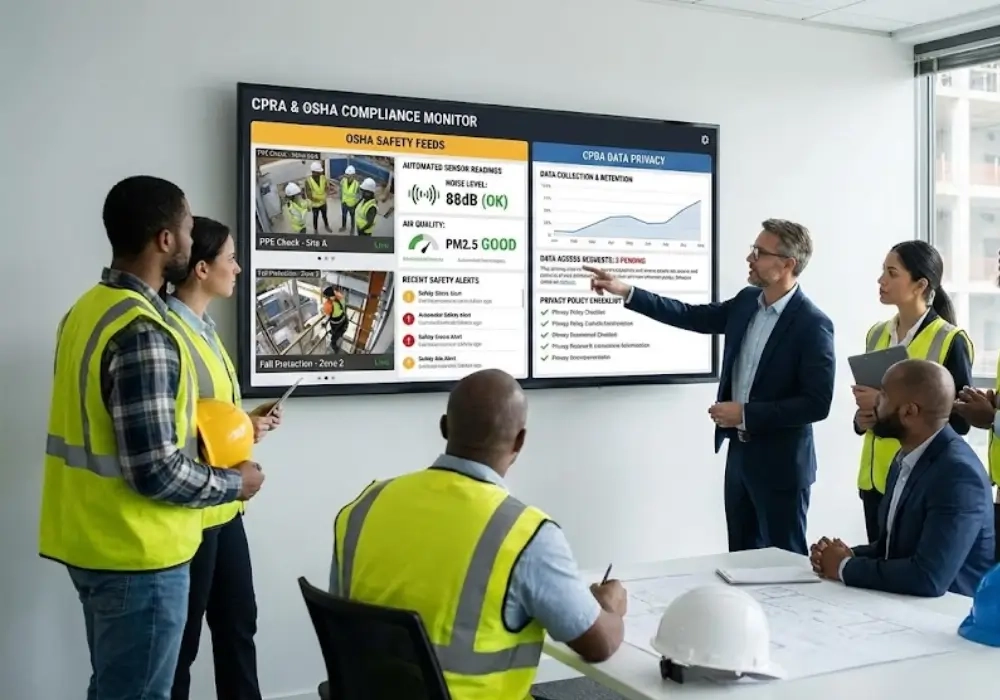
Our unified monitoring and automated reporting solution, Stellifii, brings data from safety, environmental, and security feeds into one central dashboard.
Construction managers can view OSHA-relevant information from their vehicles or remote sites, knowing that the platform meets CPRA's strict data protection standards. The system is end-to-end AES-256 encrypted (Advanced Encryption Standard with 256-bit keys), providing 14 rounds of encryption to safeguard data.
Our systems are also NDAA‑compliant to protect federal contractors from restricted surveillance equipment (including Chinese-made cameras).
Read more: Stellifii: Our New Smart Platform Transforming Surveillance, Safety, and Compliance
CPRA Considerations when Implementing Monitoring
As mentioned, OSHA and CPRA can overlap, so to ensure compliance with the Privacy Act, pay attention to the following when deploying monitoring:
-
Data can only be collected for legitimate purposes (e.g., jobsite security or compliance surveillance). This might mean limiting live monitoring to safety-critical zones instead of continuous employee tracking.
-
Personal data collected should only be kept as long as it's needed for compliance purposes.
-
California residents have the right to know what personal information is captured. They can also correct inaccuracies, request that information be deleted, and/or limit the processing of sensitive personal information.
-
Transparency is key. All parties should understand the reasons for monitoring and what data is being collected.
4 Benefits of Real-Time Monitoring of Regulatory Requirements
Adding real-time monitoring to your compliance strategy delivers 4 major benefits:
1. Faster incident response
Continuous monitoring provides immediate, indisputable evidence, cutting detection and investigation times. Precise alerts give your managers and response crew the information they need to address incidents urgently.
-
Proactive risk management: Rapid response resolves issues before they escalate, preventing work disruptions and keeping projects on schedule.
-
Fewer liabilities: Immediate intervention minimizes risks such as fines and reputational damage.
-
Better post-incident analysis: Investigations and cause analysis based on verifiable evidence become simpler and faster.
2. Improved reporting
The system documents what happened and how your team responded, providing:
-
Verifiable logs: Time-stamped, accurate visual records replace unreliable manual logs and witness statements that are easily challenged.
-
Proven diligence: By showing that alerts were sent quickly to compliance/fire/safety managers, you have proof of your team's swift corrective actions.
3. Strong audit and legal defenses
Ongoing compliance ensures you always have the necessary information to handle audits, OSHA inspections, risk assessments, and even lawsuits:
-
Audit readiness: Keeping up-to-date records in one place makes it easy to retrieve documentation when auditors or inspectors arrive. With a few clicks, you have strong audit trails covering everything from PPE to noise ordinance compliance.
-
Legal defense: If a compliance issue leads to a lawsuit, you can produce a report detailing the event, the immediate alerts, and the effectiveness of your response. An unimpeachable audit trail forms the basis of a robust legal defense.
Read more: How Digital Tools Ease Audit Prep and Cut Reporting Time in Half for Your Jobsite
4. Cost efficiencies
Real-time monitoring and automated reporting eliminate hours spent searching for old files and compiling reports.
-
Improved productivity: Labor cost savings and productivity gains boost the bottom line.
-
Operational efficiency: Apart from the productivity wins, the lower risk of OSHA and other fines can reduce your monitoring costs by up to 88%.
Read more: How Smart Monitoring Saves Construction Jobsites Money
Upgrade to Real-Time Tracking to Improve CPRA and OSHA Compliance
Real-time compliance tracking of OSHA regulations and recognizing CPRA requirements is essential in the California construction environment.
Stellifii’s cloud platform integrates all your compliance data into one CPRA-compliant hub, enabling quick OSHA reporting and streamlined oversight.
If you're looking to upgrade your existing systems into a single connected solution that identifies potential risks in real-time, contact us to discuss the solution.