Personal Protective Equipment (PPE) compliance is a critical safety priority across construction sites, yet most companies still rely on manual processes that create significant oversight gaps. To address these vulnerabilities head-on, construction leaders are now turning to intelligent monitoring solutions.
AI-powered PPE detection technology offers one clear way to tighten oversight, enabling more proactive PPE enforcement and stronger incident reporting to support audits and inspections.
This guide explains how AI-driven detection allows construction leaders to strengthen compliance, improve audit documentation, and scale safety management without increasing headcount.
The Challenges and Costs of PPE Non-Compliance in Construction
OSHA's PPE standards (29 CFR 1926.95-106) require all employers to provide protective equipment that meets safety design standards and fits workers properly. This includes hard hats, high-visibility vests, safety glasses, protective boots, hearing protection, gloves, respiratory masks, and harnesses.
Despite strong general awareness of the importance of protective equipment, 54% of construction leaders say PPE compliance is a major challenge, according to a 2025 industry study.
Some of the reasons for PPE non-adherence include:
-
Busy workers taking shortcuts
-
Subcontractors with weak safety protocols and limited supervision
-
Incorrectly-sized equipment
-
Workers removing PPE because of the heat
-
Supply issues
But failure to enforce proper PPE usage can have serious repercussions. One missed violation could lead to a fatal head injury with legal and other costly consequences.
With around 150,000 injuries on construction sites every year, OSHA maintains strict oversight of the industry. In 2024 alone, the agency issued nearly 2,500 citations for missing respiratory protective equipment (the top PPE violation that year).
OSHA penalties start at $16,550 per violation and can rise to $165,541 for willful or repeated infringements. Projects can be shut down for PPE failures, and, in extreme cases, violations can result in criminal charges.
It's important to note that under OSHA’s Multi-Employer Citation Policy, a General Contractor (often called the “controlling employer" in law) can be held accountable for safety violations caused by subcontractors. Taking this further, individual compliance officers and project owners may be personally liable if they're found to be negligent or repeatedly guilty of poor safety controls.
Understanding these risks and consequences makes it clear why many teams now choose AI systems as a cost-efficient and proven solution.
Read more:
-
The Rise of Smart Construction Jobsites: How Tech Is Transforming the Industry
-
Stellifii: Our New Smart Platform Transforming Surveillance, Safety, and Compliance
How AI-Powered PPE Detection Works to Ensure Project Safety
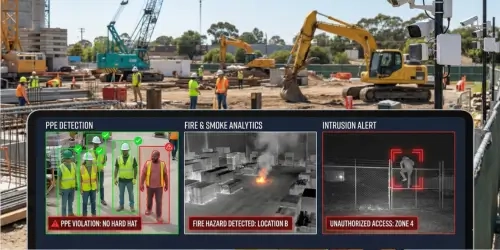
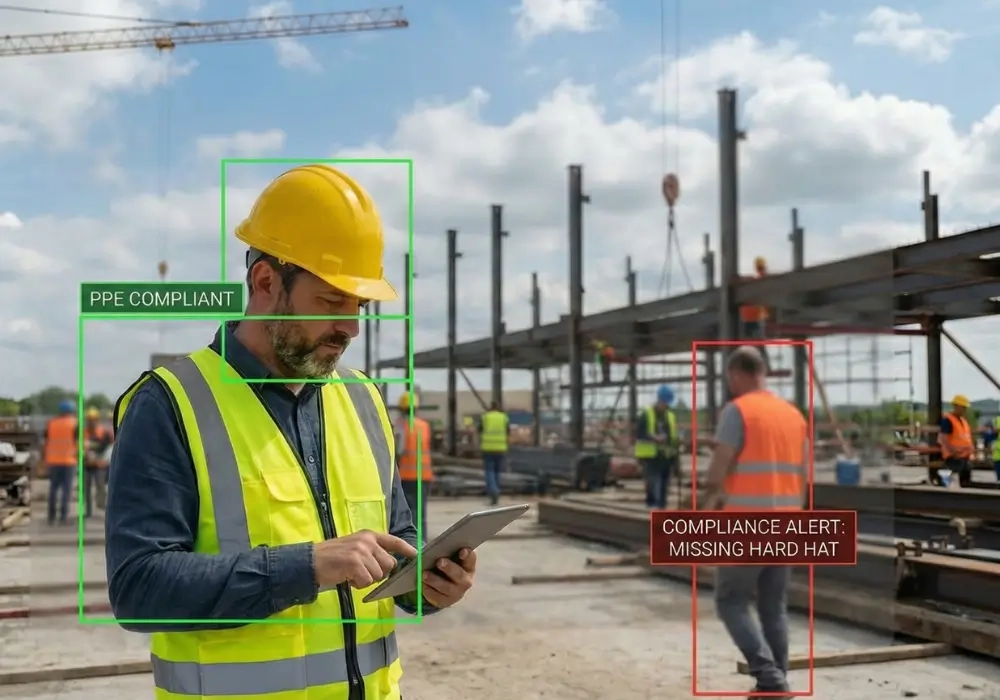
AI PPE Detection monitors jobsites continuously using video analytics to ensure that workers are using proper safety gear. AI analytics employs advanced algorithms to automatically spot and flag crew members not wearing required safety equipment, e.g., "High-Visibility Vest Violation at Zone B".
The AI is trained on thousands of hours of real-world data to understand genuine PPE violations and filter out false alarms. In fact, construction-specific AI models trained in authentic jobsite conditions deliver fewer false positives and better accuracy than generic computer vision systems.
Here's an easy 4-step guide to how you can implement smart PPE monitoring on your jobsites:
-
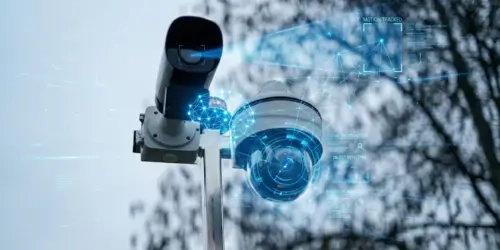
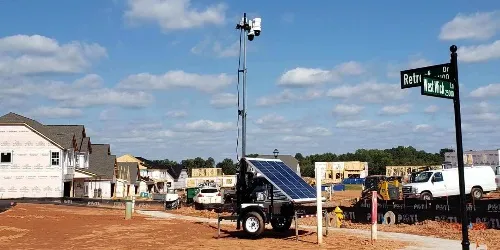
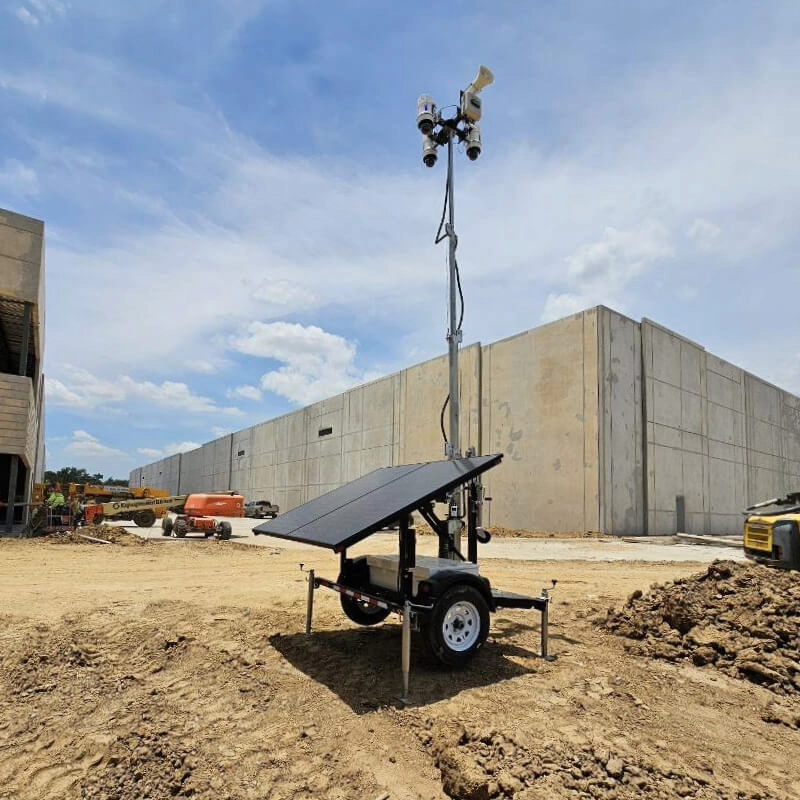
Camera network: AI PPE detection works through our easily deployable Surveillance Trailers, Pole Cameras, or temporary cameras. These PTZ (Pan-Tilt-Zoom) HD units operate effectively indoors and outdoors at all hours, day and night.
-
Configure detection zones: You define the zones to be monitored based on your safety protocols. Once you set the PPE requirements for each zone and the monitoring times, tracking can begin.
-
Real-time alerts: If a crew member enters a designated zone without the proper PPE, the system instantly alerts your safety team, allowing you to take swift corrective action. Each notification includes a visual snapshot, and the incident is logged automatically.
-
Record keeping: Each event is recorded with time-stamped footage in Stellifii, our secure monitoring platform. Your team can access incident details for later review or to share for insurance, training, or legal purposes. This record ensures you have visual proof to address workers about missing PPE, removing any debate from the conversation.
According to a 2025 International Data Center Authority (IDCA) survey, 87% of companies say AI is a top priority in their business plans. PPE with video analytics is an excellent example of how AI systems are reshaping workplace safety and adding real business value in construction companies.
Similar Smart Detection Systems include:
-
Smoke and Fire Detection: Fire detection cameras with AI analytics spot the earliest indicators of fire faster than traditional smoke alarms.
-
Intrusion Detection: These automatically detect and report intrusions and jobsite security breaches, while keeping detailed incident logs.
-
Live Video Monitoring: Video streams can be connected to a monitoring center where trained operators respond to safety and security alerts by issuing voice challenges or activating sirens and light warnings.
Our systems are fully NDAA‑compliant, meaning they're suitable for use on federal projects (the NDAA restricts certain foreign-made technologies/materials in government contracts).
Read more:
How Centralized Compliance Management Improves Safety Oversight
In our data-driven age, disconnected systems with siloed information can be more of a hindrance than a help.
Stellifii, our leading-edge compliance platform, modernizes safety compliance through automated detection and unification of business intelligence in one place. With Stellifii, PPE data from every camera across every jobsite flows into a single interface.
Managers can view the central dashboard from anywhere, making it easy to track and respond to the latest PPE issues from the office, truck, or a remote site. There's no longer a need to physically visit projects or rely on a foreman or site clerk's reports, which might be delayed or inconsistent.
With real-time remote visibility, owners can enforce protocols, ensuring correct PPE usage is practiced at all times.
Here are the other core features that make Stellifii such a trusted solution:
-
Organized record storage: The platform stores all documentation in audit-ready formats in one place. Records can be securely retained for as long as they're needed for compliance purposes, often 5 years. Owners and authorized managers can typically pull these reports 5X faster compared to legacy systems.
-
Cloud technology: Stellifii runs on resilient cloud infrastructure, allowing you to access the platform from anywhere with an internet connection. Cloud resources are highly elastic, so storage capacity can be scaled up or down quickly and easily as your projects grow or your technology evolves.
As organizations modernize and digitize to stay competitive, cloud technology is becoming increasingly central. To illustrate, it's estimated that 30% of total IT spending today goes toward cloud services. -
High-grade security: In a cyber threat landscape where an astonishing 60 billion records were exposed to cyber breaches over the past two decades (over 3 billion a year on average), strong data security is non-negotiable.
Stellifii is end-to-end AES-256 encrypted (Advanced Encryption Standard with 256-bit keys), providing 14 rounds of encryption to protect worker, client, vendor, and other partner information. -
Intelligent integrations: Stellifii can pull in data from other specialized cameras/sensors and to comprehensively oversee all risk areas. These add-ons integrate seamlessly with the central dashboard, reducing the inefficiencies of juggling separate tools. They include:
-
Licence Plate Recognition (LPR): LPR logs all vehicles entering and exiting building jobsites with timestamped access control records for improved accountability and security.
-
Environmental Monitoring Systems: These track the following environmental conditions:
-
Air Quality Sensors automatically detect and warn of harmful emissions and air quality breaches.
-
Noise Monitoring Devices continuously measure and report site sound levels and trigger alerts if limits are breached
-
Weather Monitoring Stations track and record weather conditions (heat, winds, storms, humidity) in real-time. The system can activate a temporary shutdown or reschedule work to protect the site and crew from extreme weather events.
Read More: Air Quality Data Management: Turning Sensor Data Into Actionable Insights for Jobsites
5 Benefits of AI- PPE Detection and Monitoring
Here, we highlight 5 widely recognized advantages of AI-powered PPE detection software in construction.
-
Fewer compliance blind spots: AI systems deliver continuous visual coverage and eliminate compliance blind spots by monitoring every zone simultaneously, ensuring safety protocols are followed even when a supervisor is not on site.
-
Faster incident responses: Automated PPE detection and real-time alerts give your safety managers the information they need to address incidents urgently. Rapid responses reduce workplace injuries and improve worker safety, while active, visible vigilance encourages workers and contractors to follow personal protective equipment rules consistently.
-
Documented corrective actions: The system automatically documents corrective actions by linking the initial alert to the response. This solid audit trail proves that when a hazard was identified, management took appropriate steps to tackle it.
-
Strong record keeping: If OSHA inspectors, insurers, lawyers, or other stakeholders request proof of compliance two years after an event, reliable audit logs and records synced with timestamped video can be retrieved with a few clicks.
Incontestable, digitized evidence of safety practices offers tremendous peace of mind when it comes to defending company or personal liability claims. -
Operational and headcount efficiencies: Scaling compliance used to entail new hires, but AI detection lets you expand oversight without additional headcount. Your existing team can manage multiple locations from a centralized dashboard, prioritizing safety incidents expertly guided by AI insights.
As mentioned, PPE detection can be integrated with other safety compliance areas (fire detection, environmental monitoring) to streamline management, achieving operational efficiencies. For instance, some construction companies have reduced their security costs by up to 88% by unifying security controls.
Read more:
- How Digital Tools Ease Audit Prep and Cut Reporting Time in Half for Your Jobsite
- What Does System Integration Really Mean and Why Does It Matter?
Manage Project Safety Compliance Smarter with Stellifii
Making sure that all workers have the required safety gear on large complex jobsites, especially when managing multiple locations, is a challenge that human oversight and manual processes can't adequately meet.
Automated PPE detection via AI cameras and video analytics successfully addresses this gap. These modern systems act as a 24/7 foreman and safety officer, identifying and flagging PPE risks in real-time to reduce workplace injuries, improve operational safety, and provide incontestable evidence of responsible due diligence.
If you're ready to drive up project safety standards while driving down costs and audit worries, reach out to discuss smart PPE detection with Stellifii. If you need to upgrade your Security Systems, we have excellent solutions for you, too.
Read more: How Smart Monitoring Saves Construction Jobsites Money