Managing multiple construction jobsites can be a burden. You carry responsibility not only to your crews and clients, but also to stakeholders and federal/state regulators who expect consistent compliance and oversight.
Construction projects are demanding and dynamic, and conditions can change with little warning. Environmental factors such as strong winds, a toxic leak, or a natural disaster can turn a jobsite into a crisis zone in minutes, jeopardizing the safety of workers and putting your reputation at risk.
An integrated environmental monitoring system helps to foresee and take steps to reduce these risks. Connected sensor networks provide real-time awareness, helping you manage construction operations safely and responsibly. The system also automates compliance and generates audit-ready reports to satisfy regulators and stakeholders with the click of a button.
In this article, we explore how integrating environmental monitoring sensors on construction jobsites helps industry leaders catch safety problems before they escalate and shut projects down.
What Are Environmental Monitoring Sensors in the Construction Industry?
Environmental monitoring sensors are IoT (Internet of Things) devices that collect and transmit real-time data about jobsite conditions. A reliable monitoring system delivers accurate, continuous measurements of crucial environmental factors such as:
-
Air quality
-
Noise levels
-
Temperature and humidity
-
Weather conditions
The table provides a quick overview of these smart environmental/temperature sensors and their roles on-site:
| Sensor type | What it does | Identified risks |
| Air quality sensors | Monitors airborne pollutants and toxic gases, while providing continuous readings of dust, particulate matter (PM1, PM2.5, PM10), CO₂, CO, and VOCs. |
|
| Noise sensors | Measures sound levels (decibels) across sites by logging thousands of data points for accuracy. They detect peaks (from heavy equipment or blasting) and sustained exposure. |
|
| Temperature and humidity sensors | Records ambient temperature data and humidity, while detecting dangerous heat, cold, or humidity levels that can affect worker safety. |
|
| Weather condition sensors | Records meteorological data in real-time (temperature, pressure, wind, rainfall, UV radiation, severe weather events). |
|
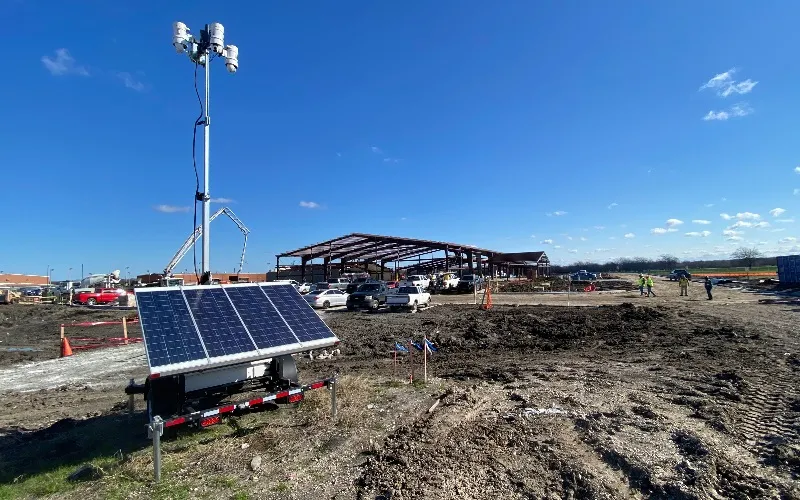
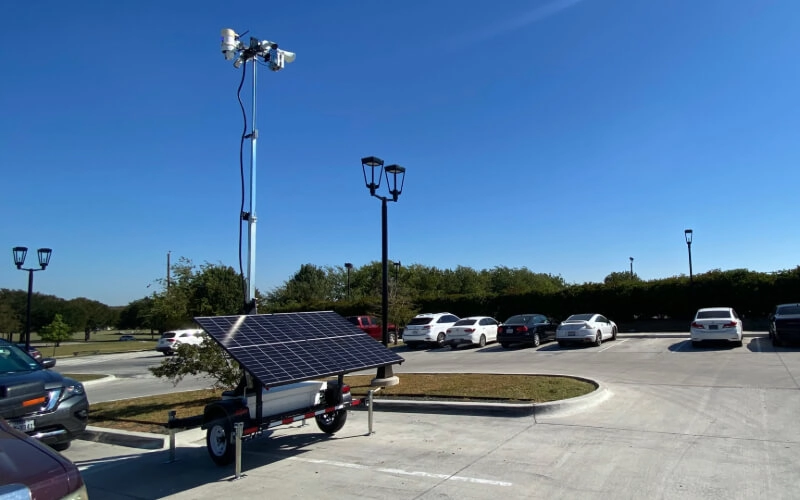
Environmental sensors are typically mounted on poles or perimeter fencing and positioned for continuous monitoring to catch accurate, real-time data. They are also commonly deployed on mobile surveillance trailers, especially in short-term or remote jobsite environments.
But how do project managers receive this information? The data collected is typically transmitted via secure 4G/5G networks. Project leaders can access this data through a dedicated app, such as Stellifii, our cloud-based platform, allowing them to track conditions across dynamic construction environments and quickly respond to developing risks.
The Benefits of Construction Environmental Sensors
Let's explore the major benefits that real-time monitoring of environmental data brings:
Air Quality Sensors
Air monitoring sensor systems provide:
-
Vital protection of your crew. According to the CDC, over 12,000 US workers die annually from respiratory diseases caused by hazardous airborne exposure at work.
-
Real-time alerts when pollutant levels are breached.
-
Automated logs to support your compliance audits and ESG efforts.
-
Audit-ready compliance with EPA/OSHA standards.
-
Support for Net Zero sustainability goals.
Read more: Air Quality Data Management: Turning Sensor Data Into Actionable Insights for Jobsites
Noise Sensors
Construction projects that manage noise levels vigilantly benefit from:
-
Real-time alerts for noise violations (e.g., spikes from machinery or blasting).
-
Protection of your workers' hearing.
-
Automated logs that simplify your compliance audits and reporting.
-
Compliance with local noise regulations and OSHA/EPA standards.
-
Better community relations by managing and minimizing disturbances.
Weather Monitoring
Monitoring and preparing for unfavorable weather keeps you a step ahead, through:
-
Early detection of dangerous incoming conditions (e.g., high winds, heatwaves, etc.)
-
Improved planning and scheduling by working around weather disruptions.
-
Safeguarding your crews from extreme conditions.
-
Avoiding costly Department of Labor (DOL) investigations and penalties.
-
Time-stamped records for compliance, insurance claims, and incident documentation.
-
Less downtime.
Who should use smart environmental sensors?
Environmental monitoring is hugely beneficial to operations such as:
-
Construction/industrial environments
-
Public and infrastructure works
-
Demolition projects
-
Critical infrastructure sites
-
Highway maintenance
-
Mining and extraction operations
-
Environmental and emergency agencies
Read more: Benefits of Mobile Surveillance for Construction Jobsite Security
Why Integrated Real-Time Monitoring Systems Matter in US Construction
The most successful construction firms combine security and environmental monitoring solutions into a single platform. Stellifii seamlessly consolidates all critical jobsite data for noise, air quality (dust/particulates), and weather into a single interface with real-time visibility.
This data integration goes even further by incorporating smart detection systems with in-built [AI-video analytics] to detect PPE non-compliance, smoke and fire, and intrusions, giving you a near-360° view of construction jobsite safety across every corner of your operations.
This matters because information from every sensor across every jobsite flows into one unified dashboard, giving construction managers comprehensive oversight without switching between multiple vendors and tools.
Enhanced project efficiency and productivity
-
Complete remote visibility: Managers can see what’s happening across all their jobsites. You can easily access whatever you need from your phone, in your office, truck, or home. There's no need to visit projects physically or rely on a foreman or site clerk's reports (which might be delayed or inconsistent).
-
Proactive alerts: Instead of waiting for a crew member to call you when a noise or dust limit is breached, or worse, an EPA inspector drops in, Stellifii automatically sends a notification to management teams responsible for handling the situation, ensuring quick corrective action.
-
Reduced travel time: Stellifii saves you hours of travel time every week since there's no longer a need for manual spot checks.
Automated compliance and reporting
In the US, where regulations around air quality, noise, and jobsite safety continue tightening, integrated monitoring systems help contractors stay ahead of compliance requirements.
-
Unified stakeholder communication: Stellifii provides clear dashboards, actionable reports, and video evidence all in one place. This shows authorities like the municipal permitting office or the state EPA regulator that you are on top of due diligence. Current, accurate reports on construction activities ensure you're managing jobsites proactively, not reactively, building confidence among stakeholders and clients.
-
Evidence-based audits: Every reading is automatically logged, time-stamped, AES256 encrypted, and stored in Stellifii, so when a regulator asks for an air quality report for a specific date, you can pull it with a click or two.
Read more: The Future of Construction Security: From Guards to AI-Powered Smart Systems
Better decision-making
-
Better data relationships: Monitoring systems that are connected show crucial intersections between all environmental elements. For example, if your dust level rises, the system shows you the wind speed and direction at that moment. This quickly tells you if the spike is operations-related or caused by external factors like gusting winds.
-
Big picture view: A unified real-time view supports better, faster evidence-based decisions and reduces the need for guesswork.
Maximizing ROI
Smart integrated construction jobsite monitoring delivers cost savings and efficiencies in numerous areas:
-
Consolidated and automated efficiency: One central platform means less switching between tools. With an automated system, you have all the info you need in a single interface.
-
Minimized downtime: Continuous data collection and real-time alerts enable rapid responses to manage challenges and keep projects on track.
-
Compliance without fines: Automated audit trails provide solid proof for regulators, demonstrating compliance and avoiding penalties.
-
Operational efficiency and sustainability: Linking weather with resource use optimizes water for dust suppression and energy for heating and cooling. This lowers costs while driving sustainability goals.
A 2021 McKinsey report projects IoT could unlock up to $12.6 trillion in value by 2030. In the construction industry, the key to capturing this lies in smart, connected systems that transform complex data into actionable insights. This creates efficiencies across resource management, construction safety, project performance, compliance, structural health monitoring, and optimal jobsite security.
Read more:
- Reduce Your Security Costs by 88% With WCCTV
- The Benefits of Integrating Your Security and Communications Systems
How to Integrate Environmental Monitoring on Construction Projects
Let’s discuss how to integrate an environmental sensor network successfully and address challenges that might arise.
Managing Challenges
Here are 4 challenges, together with smart approaches to help tackle them.
1. Upfront cost
Real-time environmental monitoring requires a sizable investment in hardware, software, implementation effort, and training. An obvious question is, will the returns justify the expense?
Actionable solution: Firstly, it's important to know the numbers. Then it helps to frame the cost as insurance against expensive future risks. For example, if investing $25,000 in environmental sensors prevents a potential $75,000 overrun, you have a strong business case.
2. System integration issues
Many projects rely on older, legacy systems that aren’t compatible with modern, cloud-based sensors.
Actionable solution: Go for US-specific monitoring partners that support smart integrations with cloud-based monitoring platforms like Stellifii.
3. User resistance
Jobsite crews and field managers may resist new tech because they feel it will complicate their lives.
Actionable solution: Aim to get staff buy-in early. Run training sessions to overcome fears about complexity and explain the direct benefit to their job (e.g., less manual logging of air pollution readings).
4. Security and data integrity risk
Real-time monitoring produces tons of project-critical environmental data. This raises valid concerns about cybersecurity and data integrity risks.
Actionable solution: Research and choose secure, cloud-based platforms that use strong encryption and strict access controls. Ensure sensor data is stored with backups and audit trails, helping to maintain integrity and compliance throughout the project and beyond.
Read more: Five Myths About Smart Systems Debunked
Practical implementation steps
Once you've worked through challenges and buy-in, here are 6 steps to implement the system:
Step #1: Conduct a jobsite environmental assessment
Map out the jobsite to identify the multiple sensor types required for each area. Pay particular attention to high-risk zones such as:
-
Excavation sites
-
Confined spaces
-
Site boundaries near residential zones
-
Demolition areas
-
Fuel/ chemical storage facilities
Step #2: Establish your jobsite connectivity requirements
Reliable connectivity is crucial to ensure your data delivers value. Modern temporary construction jobsites benefit from flexible, easy-to-deploy solutions that don't rely on fixed infrastructure or stable Wi-Fi.
Stellifii seamlessly connects over secure 4G/5G networks, providing instant access to HD footage and remote control of your entire surveillance system. This makes Stellifii-powered systems ideal for short-term or remote work sites, where rental options may be more beneficial.
Step #3: Choose high-quality sensors
Research and pick devices with:
-
High accuracy and support
-
Weatherproof housings
-
Long battery life or solar charging
-
Open APIs for integrations
Step #4: Optimize sensor placements
Position your sensors to avoid blind spots. For example:
-
Air quality sensors close to worker height
-
Noise sensors along the property lines
-
Weather stations in open, clear areas
Step #5: Training and adoption
Provide ongoing training as necessary to ensure your construction team can confidently:
-
Read dashboards
-
Understand alerts and their individual responsibilities
-
Make good operational decisions based on data
Monitor Jobsites the Smart Way with WCCTV
Integrating environmental monitoring sensors on construction jobsites helps companies operate more efficiently and responsibly, giving them a competitive edge.
The best modern construction practices emphasize tracking environmental conditions with smart connected systems. From air quality to noise control and weather, an integrated network provides the real-time environmental insights you need to protect workers, meet compliance obligations, and deliver projects on schedule and within budget.
To get eyes on every site and make crucial decisions about environmental impacts directly from your phone, contact WCCTV today.