License Plate Recognition (LPR) systems help control jobsite access, while surveillance cameras monitor jobsite activity and deter intruders. Since these two functions are closely linked, they should be connected. But the reality is they often work completely separately, leaving critical visibility and control gaps.
Traditional surveillance may capture general activity but lacks the intelligence to track specific vehicles. A basic LPR system records a truck entering and exiting, but misses that it accessed a restricted zone and almost collided with crew members. This fragmented approach means you're always working with incomplete information, which makes it nearly impossible to stay ahead of incidents.
When you combine surveillance with AI‑driven LPR tracking, you expand jobsite visibility, gaining advanced intelligence to protect your assets and create a much safer operational environment. In this article, we explore how integrated surveillance and LPR keep jobsites secure and compliant, allowing leaders to focus on their core mission: delivering successful projects.
The Components of Integrated Security and Access Control
An integrated surveillance solution connects video monitoring with automated vehicle tracking to create a fuller, timestamped record of jobsite activity.
The core pillars of the system are:
-
Security cameras covering entry points, perimeters, restricted zones, and key sectors
-
Specialized LPR cameras capturing vehicle license plate data on entry and exit (and in designated zones)
-
A centralized platform bringing all data feeds together
-
Secure, cloud-based storage for easy access and viewing
Here's a high-level summary of the surveillance and LPR system.
|
Function |
What It Does |
Operational Benefits |
|
Uses HD cameras paired with video analytics to accurately identify security threats such as perimeter breaches and unauthorized entry, while filtering out false triggers caused by wildlife and weather conditions. Suitable for temporary or semi-permanent environments. Delivers near-instant threat notifications to your chosen contacts and remote monitoring partners. Comprehensive reports log every risk event and the corresponding response, giving stakeholders clear evidence of your security practices. |
Protects assets and deters trespassing 24/7; it offers more extensive coverage than existing security systems (e.g., guard patrols). Detailed reports record all risk incidents and responses, demonstrating your security measures to stakeholders. Provides evidence for reporting, investigations, security reviews, and insurance issues. |
|
|
LPR technology accurately reads vehicle license plate information using AI-assisted imaging and logs every vehicle entering and exiting jobsites. Note: LPR systems cover all wheeled vehicles and jobsite equipment such as cars, delivery vans, trucks, loaders, concrete mixers, etc. |
Improves access control and parking management and blocks unauthorized vehicles. Creates accountability for vehicle operators and encourages safer driving on jobsites. Strengthens security protocols, assists law enforcement agencies and other investigations, and provides transparent audit trails for compliance. |
|
|
Cameras feed directly into a professional monitoring center where specialist operators review alerts of unauthorized activity and respond immediately. Response options include:
|
Stops crime and theft before losses occur. Controls vehicle access and prevents unauthorized entry at gates and checkpoints. Reduces the likelihood of asset losses and helps lower the volume of insurance claims. |
Working together, these connected technologies provide the visibility that helps organizations manage vehicle movements and safeguard equipment, materials, metals, and other assets 24/7.
Our surveillance and LPR systems are connected to a Live Video Monitoring control center, where trained specialists react to threat alerts and intervene swiftly. A voice-down challenge from the control center is shown to deter around 90% of intruders.
A central platform: To host large volumes of data from multiple jobsites, a central platform has become an essential tool.
Our secure, cloud-based platform, Stellifii, brings all feeds from LPR and surveillance cameras into a single interface, providing you with alerts and insights to guide the best response to events on the ground.
You and your managers can view real-time (and historical) LPR and security footage from your phone or desktop, whether you're in the office, traveling, or on-site.
Read more: Stellifii: Our New Smart Platform Transforming Surveillance, Safety, and Compliance
How Integrated License Plate and Surveillance Systems Operate
Let's look at how integrated surveillance and LPR setups work to strengthen access control and security efforts.
Surveillance networks
Security surveillance networks deploy advanced PTZ (Pan-Tilt-Zoom) cameras that record high-resolution images of activity on and around the jobsite, usually covering the entrance, perimeters, and high-risk zones. The cameras have built-in AI video analytics that use machine learning to identify risks based on motion and behaviour analysis.
The AI is trained on thousands of video examples to recognize risks and flag them faster and more consistently than human monitoring.
Operating continuously across shifts and different lighting conditions, these surveillance setups give owners and managers complete real-time visibility into all threats across multiple sites. For compliance and investigation purposes, the system retains a video-supported record of events for as long as required.
Key features include:
-
Infrared (IR) illumination and night vision technology for clear image capture in low-light or nighttime conditions.
-
AI-powered analytics to quickly and accurately detect security issues.
-
Machine learning that filters out false alarms such as animals, weather, debris, shadows, and blowing tarps and sheets.
-
Immediate automated alerts of suspicious and criminal activity.
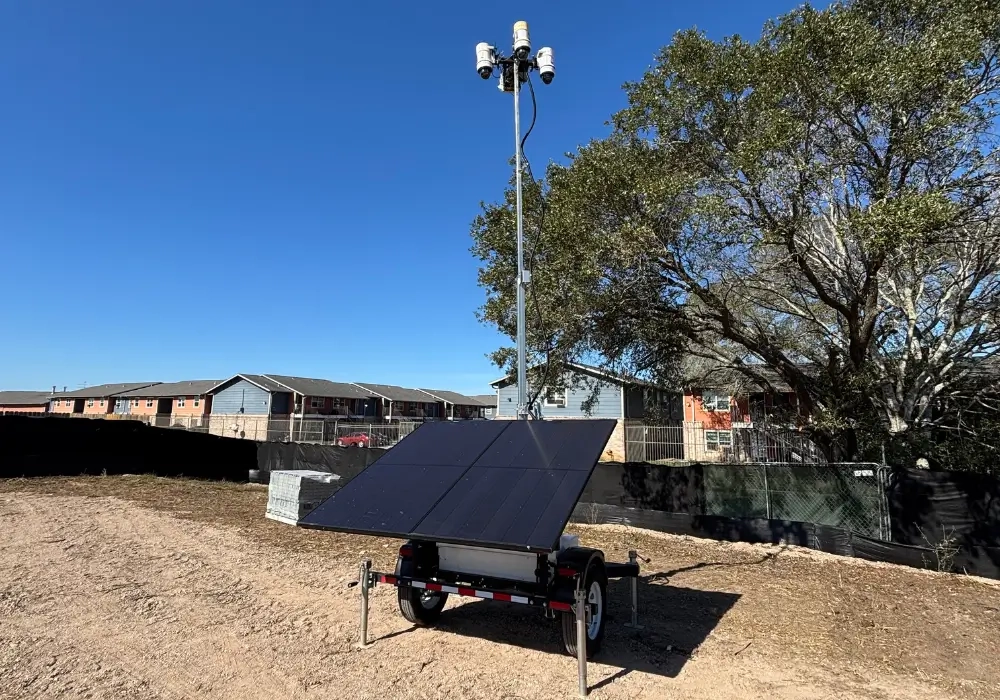
Cameras can be rapidly deployed on mobile platforms, such as our Mobile Solar Surveillance Trailers that are purpose-built for deployment in dynamic construction environments. These adaptable monitoring units require no site power or internet, and include the following features and capabilities:
-
Solar powered: Solar panels with battery backup make them ideal for locations with limited grid infrastructure.
-
Rapid deployment: Trailers are rapidly and easily deployed. They can also be conveniently moved around the jobsite as the project progresses.
-
Cellular connectivity: 4G/5G connectivity supports the video feed in areas with limited or no internet.
Read more: Why Smart Surveillance Systems Are the Future of Business Security
Licence Plate Recognition
License Plate Recognition systems automatically capture and log vehicle registration plates using AI-assisted imaging, reading plates in all weather and lighting conditions, at speeds up to 130 mph.
Key features of LPR technology include:
-
PTZ cameras with infrared and night vision technology
-
Vehicle recognition by license plate, make, model, and color
-
AI-assisted imaging for accurate and efficient license plate recognition and logging
-
Cross-referencing, which instantly matches license plates against authorized vehicle lists, warning/restricted lists, and stolen vehicle databases
-
Automated alerts that notify security personnel as soon as suspicious vehicles or anomalies are spotted
Read more: The Future of Construction Security: From Guards to AI-Powered Smart Systems
Why Integration Matters
Standalone security installations capture footage, while basic vehicle tracking systems log license plates, often on paper forms. Without integration, you must piece together information and manually cross-check timings to compile the full picture. Those information and visibility gaps mean crucial connections between vehicle identification and incidents are often missed.
Tracking security and vehicle incidents together delivers deeper, richer intelligence:
-
Accurate vehicle identification with timestamped logs and alerts
-
Clear visual evidence of driver behavior and footage of any incidents (recorded in high definition from up to 600 feet away)
Integration via Stellifii enables you to handle law enforcement investigations, insurance claims, reports, and audits in one system. Instead of trying to patch together information from scattered files, you have all the documentation you need, clearly organized in a central hub.
Unified platform integration
The Stellifii platform consolidates vital real-time information from your surveillance and LPR feeds into smart dashboards, allowing managers and monitoring partners to:
-
Instantly access notifications of developing security and vehicle issues
-
Respond faster to these risks, limiting the fallout
-
Compare trends and security/compliance performance across jobsites
The platform's cloud technology enables remote access from anywhere on mobile or desktop. Secure storage, including AES-256 end-to-end encryption, safeguards all data against breaches, while cloud backup protects your records against disaster events such as fires, floods, riots, and earthquakes. The system components are NDAA-compliant, making Stellifii suitable for use on federal contracts.
It's estimated that 30% of total IT spending now goes toward the cloud, highlighting the increasing adoption of this cost-efficient, super-flexible technology.
Integrating other safety and compliance tools
With your surveillance network running through Stellifii, you have the foundation to connect other monitoring tools. This offers comprehensive jobsite safety and compliance oversight, typically including:
-
Smoke and Fire Detection: Cameras with analytics detect smoke or fire hazards early, allowing leaders to respond rapidly before the fire can spread and cause damage.
-
PPE Detection: Uses AI-video analytics to spot and flag missing PPE (hard hats, high-visibility vests, safety boots, goggles, respirator masks). Smart detection and alerts give managers strong oversight of this critical compliance area.
-
Air Quality Monitoring: IoT sensors with connected cameras measure dust, CO, VOCs, and other airborne hazards to safeguard crews and meet regulatory obligations.
-
Weather Monitoring: Delivers continuous weather data (temperatures, humidity, rainfall, wind speed/direction) to enable leaders to prepare for dangerous weather and adjust workflows to avoid risks while staying on schedule.
-
Noise Monitoring: Continuously measures and records jobsite sound levels to protect workers' hearing and comply with noise ordinances.
Read more:
How Integrated License Plate Recognition and Surveillance Protect Your Jobsite
Let's explore how leveraging license plate recognition technology and surveillance improves security and reporting.
Reduces theft and unauthorized activity
The US construction industry loses over a billion dollars each year to crime and related work disruptions. A well-controlled jobsite with proactive security measures makes you a harder target for criminals and vandals.
-
Visible vigilance: Visibly monitored entry and exit points discourage opportunistic theft and signal that the area is safeguarded, acting as a strong deterrent to criminals.
-
Linking vehicles to incidents: When something goes missing or an issue arises, you have a record of all vehicles on-site at the time. You can cross-reference timestamped footage with license plate data to develop a timeline and picture of events.
-
Faster investigations: You can filter by time, date, location, or vehicle details to find relevant records and resolve issues in minutes rather than hours (downloaded footage with metadata is available in seconds).
Improves access control
By eliminating manual workflows, License Plate Recognition makes access a smoother, more efficient process. Crucially, automation ensures that vital details aren't missed or recorded incorrectly.
-
Automated vehicle ID: The system identifies and logs every vehicle moving in and out of the jobsite, applying access rules that help smooth traffic flows.
-
Smart access management: Pre-approved lists allow quick entry for authorized vehicles such as company machinery and approved delivery vehicles. Unknown vehicles trigger real-time alerts, requiring verification checks.
-
Support for multi-site operations: For project managers overseeing several jobsites, one platform provides centralized oversight across all locations. Standardized processes reduce variation, keeping teams aligned and working from the same information.
Supports compliance and claims
Consistent and organized data collection builds strong evidence-backed records to assist regulator and insurer inquiries.
-
Timestamped entry and exit logs. Accurate, automated records provide clear documentation of jobsite activity, supporting audits and regulatory inquiries.
-
Strengthening insurance claims: When incidents occur, timestamped evidence reduces disputes with insurers and speeds up the claims process, producing better, fairer outcomes.
-
Stakeholder reporting: Detailed reports can be shared with owners, clients, investors, and other stakeholders as evidence of well-organized processes, inspiring trust in your abilities and professionalism.
Read more:
-
Why Smart Surveillance Systems Are the Future of Business Security
-
The Benefits of Integrating Your Security and Communications Systems
5 Business Benefits of Integrated Jobsite Tracking Solutions
This is how you'll benefit from connected jobsite surveillance, LPR, and monitoring:
-
Less tool switching: A centralized platform reduces tool-switching and vendor sprawl, largely eliminating the inefficiencies of searching for fragmented information, which can waste 10% each week.
-
Consistent reporting: Reporting is consistent across all projects because every jobsite uses the same unified approach. This makes it easier to compare security performance, track trends, manage compliance, and report meaningfully to stakeholders.
-
Easy scaling: The system employs flexible infrastructure and scalable cloud computing, meaning additional surveillance can be deployed within hours, and elastic cloud storage can be expanded seamlessly as your projects grow.
-
Improved efficiencies: Unified systems drive operational efficiency and ROI by reducing administration, travel, and vendor licenses, lowering incident rates, and boosting productivity. Some firms reduce security costs by up to 88% through smart integrations.
-
Stronger compliance: As mentioned, Stellifii can connect PPE, fire, and environmental monitoring tools to manage regulatory standards, such as:
-
OSHA and EPA noise and air pollution limits
-
Heat exposure expectations in line with OSHA's Heat NEP
Read more:
-
Construction Jobsite Compliance Failures and Lessons Learned
-
Air Quality Data Management: Turning Sensor Data Into Actionable Insights for Jobsites
Secure Your Jobsites the Smart Way
Advanced surveillance integrated with License Plate Recognition delivers comprehensive vehicle tracking and real-time security monitoring.
These future-ready solutions operate 24/7 to ensure teams can respond swiftly to rising security threats and meet reporting requirements confidently.
Secure your jobsite the smart way and gain the peace of mind that comes with a safe, well-controlled work environment. Connect with us today to discover how our integrated solutions can upgrade your security measures and access control.