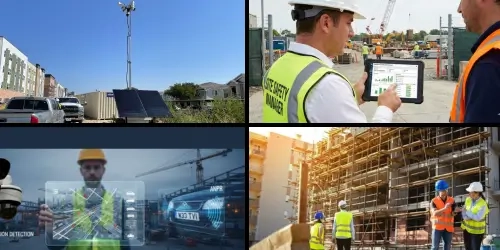
Managing complex, high-stakes infrastructure projects demands experience and expertise, but also full visibility into events on the ground everywhere.
Leaders who demonstrate command of safety, environmental standards, and jobsite security through integrated monitoring inspire trust with all parties involved, from their crews to public agencies.
Integrated monitoring provides a holistic view of project activities. It combines multiple technologies into one platform for faster, more precise oversight of all movement. It delivers the real-time reporting and risk management that funders and regulators expect as proof of professional control.
This article breaks down integrated monitoring systems, explaining their components and how they help companies win infrastructure projects and deliver success in high-pressure, multi-site build environments.
What Makes Complex US Infrastructure Projects So Complex?
US infrastructure projects are demanding and high-pressure commitments. The scale, stakes, environmental concerns, and regulatory scrutiny leave little room for error.
Let’s look at the forces and influences that project managers (PMs) must manage on major builds.
Multiple stakeholders and funding sources
Infrastructure projects often involve a mix of key stakeholders, each with their own priorities and interests. These might include:
-
Federal authorities
-
State and local agencies
-
Private investors
-
Designated subcontractors and vendors
Public funding may come with strict oversight, while private investment demands efficiency and return. Public–private partnerships (P3s) require a skillful balancing of these priorities.
Reporting requirements vary across stakeholders, making communication gaps and misunderstandings inevitable without tight project control.
Strict safety and regulatory compliance
Infrastructure projects must meet rigorous safety and operational standards.
-
For starters, companies bidding for federal contracts must satisfy NDAA requirements. The NDAA (National Defense Authorization Act) prohibits certain foreign-made materials and technologies in government projects.
-
Contractors in California must comply with the CPRA (California Privacy Rights Act), which regulates how organizations collect personal information in the State.
-
OSHA (Occupational Safety and Health Administration) officials can visit your jobsite at any time to check on the following (and more):
-
PPE standards: Employers are expected to provide employees with proper personal protective equipment.
-
Hazard Communication (HazCom): Hazardous materials must be labeled, and workers must be trained about the dangers of the chemicals they work with.
-
Fall Protection: Requires fall prevention equipment and safety practices when working at heights of 6 ft+ above a lower level.
-
Jobsite noise and air pollutant monitoring and incident reporting.
-
Maintaining consistent regulatory standards across multiple sites and contractors is an ongoing challenge. Without effective monitoring tools and accurate up-to-date data and reports, proving compliance when inspectors arrive can be tricky. OSHA conducts nearly 35,000 workplace inspections every year and usually arrives at your site unannounced, so you should always be prepared.
Read more:
Environmental and community considerations
Infrastructure projects are increasingly affected by environmental laws and community impact concerns. Regulations within the Clean Water Act (CWA), Clean Air Act (CAA), and Toxic Substances Control Act (TSCA) may apply to the project, requiring contractors to monitor and manage:
-
Air quality, noise levels, and emissions
-
Water usage and environmental disruption
-
Working hours, traffic impact, and community disturbance
These obligations are tied to permits and ordinances (often enforced by State and local government agencies). Companies can't ignore the impact of their activities on the surrounding neighborhood. Formal complaints from the local community have seen many jobsites shut down, seriously derailing project timelines.
The message is clear: No infrastructure undertaking can afford to ignore its obligations to employees and the public without jeopardizing the company's reputation and profitability (through fines, delays, malicious damage, lawsuits, and other liabilities).
Read more: Air Quality Data Management: Turning Sensor Data Into Actionable Insights for Jobsites
Multi-site, high-value operations
Many infrastructure projects span several locations and different phases running simultaneously under tight deadlines.
Coordinating teams and workflows across jobsites and protecting high-value materials and assets is hugely challenging without unified systems and eyes on the ground everywhere
A few seemingly minor issues, such as a subcontractor delay, rework, or the theft of vital equipment, can quickly add up to substantial losses.
What is an Integrated Monitoring System?
Integrated monitoring is the unification of video surveillance, IoT sensors, and environmental tracking into a single smart oversight platform. With centralized dashboards, AI-driven analytics, and real-time reporting, this integrated system supercharges project monitoring and management.
Here's an overview of the key components.
|
Component |
Description |
Role in the Integrated Platform |
|
Video Surveillance |
Advanced cameras capture live footage of infrastructure and construction jobsites. |
Provides visual oversight and evidence for safety/security. |
|
AI-Powered Analytics |
Machine learning algorithms process video and sensor data to detect anomalies, predict risks, and generate actionable insights. |
This critical component transforms raw monitoring data into valuable intelligence, reducing human error and manual analysis. |
|
IoT Sensors |
IoT-enabled devices measure noise, air quality, temperature, and other weather conditions. |
Collects and transmits environmental data into dashboards, providing real-time risk insights. |
|
Central Dashboards and Reporting Tools |
Unified interface consolidating all monitoring data. |
Enables decision-making, trend analysis, and compliance reporting. |
By connecting and aligning systems with a central platform, you solve the problems of siloed data and fragmented information that break down communication and trust.
Stellifii is our trusted cloud platform for managing large, dynamic construction projects. It turns all jobsite data streams - noise, contaminants, PPE, and security - into a single point of control, viewable on your phone.
For firms pursuing government-funded contracts, the platform is NDAA-compliant and boasts enterprise-grade AES-256 end-to-end encryption to secure sensitive project data.
Read more: Stellifii: Our New Smart Platform Transforming Surveillance, Safety, and Compliance
8 Ways Integrated Monitoring Helps Win Infrastructure Projects
Let's explore how connected monitoring gives contractors a competitive edge on infrastructure projects and bidding.
1. Real-time visibility across all sites
Integrated monitoring brings live data, including video feeds, environmental sensors, access logs, and security statuses, into a unified platform. Instead of relying on delayed reports or irregular updates, leaders can view jobsite conditions on their phones in real time.
Comprehensive visibility allows you to target potential issues before they escalate into delays or accidents. Real-time jobsite insights help you make informed up-to-the-minute decisions and coordinate teams more effectively and productively.
2. Stronger site safety and risk management
Connected monitoring streamlines risk management, making this critical function more dynamic and proactive. When tools detect risks (missing PPE, unsafe weather conditions, etc.), they auto-generate instant alerts, enabling a near-immediate response.
Faster reactions mean fewer injuries and incidents, and agile problem-solving keeps projects on schedule and budget, shielding PMs from stakeholder pressure.
24/7 monitoring also uncovers concerning trends, like weak subcontractor supervision on a high-risk task. These precise insights inform targeted corrective actions to mitigate risks and drive a continuous improvement in site safety culture.
3. Improved workflow and team alignment
Ensuring all teams are working from the same schedules and site realities is mission-critical in high-stakes multi-location builds.
By combining live monitoring with a digital project management system, teams have centralized access to plans, schedules, specifications, and real-time updates. This ensures:
- Fewer errors and rework: Live updates and visibility reduce the risks of crews acting on outdated instructions and plans.
- Higher quality standards: Coordinated monitoring enforces compliance and accountability across the project.
Together, integrated monitoring and project management systems strengthen jobsite controls and boost collaboration, coordination, quality, and performance.
4. Stakeholder trust
Unified monitoring demonstrates proactive leadership and fosters stakeholder trust. Consistent communication ensures all parties involved see the same information, enabling stakeholders to track the latest developments and stay apprised of progress.
Clear, transparent reporting minimizes misunderstandings, disputes, tensions, and potential contractual issues. When you can quickly provide an owner with detailed records and video footage of a safety/ regulatory issue they're questioning, it tells them you're firmly on top of things.
5. Stronger compliance
Continuous compliance oversight positions contractors to manage all risks affecting workers, while environmental monitoring limits the effects of noise and pollutants on the surrounding community. This demonstrates care and social responsibility and protects your company from social media attacks and other negativity.
Bid assessors often want to see your commitment to Environmental, Social, and Governance (ESG) initiatives, and compliance tools provide the evidence.
Our advanced monitoring technologies that help you here include:
-
Air Quality Monitoring sensors with connected cameras track fine particulate matter (PM1, PM2.5, PM10), VOCs, and CO to safeguard crews and meet regulatory standards.
-
Noise Monitoring devices continuously measure and record jobsite sound levels to protect workers' hearing and meet noise ordinances. Data records and automated reports demonstrate compliance efforts.
-
Weather Monitoring stations track live weather data (temperatures, humidity, rainfall, wind speed/direction) to enable leaders to prepare for weather risks and avoid infrastructure damage or workforce injuries.
-
Smoke and Fire Detection alerts you near-instantly to smoke and flame indicators before fires can cause damage, and logs incident reports for compliance purposes.
-
PPE Monitoring and Detection spots and flags missing PPE (hard hats, high-visibility vests, safety boots, goggles, respirator masks), to enforce and prove safety compliance.
Read more:
6. Better decision-making and problem-solving
Proactive activity tracking and data-backed evidence drive better, faster project decisions. What used to feel like frantic firefighting now becomes calculated strategizing.
For example, 54% of leaders find PPE compliance a challenge. Capturing PPE data and analyzing the insights can lead to a solution (say, live audio warnings to non-compliant workers) that delivers dramatic improvement, meaning jobs are no longer delayed due to missing protective gear.
Tracking and analyzing data turns jobsite activity into measurable performance by linking live information to clear KPIs. Teams can meaningfully manage metrics such as productivity, safety incidents, equipment uptime, and environmental compliance.
7. Reduced theft and crime problems
Theft and vandalism are a billion-dollar-a-year headache for the US construction industry. Infrastructure bid assessors want assurances and evidence that you can safeguard your jobsites against crime-related disruptions.
Our smart surveillance systems retain timestamped data and reports from your previous projects, helping prove security measures to authorities and other stakeholders.
-
Security surveillance: High-definition infrared camera networks scan perimeters and designated zones 24/7. Our mobile security solutions are conveniently deployed as temporary installations or on versatile, solar-powered Mobile Surveillance Trailers. Running on renewable energy, these units are a plus factor in contracts prioritizing sustainable
-
Intrusion Detection Systems: Smart detection powered by AI protects your jobsites and assets around the clock against breaches, theft, vandalism, and trespassing.
-
License Plate Recognition (LPR): LPR systems with AI imaging monitor all vehicles on site (including wheeled equipment/machinery), preventing unauthorized access and improving asset control and traffic flow.
-
Live Video Monitoring: Remote monitoring professionals respond in seconds to security threats, deterring up to 90% of crime with an audio voice down
Read more:
8. Solid compliance documentation
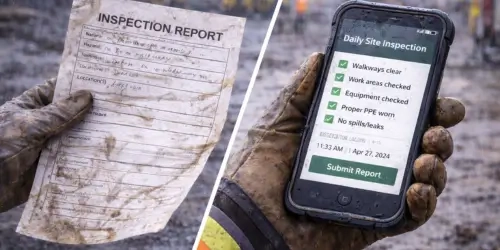
Monitoring systems provide a reliable record of compliance documentation, ensuring you're always audit-ready. Instead of searching scattered files for records, you can pull comprehensive reports on environmental compliance, PPE adherence, and security checks at the touch of a button.
If an inspector investigates an environmental issue that occurred two months ago, you can quickly produce a timestamped sensor reading linked to the corrective action you took.
This demonstrates to authorities that you adhere to sound safety protocols and are committed to enforcing regulatory rules in the workplace.
How Smart Monitoring Drives Project Efficiencies and Scale
Connected monitoring not only provides more data and smarter oversight to enhance operations, but it also delivers economies that can accelerate business growth. Here's how.
Operational efficiencies
A key benefit of streamlined operations is efficiency gains.
-
Reduced tool switching: Unifying all surveillance and monitoring into a single platform eliminates multiple vendor licenses and system switching, which costs up to 10% of each workweek.
-
Data-driven decision making: Centralized data insights help managers to track progress and coordinate teams and workflows to reduce bottlenecks, delays, and costly rework. Data quality and accuracy improve over the project lifecycle, becoming more valuable, even supporting predictive analytics.
-
AI-enhanced productivity: According to a recent Bloomfire/Harvard Business Review report, well-organized information and AI insights can improve speed and efficiency by nearly 40%.
-
Scalable operations: Smart systems allow companies to expand safety and security coverage with fewer compliance and security personnel, effectively achieving more with less.
Growth opportunities
-
Enhanced reputation: Standout project performance builds trust and reputation, positioning firms as reliable partners and opening doors to new contracts.
-
Stakeholder confidence and investment: Reliable documentation and compliance records reassure owners, clients, and authorities, inspiring confidence and attracting potential investors.
-
Cost savings toward growth: Some construction firms have reduced security bills by up to 88% by streamlining security, freeing capital for reinvestment in growth efforts.
Read more: How Can Construction Jobsites Adapt To Digital Transformation
Gain Smart Control and Ensure Safety on Infrastructure Projects
Future-focused US construction firms increasingly adopt cost-effective smart technology to win and run large infrastructure projects.
These modern solutions deliver real-time integrated monitoring, mobile-friendly access, and unified dashboards, allowing PMs to control events from a central command center. AI-powered detection and reporting provide you with the data you need to make informed decisions at every stage of the build, around every risk area.
Comprehensive oversight and compliance demonstrate professionalism and risk control to public agencies and assessors, and strengthen bids. To implement smart monitoring and scale project success, contact us before your next infrastructure undertaking.