On top of managing jobsite safety and keeping high-pressure projects on schedule, construction superintendents are expected to oversee and enforce OSHA compliance requirements.
As the country's chief workplace safety regulator, the Occupational Safety and Health Administration (OSHA) enforces multiple compliance standards in the construction industry. Project leaders are tasked with managing noise levels, safety equipment protocols, heat hazards, air contaminants, and many other jobsite risks, but relying on physical inspections and manual records isn't sufficient to cover all your bases.
Our article explains why traditional safety methods fail and how modern monitoring tools strengthen and simplify compliance management. We look at how AI detection, timestamped evidence, automatic alerts, and complete incident reports provide stronger documentation and ease your regulatory admin.
Challenges and Weaknesses When Managing OSHA Compliance
Traditional compliance approaches leave oversight gaps that expose site leaders to OSHA penalties and other liabilities, including potential lawsuits. It’s worth noting that individual managers can be held personally liable for workplace injuries if they're found to be negligent in carrying out their oversight obligations.
Let's walk through 5 challenges and common blind spots in workplace safety conditions:
- Non-compliance when managers are absent: When a superintendent is present or when inspections are underway, crews make sure to wear their PPE and follow the correct protocols.
But when a superintendent leaves the site, some crew members may be less diligent about adhering to rules. That gap between supervised behavior and what actually happens when nobody is looking creates an inaccurate picture of safety compliance because it only reflects behavior under direct observation.
- Time gaps: An OSHA standard check first thing in the morning, like measuring hazardous dust levels, doesn't protect you if an incident occurs in the afternoon.
Capturing a snapshot of site conditions demonstrates compliance at that moment, but if long periods go unmonitored, the risk is effectively unmanaged. In investigations or insurance claims, these gaps weaken your position because project inspection reports can't prove due diligence at all times.
-
Large site challenges: On large or complex jobsites, conditions evolve faster than a manager can walk from one end to the other. By the time you finish checking one area, the situation at your starting point may have changed. This means you are constantly chasing updates rather than controlling risks.
-
Data silos: Oversight involving paper logs and spreadsheets often buries critical information, making it difficult to spot recurring problems. If you can't see the full picture, you miss trends, like a subcontractor repeatedly ignoring PPE rules. This makes it harder to address root causes before they escalate into accidents and damage.
-
Inconsistent standards: Different contractors, crews, and managers often document and enforce OSHA standards in different ways. Reporting varies depending on who is in charge, which creates blind spots and uneven accountability.
Without consistent standards across teams, your compliance processes are flawed and uneven. As a result, it's difficult to build the strong, unified safety culture that good contractors aspire to.
Read more: How Reporting Automation Protects Personal Accountability
9 Key OSHA Safety Priorities and How Smart Monitoring Helps Manage Them
We spotlight 9 important OSHA safety priorities in construction and how AI-powered monitoring helps you keep on top of them.
1. Fall protection (OSHA 1926 Subpart M and additional standards)
Falls are one of the leading causes of construction fatalities and severe injuries. Based on the latest data, 421 out of 1,075 deaths (39.2%) in 2023 were due to falls, slips, and trips. To address this major jobsite safety risk, OSHA requirements address:
-
Proper and safe erection and maintenance of scaffolding (451)
-
Secure and proper use of all ladders on construction sites (OSHA standard 1053)
-
Subpart M regulations require safety equipment (harnesses, guardrails) and safe practices when working at heights of 6 ft+ above a lower level
Fall protection training and ongoing enforcement of OSHA regulations reduce fall accidents and injuries. However, it's physically impossible for superintendents to continuously monitor every elevated work area, especially on large and/or multi-level builds.
How jobsite surveillance makes fall prevention compliance easier
Smart surveillance cameras that operate in all light conditions capture clear HD footage of your jobsite and transmit it using cellular networks. Managers can view live video feeds through a secure platform from any device. With remote access, you can identify unsafe behaviors immediately and intervene before accidents happen.
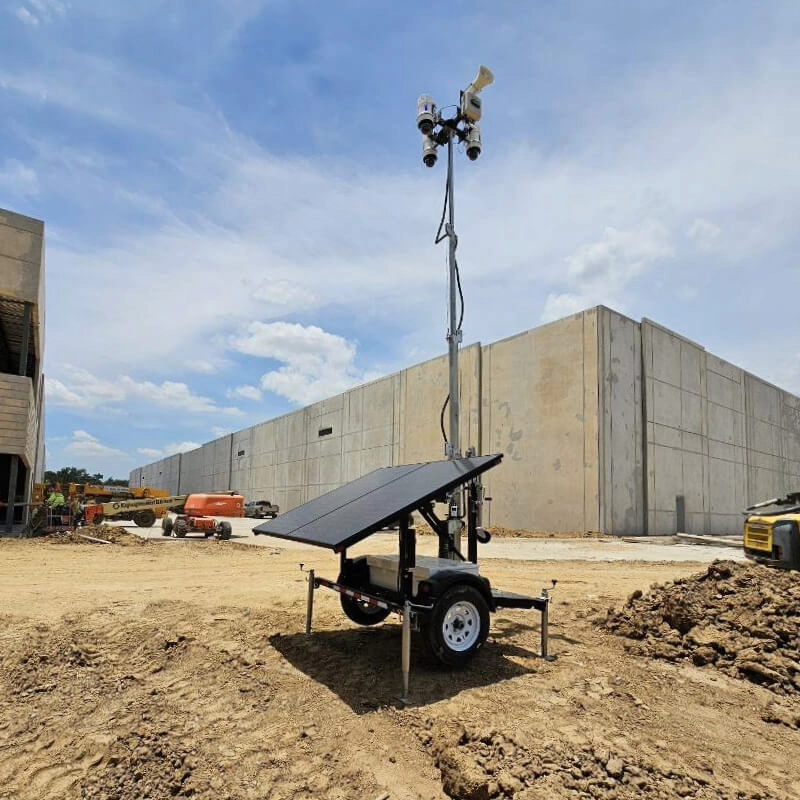
Our surveillance systems are used by law enforcement and designed to be deployed quickly, moved easily, and operated remotely. Many companies employ our highly versatile Mobile Solar Surveillance Trailers to safeguard their projects, especially remote and temporary sites. Powered by solar energy and battery storage, the trailers are fully autonomous, needing no power or internet infrastructure to operate.
All camera footage is securely stored, creating a consistent record of jobsite conditions and security events for investigations and compliance reporting.
2. Personal Protective Equipment (PPE) (OSHA 1926 Subpart E)
OSHA's PPE requirements under 1926 Subpart E are clear. To protect workers from serious physical harm (falls/falling objects, struck-by/caught-in-between accidents, and electrical hazards), crews must wear appropriate PPE in designated zones and when performing certain tasks.
Required personal protection equipment in project environments includes:
-
High-visibility clothing
-
Hard hats
-
Electrical hazard boots
-
Ear and eye protection
-
Respiratory masks
-
Face masks
-
Gloves
Documenting PPE standards in your jobsite Safety and Health program, providing relevant training, and displaying OSHA posters all encourage PPE adherence. However, these aren't enough without consistent, visible enforcement.
The reality is that non-compliance often happens when supervisors aren’t present, highlighting the need for constant oversight.
How PPE monitoring tools help ensure OSHA compliance
Our PPE Detection and Monitoring system checks for mandatory safety gear across the work areas and time periods you set up. Using AI analytics, the smart detection system alerts you to non-adherence in real-time, giving you the chance to take corrective action right away and keep your site within OSHA standards. Advanced setups can also issue live audio warnings to workers not wearing the required equipment.
All PPE incidents with video evidence are logged through our cloud-based safety management platform. It gives you verifiable evidence to address non-compliant crew members and demonstrates your safety protocols and practices to inspectors.
Read more: AI for PPE, Fire, and Intrusion Safety
3. Noise hazards (OSHA 1926.52)
Construction noise exposure must be strictly monitored and controlled to limit workplace injuries ranging from tinnitus and temporary deafness to long-term hearing loss.
While no authority expects you to run a workplace free of reasonable operational sound volumes, OSHA's standard 1926.52 sets decibel limits that workers can legally be exposed to.
Important thresholds under this regulation include:
-
90 Decibels averaged for 8 hours
-
100 dB averaged for no more than 2 hours
-
105 dB averaged for no more than 1 hour
Measuring sound levels via spot checks (even hourly tracking) is completely inadequate to control this workplace hazard. Noise fluctuates widely and constantly, depending on activity and equipment use. The acoustic profile of a crew cutting steel is nothing like the profile of a team doing electrical work, and those transitions can happen in a matter of minutes.
How noise monitoring sensors make it easier to stay OSHA compliant
Our IoT Noise Monitoring Sensors with connected cameras continuously track jobsite sound levels across 30-130 Decibels and 20Hz to 12.5kHz frequency, complying with both OSHA and federal noise standards. By using live, accurate data to control site sound levels, you avoid complaints and compliance issues while protecting workers and project timelines.
Besides providing 24/7 readings and instant alerts, the platform also retains a timestamped record of all incidents to assist OSHA inspections.
Read more: Smart Noise Monitoring: Protecting Workers and Staying OSHA-Compliant at Your Jobsite
4. Heat exposure (OSHA's National Emphasis Program NEP for Heat Hazards)
Heat illness is an increasing health and safety concern, particularly on exposed sites and in southern states as summer temperatures soar. Excessive heat exposure causes exhaustion, dehydration, and heat stroke. It also affects workers' judgment and abilities, leading to errors and accidents.
To address this priority risk area, OSHA launched its NEP for Heat Hazards in April 2022. The program expects employers to protect workers at 80°F+ heat index by providing water, rest, shade, training, and proper acclimatization.
Traditional environmental safety measures often fall short in managing heat dangers because weather conditions can change quickly. Manual tracking and general forecasts fail to recognize potential hazards in real-time.
How weather and environmental monitoring tools help
Our Weather Monitoring Station continuously tracks jobsite specific:
-
Temperature (-4° F to 122° F)
-
Humidity (10% to 99%)
When set thresholds are reached, alerts prompt managers to implement rest breaks, hydration, or schedule changes to ensure worker safety while maintaining productivity.
These monitoring stations also track other weather risks such as wind and rainfall, giving you an immediate heads-up of pending perils so that you can adjust operations or implement site protection.
Read more: Weather Monitoring Tools that keep Construction Projects on Track
5. Air quality hazards (1910 Subpart Z)
Various airborne pollutants produced by construction work make the air quality on jobsites unhealthy and unsafe for crews, including.
-
Volatile organic compounds (VOCs) from industrial solvents
-
Carbon dioxide (CO₂)
-
Carbon monoxide (CO)
-
Silica and asbestos dust
-
Fumes from hazardous substances
This is why OSHA requires contractors to manage potential airborne hazards on their builds within Permissible Exposure Limits (PELs).
Proper controls, including environmental monitoring, adjusting workflows to limit emissions, and using PPE (e.g., respiratory protection), are key to mitigating air pollutants, safeguarding workers and the surrounding public, and staying compliant.
How air quality monitoring sensors make compliance easier
Our Air Quality Monitoring Systems (sensors and connected cameras) measure fine particulate matter (PM1, PM2, PM10), CO, CO₂, VOCs, and other airborne pollutants and gases on your jobsite 24/7.
The system automatically alerts managers before pollutants or hazardous fumes/substances approach allowable limits or endanger your crew. By connecting cameras, you can understand the relationship between air quality and work activities. For instance, cutting, grinding, and excavation are generating excessive dust, which is slowing work because not all crew members have respiratory masks.
Like the other tools discussed, the system connects to our dedicated cloud-based platform, where you can instantly access the data and reports you need to address OSHA inspector inquiries.
Read more: Air Quality Data Management: Turning Sensor Data Into Actionable Insights for Jobsites
6. Fire safety (General Duty clause)
With fires causing several fatalities and injuring dozens in construction every year, fire safety measures cannot be an afterthought on any project. Apart from the obligation to protect your crews and valuable assets, the General Duty Clause of the Occupational Safety and Health Act is also relevant here.
The clause requires employers to provide employees with a workplace that's free of recognized hazards likely to cause death or injury.
How smoke and fire detection systems help to maintain safe and compliant sites
Our Smoke and Fire Detection systems use HD cameras with AI-powered video analytics to quickly and accurately identify the early signs of smoke or flames.
After flagging the danger, the system sends an immediate alert to your designated contact or responsible crew, so that emergency procedures can be activated to prevent loss and damage.
Detailed records of all fire incidents are retained within the platform to assist fire marshal and insurer investigations and demonstrate that you respect the General Duty clause.
Read more: The Benefits of Smoke and Fire Video Analytic Detection on Jobsites
7. Unified, easily accessible documentation via a connected cloud platform
All of the above tools can be managed through our central cloud platform. This smart centralized system serves as a control hub for jobsite safety, connecting live camera feeds, AI analytics, and sensor data into one intuitive interface.
Managers get real-time data and actionable insights about all serious recognized hazards remotely on their mobile or desktop.
Replacing fragmented processes and tool switching, our cloud-based solution consolidates compliance into structured, user-friendly dashboards for simplicity and control. Further than that, it applies AI analytics to reveal high-value insights that help you make confident, informed decisions on the go.
Cloud data storage secured by AES-256 end-to-end encryption maintains all documentation and visual evidence to satisfy OSHA inspections. Most companies find that streamlining compliance this way cuts audit prep time in half compared to legacy systems.
Read more: Stellifii: Our New Smart Platform Transforming Surveillance, Safety, and Compliance
8. Record keeping (injuries and illnesses)
As part of OSHA recordkeeping requirements, employers must record all work-related illnesses and injuries using OSHA forms 300, 300A, 301 (these must be retained for 5 years).
By integrating video surveillance, AI analytics, and monitoring tools through our dedicated cloud platform, you have an automatic, continuous audit trail of site injuries and resulting illnesses. This helps you complete the forms fully and accurately, without anything falling through the cracks.
9. Jobsite security
Safety and jobsite security responsibilities are closely aligned, and superintendents are often actively involved in both. Leveraging our smart surveillance setups and cloud-based platform, companies can tighten their perimeter defenses with tech-enabled access control and security solutions, including:
-
Intrusion Detection Systems: Cameras with built-in AI analytics detect suspicious activity on your borders to protect against unauthorized access, vandalism, and theft. The platform raises near-immediate alerts to you/your monitoring partners of breach attempts and supplies detailed, timestamped documentation for later review.
-
License Plate Recognition (LPR) tracks and logs all vehicles entering and exiting the jobsite via smart surveillance. Accurate monitoring of vehicle movement improves access control and encourages safer driving in work zones.
-
Our Live Video Monitoring service, which is included with all our security solutions, connects your surveillance feeds to a control center where security professionals receive AI alerts and react immediately. The combined AI and human monitoring is aimed at deterring crime before it happens by eliminating false alarms and launching a rapid response to genuine threats.
Successful OSHA Compliance Starts Here
Real-time compliance monitoring of regulatory standards helps leaders address workplace hazards consistently and proactively. It also documents due diligence so you're always ready for OSHA inspections.
Our in-house cloud platform integrates all your OSHA-relevant data and tools, from PPE adherence to environmental tracking, into a central control point. This smart system enables robust oversight and confident compliance reporting that avoids common pitfalls like accidents and injuries, regulatory penalties, legal liabilities, reputational harm, and targeted inspections.
To unify your existing systems into an intelligent platform that identifies potential risks in near real-time and makes safety and compliance simpler and stronger across every part of your operation, reach out today.