Construction environments are inherently dangerous, with constant on-site hazards ranging from serious worker accidents to extreme weather that halts operations unexpectedly. Safety managers equipped with real-time data and insights into emerging risks are better positioned to control their environments and protect crews.
Manual logs and delayed reporting often leave visibility gaps that can have fatal consequences. Think missing PPE/fall protection, a gas build-up, or a reckless driving incident.
Real-time construction reporting introduces continuous oversight to close these gaps. It captures jobsite activity as it occurs and converts it into immediate alerts and digital records.
This article explains how real-time construction jobsite reporting works and how it enables faster safety interventions. It also covers how centralized dashboards improve audit-readiness, reduce admin workloads, and strengthen OSHA defensibility.
What is Real-Time Jobsite Reporting?
Real-time reporting in construction is the process of capturing and analyzing site data as it happens. Instead of relying on paper-heavy processes and end-of-day summaries, site teams use AI-powered systems (smart cameras, IoT sensors, smart detection, cloud platforms, etc.) to see everything that happens on-site in real-time, right now.
Here's a quick breakdown of the information real-time reporting systems capture:
-
Jobsite noise levels
-
Air pollution
-
PPE use
-
Heat/humidity readings
-
Fire signatures
-
Vehicle speeds
-
Perimeter breaches
In a nutshell, real-time reporting covers virtually anything that jeopardizes jobsite safety and security.
Cameras and monitoring devices continuously stream project data, capturing incidents as they arise. AI-video analytics convert raw data into actionable, real-time project insights. This enables safety teams to make faster, more informed decisions regarding the safety of workers.
With cloud-based remote access, you can review the latest safety information (supported by video and audit logs), respond immediately to emerging threats, and adapt safety strategies for continuous improvement.
The key advantage of automated reporting? Instant access to accurate information with minimal human input. There's no need to wait for foremen to fill out forms or spend hours travelling to remote sites for spot checks.
How Real-Time Jobsite Reporting Works
The 3 main components that power real-time reporting are: surveillance networks (data capture), AI video analytics, cloud-based dashboards, and storage:
This is how they work together:
-
Surveillance feeds (e.g., PPE monitoring) stream into a central dashboard.
-
AI-video analytics analyzes live footage in real-time, detecting risks (e.g., a worker without a hard hat) and flags them.
-
Timestamped image/video and incident logs are securely stored in the cloud. Here they are easily accessible for further action and compliance audits.
Let's look at this smart technology in more detail:
|
Component |
What it is |
How it works |
Results delivered |
|
Surveillance Network |
Cameras, IoT sensors, and monitoring devices. |
Continuously capture jobsite activity, incidents, and environmental conditions. |
Provides live visibility and evidence without manual involvement. |
|
AI Video Analytics (Construction Management Software) |
Intelligent algorithms analyzing video streams. |
Identifies safety/security risks and incidents in real-time. |
Enables quick intervention to address unsafe conditions or non-compliance, and logs incidents. |
|
Centralized Dashboards and Cloud Storage |
Unified reporting platform with secure cloud storage. |
Aggregates surveillance data and analytics into clear dashboards. Generates detailed reporting of safety and security events. |
Facilitates faster, data-driven decisions. Provides objective evidence of safety due diligence for regulators and keeps owners and stakeholders informed. |
1. Smart surveillance
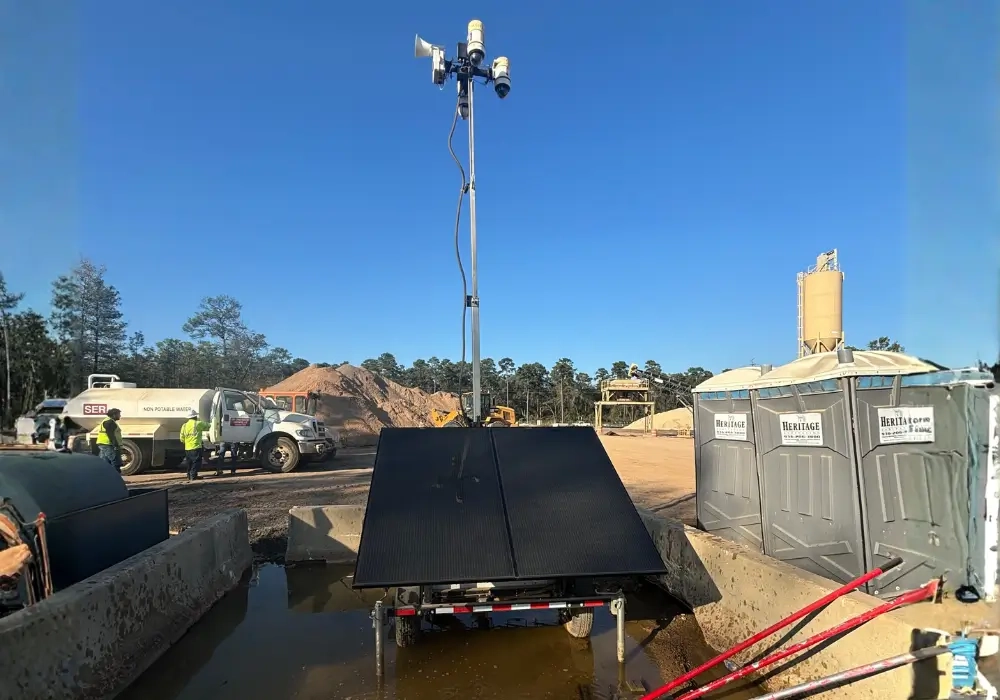
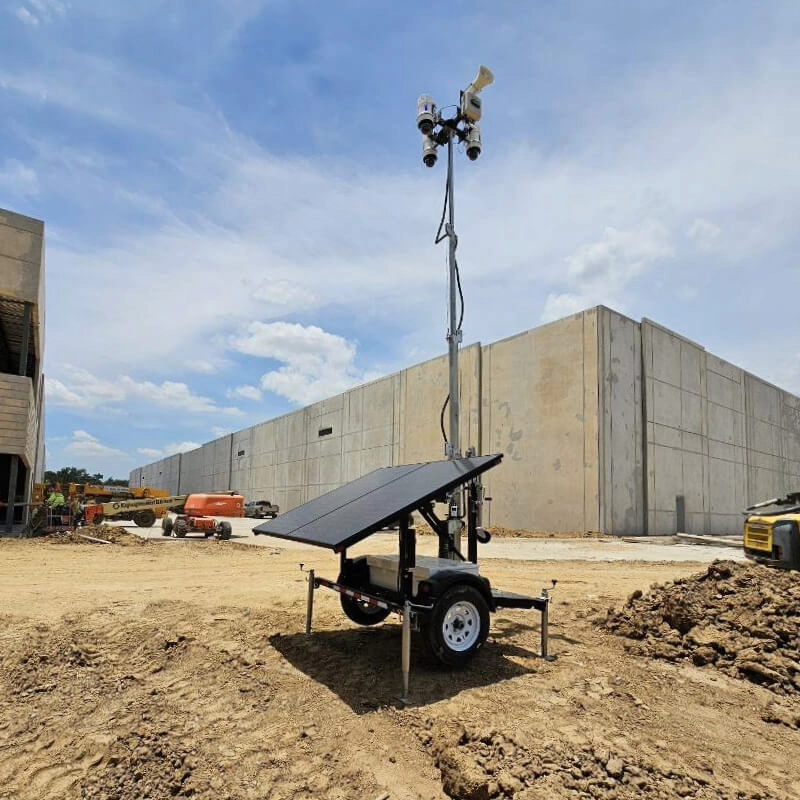
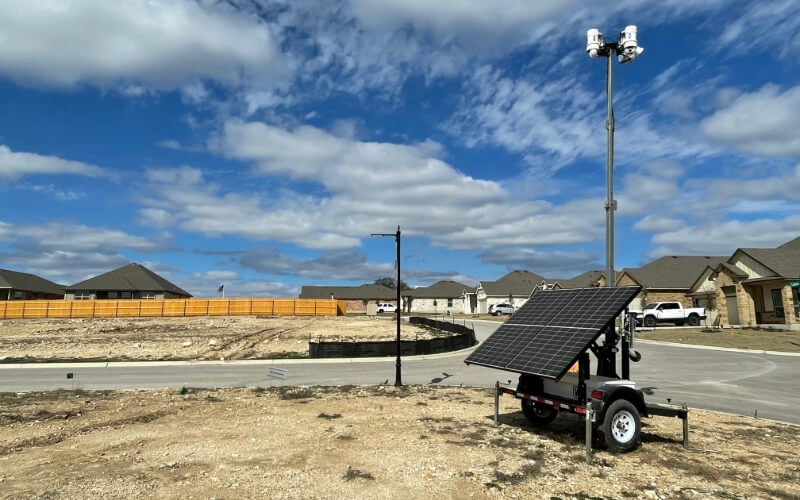
High-definition PTZ (Pan-Tilt-Zoom) cameras and sensors scan jobsites 24/7 to capture the real-time data you're monitoring. Since construction jobsites are temporary locations, surveillance is usually installed with flexible infrastructure, such as:
-
Mobile Surveillance Trailers: These rapidly deployable platforms deliver near-360° surveillance coverage of construction projects. With 4G/5G connectivity, they are ideal for remote locations where fixed infrastructure is impractical or limited.
-
Pole Cameras: Equipped with infrared (IR) night vision, easy-setup pole cameras fix to existing infrastructure such as utility poles or buildings and provide temporary or semi-permanent coverage without the need for fixed cabling or complex installation.
Read more: How Do Solar Surveillance Trailers Deter Crime?
2. AI-Video Analytics
AI-powered video analytics use intelligent algorithms, computer vision, and machine learning to analyze live surveillance feeds. They identify potential hazards, such as missing PPE, unauthorized access, or unsafe vehicle/equipment operation, and flag them automatically.
An immediate alert with a timestamped image (and often corresponding video footage) is sent to the responsible manager or team so that prompt action can be taken.
Example: Fire detection analytics are trained to look for signatures such as flicker rates, color changes, movement, and heat patterns to identify fire and smoke risks.
What's more, smart analytics filters out false positives and only raises alarms for genuine risks. For instance, systems can distinguish between a real trespasser and false indicators such as passing vehicles, wildlife, weather conditions, or flapping tarps.
Operating both day and night continuously, real-time tracking gives safety and project managers uninterrupted visibility into all potential hazards affecting their construction teams.
3. Cloud access and storage
Cloud platforms log and store all jobsite incidents, including near-misses. This level of intelligence gives safety officers a reliable record of events for investigation or review purposes.
Storing this evidence using traditional methods (siloed systems, physical files, local servers) results in less organized information that's prone to human error. Legacy systems also increase the risk of data loss or theft, because hackers have more entry points to exploit.
Businesses globally are increasingly investing in flexible, scalable cloud resources. It's estimated that 30% of total IT spending now goes toward cloud services. Our secure reporting platform, Stellifii, is a powerful cloud solution that integrates the following into a single interface:
-
Surveillance streams
-
AI-driven detection
-
Environmental monitoring
-
Automated real-time reporting
-
Live dashboards
With Stellifii, project managers and authorized users can access the latest safety information and documentation in an audit-ready format from any connected device, anywhere.
What about data security? According to 2025 industry reports, 21.5% of construction/engineering firms experienced a cybersecurity incident in the past year, with 40% of those violations causing business disruptions. These concerning stats highlight the importance of high-quality security measures.
To ease concerns, Stellifii uses AES256 end-to-end encryption (14 rounds of encryption) to protect your project data continuously.
Read more: Stellifii: Our New Smart Platform Transforming Surveillance, Safety, and Compliance
8 Real-Time Reporting Tools That Help Construction Safety Leaders
Let's walk through 8 real-time reporting tools that help safety leaders oversee large, complex operations effectively.
1. Smoke and Fire Detection
Fires endanger thousands of lives on jobsites every year and cause roughly $370 million in damages to property and assets. Speed is critical to mitigate fire threats, making immediate smart detection essential.
Our smoke detection technology catches the earliest signs of fire or smoke and sends an immediate alert to your designated contact or crew. The system reacts faster than traditional detectors, which often only sound the alarm after smoke or heat rises to a ceiling sensor some distance away.
Instant logging and alerts include:
-
A timestamped snapshot
-
Video footage
-
The precise location (e.g., by the equipment store on Level 1)
Read more: The Benefits of Smoke and Fire Video Analytic Detection on Jobsites
2. PPE Monitoring
Although the importance of Personal Protective Equipment (PPE) is widely recognized on construction projects, 54% of leaders report that consistent PPE use is an ongoing challenge. Real-time PPE reporting can certainly improve that stat.
Once project leaders identify areas where PPE is mandatory, our system scans the zone/s continuously, checking for missing gear, such as:
-
Hard hats
-
High-vis vests
-
Hearing protection
-
Safety boots and gloves
-
Goggles and face protection
-
Respiratory masks
When a worker enters a specified area without appropriate PPE, the system can issue a live audio warning to the employee while also sending an instant alert to their supervisor. The incident, including the corrective action, is logged automatically to ensure a record of proper protocols and oversight.
3. Intrusion Detection
Smart intrusion detection monitors jobsite boundaries and restricted zones day and night. Analytics "read" unusual patterns or movements that indicate:
-
Perimeter breaches
-
Unauthorized access to restricted sectors
-
Theft attempts.
-
Trespassing and vandalism
Real-time logs, reports, and video evidence are kept for executive reporting, audits, jobsite security reviews, and investigations.
Read more: The Benefits of Integrating Your Security and Communications Systems
4. Security Systems with Live Video Monitoring
AI-powered cameras constantly look for suspicious and criminal activity. When an incident is detected, it's logged with a precise timestamp and correlating video footage. On top of this, our security service connects to a live monitoring center, where security specialists respond to threats with one or more of the following interventions to deter the criminals/trespassers:
-
Audio voice down challenges
-
Blue strobe light activation
-
Dispatching a keyholder
-
Notifying law enforcement
Smart detection of security intrusions, PPE, and fire hazards can integrate with weather and other environmental monitoring tools (see more below), offering comprehensive project oversight in one place.
Read more: Why Smart Surveillance Systems Are the Future of Business Security
5. Weather Monitoring
Real-time data on atmospheric conditions helps leaders navigate weather challenges and dangers. Smart monitoring stations track weather conditions 24/7, including:
-
Temperature (-4° F to 122° F)
-
Wind speeds (0-110mph)
-
Humidity (10-99%)
-
Rainfall (hourly)
-
Lightning
-
Dewpoint
Accurate, up-to-the-minute environmental monitoring insights allow safety managers to make informed decisions to protect the jobsite and crew from heat, winds, lightning, and other natural hazards.
6. Noise Monitoring Sensors
Proactive noise control protects employees' hearing and adheres to OSHA regulations and ordinances. IoT-based sound monitoring devices continuously measure noise across jobsites:
-
30-130 Decibels (dB)
-
20Hz to 12.5kHz frequency
The system generates instant alerts/records for noise violations and potential hazards, instantly flagging these issues with the respective management team for corrective action.
7. Air Quality Sensors
Smart, IoT air quality sensors capture thousands of real-time data points every hour to minimize the risks and harm from airborne hazards. They measure conditions such as:
-
Dust and particulate matter (PM1, PM2.5, PM10)
-
Carbon dioxide (CO₂)
-
Carbon monoxide (CO)
-
Volatile organic compounds (VOCs)
Sensors trigger immediate alerts if pollutant thresholds or safety levels are breached, enabling preventive and precautionary measures, such as pausing work or bringing in respiratory masks. The system stores up to 180,000 timestamped records for trend analysis and compliance reporting.
8. License Plate Recognition (LPR)
License Plate Recognition automatically tracks and logs all vehicles entering and exiting construction jobsites and facilities. Safety managers can instantly pull up the license, make, model, and color of all vehicles on their construction projects in just a few clicks.
LPR matters because it strengthens:
-
Jobsite access control
-
Vehicle accountability
-
Safe driving and traffic flow on site
-
Jobsite safety and compliance
The system logs every entry and exit to assist with investigations and provides audit trails for compliance.
Read more: Top Strategies for Ensuring Jobsite Safety
Real-Time Reporting vs Traditional Manual Recording
Here's a quick overview of real-time reporting vs traditional documentation:
|
Variable |
Real-time reporting |
Traditional reporting |
|
Speed |
Incident logs and reports are generated instantly, supported by video verification. |
Teams fill out forms manually; they often gather data long after the fact. |
|
Consistent coverage |
24/7 monitoring through sensors and cameras delivers complete coverage. |
Human observation, periodic checks, and spreadsheet logs leave coverage gaps. |
|
Data organization and availability |
Centralized dashboards with clearly organized and searchable records. |
Fragmented files and reports, data silos, and sometimes lost records. |
|
Human element |
System-generated, evidence-backed, complete data. Low error environment. |
Human error: inaccuracies, omissions, subjective accounts, unreliable memories. |
|
Transparency compliance |
Immediate access to incident reports, video, audit trails, and dashboards. |
Requires effort to compile and present evidence to regulators. |
|
Decision-making |
Proactive, supported by AI analytics and live actionable insights |
Reactive, based on past incidents. |
Read more: How Digital Tools Ease Audit Prep and Cut Reporting Time in Half for Your Jobsite
5 Business and Operational Benefits of Real-Time Jobsite Reporting
Here are 5 strong benefits of real-time construction jobsite oversight:
1. Faster incident resolution
Immediate, evidence-backed notifications allow you and your teams to address issues early before they escalate. Faster resolution limits accidents and work stoppages that stall project progress. Decisive safety interventions help ensure owners meet deadlines and deliver project success.
2. Stronger regulatory compliance
When an inspector investigates a safety incident, they want to see the preventative measures you took to limit injury or harm.
If you can produce a timestamped digital log and documentation indicating the hazard was identified and resolved within 15 minutes you show that reasonable care and due diligence were exercised in good time to reduce harm.
In this way, real-time reporting (showing diligence) minimizes regulatory penalties and other claims.
3. Less administration
Automated real-time reporting substantially reduces labor-intensive administration. By collating real-time data and giving it immediate context, intelligent platforms provide managers with the safety information they need to make informed decisions.
Managers can also confidently report up the line, with executive-ready reports available at the push of a button.
4. Greater productivity and ROI
By minimizing admin and manual workloads, you streamline tasks and engage your teams more productively. Eliminating separate systems (and vendor sprawl) and unifying reporting in a central hub brings teams onto the same page, improving cooperation.
As an example of ROI gains from system consolidation and oversight efficiencies, some firms have reduced their security costs by 88% by streamlining security operations.
5. Improved company and professional reputation
Proactive, real-time management creates a safer, more productive work environment, not to mention a stronger safety and operational record. This doesn't go unnoticed in the construction industry. Firms and leaders with a reputation for high standards are better placed to:
-
Retain good employees
-
Win new contracts
-
Negotiate favorable insurance terms
-
Build long-term commercial trust
-
Attract finance/investment
Upgrade Safety Management with Real-Time Data
Modern safety leadership is moving away from manual inspections and logs toward real-time reporting. With live dashboards, safety teams can not only identify risks before they cause damage, but they also have detailed records of due diligence for auditors and regulators.
A real-time reporting platform removes human error and delays from the process. It gives safety leaders accurate, actionable insights that enable faster safety and compliance initiatives. And the benefits are clear: safer workplaces, smoother processes, lower liability exposures, easier OSHA compliance, and increased productivity.
If you're considering upgrading to a premium real-time platform that accelerates risk responses and provides stronger documentation with less admin, reach out to our experts to see how Stellifii can help on your next construction project.