Occupational Health and Safety Administration (OSHA) penalties start from $16,550 per incident and can exceed $165,000 for willful or repeated offences. Did you know that the Environmental Protection Agency (EPA) issued more than $14 billion in civil and criminal penalties between 2011 and 2021?
If these financial penalties don't scare you, they should, because costs can stack up quickly. What's more, a single compliance slip can trigger multi-jobsite audits that stop construction projects in their tracks and put your reputation in jeopardy. Penalties, project delays, and cost overruns aren't risks any construction project manager can afford to take.
This article covers 7 of the most costly compliance mistakes US construction firms make, and gives you practical steps to avoid them.
7 Compliance Risks Costing the US Construction Industry
We've rounded up 7 common [construction compliance mistakes] you can't ignore:
| Common mistakes | Consequence | Prevention |
| Ignoring State and OSHA regulations |
|
Real-time monitoring systems that continuously document compliance |
| Lack of PPE enforcement |
|
AI-powered PPE detection and monitoring with automated alerts |
| Poor health and safety oversight |
|
Smart detection systems for fire, smoke, weather, and PPE into predefined working zones |
| Environmental monitoring failures |
|
IoT-based environment sensors for air quality, noise, vibrations, and weather with real-time tracking |
| Poor documentation and record-keeping |
|
Cloud-based platforms with real-time, automated compliance reporting from any device |
| Overlooking jobsite security |
|
24/7 solar-powered surveillance with live monitoring, intrusion detection, and LPR technology |
| Cybersecurity mishaps |
|
AES256-encrypted, NDAA-compliant platforms with secure data storage |
1. Ignoring State and OSHA regulations
In the construction industry, OSHA requires specific safety programs, training certificates (e.g., OSHA 30-hour Construction Safety course), and hazard assessments. State regulations, such as Texas's Scaffolding Safety under 29 CFR 1926 Subpart L, require specific safety protocols, while California's Title 8, Section 1509 requires employers to have a written, effective Injury and Illness Prevention Program (IIPP) in place.
For context, in 2016, federal inspections of Florida construction sites found Jasper Contractors Inc. had ignored federal fall protection requirements, PPE rules, and other safety regulations for 7 years, leading to over $200,000 in fines.
How non-compliance happens:
-
Relying on manual reporting systems (spreadsheets, foot patrols) that don't sync across locations.
-
Missing state-specific requirements.
-
Failing to document daily safety breaches or hazard assessments.
-
Poor record-keeping when project teams rotate between jobsites.
Solution
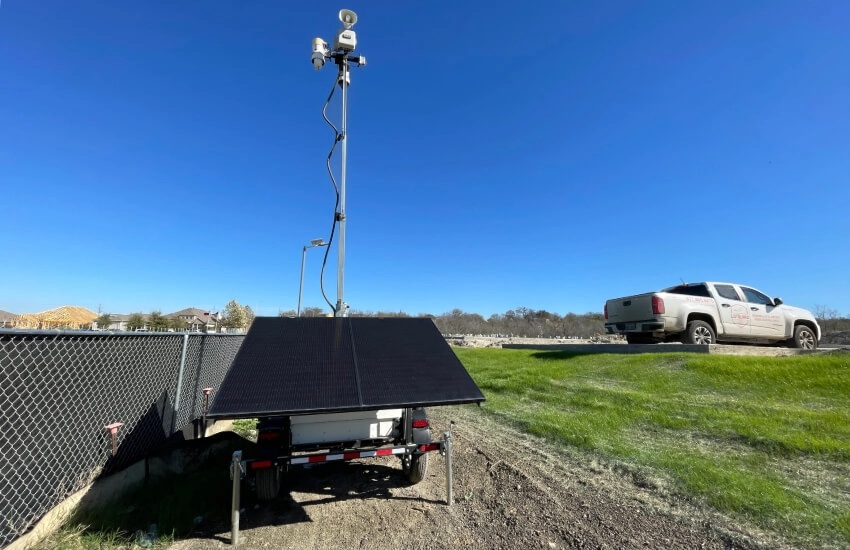
Mobile Surveillance Trailers, equipped with PTZ (Pan-Tilt-Zoom) surveillance cameras, 24/7 live monitoring, and smart detection systems, use machine learning and AI-video analytics to monitor, analyze, and document all jobsite activities in real-time. They instantly alert you when something is off, whether it's unauthorized access, smoke/fire hazards in working zones, or missing fall protection gear.
Read more:
- What Are Smart Security Systems in Construction Jobsites?
- The Hidden Costs of Legacy Systems on Modern Construction Jobsites
2. Lack of PPE enforcement
OSHA's PPE standards (29 CFR 1926.95-106) require all employers to ensure that protective equipment is designed safely and fits workers properly. This includes high-vis vests, safety goggles, hearing protection, and head protection gear, to name a few.
In 2024 alone, nearly 2,000 eye and face protection violations were found, where workers were exposed to flying particles, chemicals, and radiation without goggles, shields, or respirators.
How non-compliance happens:
-
Project managers can't be everywhere at once.
-
Workers removing PPE between construction activities.
-
New hires/subcontractors unfamiliar with site-specific standards.
-
No documentation proving PPE policies were enforced.
Solution
Advanced PPE detection and monitoring using AI-powered analytics to monitor predefined compliance zones automatically. They quickly flag compliance violations in real-time, providing time-stamped logs with exact surveillance footage when the breach occurred. All detection incidents are logged through Stellifii, our cloud-based platform, creating audit-ready documentation that proves your due diligence with stakeholders and OSHA inspectors at the click of a button.
3. Poor health and safety oversight
Construction jobsites present inherent dangers: fall risks from scaffolding, fire hazards from welding, and heat stress during outdoor work in the summer months. According to the 2022 Bureau of Labor Statistics, nearly 5,500 workers suffered fatal work injuries in the US, with the private construction industry accounting for 19.5% of total fatal injuries.
How non-compliance happens:
-
Jobsite managers focus on deadlines more than safety protocols.
-
Workers perform hot work without proper smoke/fire detection.
-
Weather conditions change quickly with little warning.
-
Incident reports compiled manually, often days later.
Solution
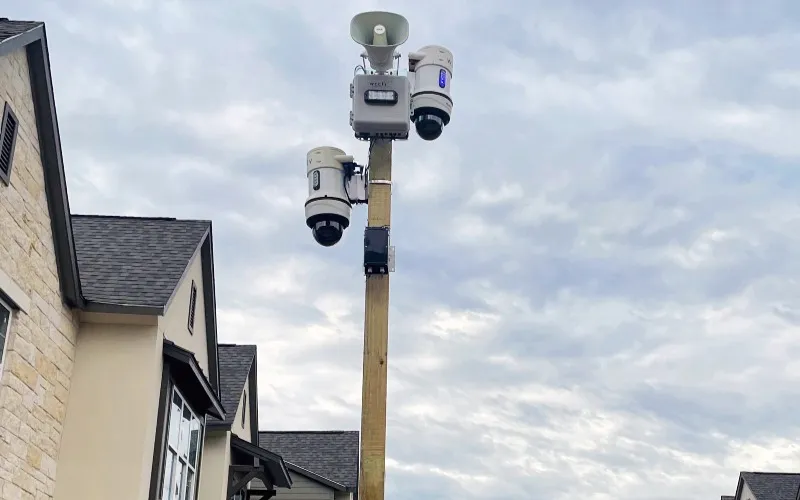
Pole Cameras equipped with infrared (IR) night vision cameras and intelligent monitoring software watch construction jobsites constantly, remaining reliable even in low-light conditions or adverse weather.
Add-on smart detection systems using AI algorithms learn "normal" jobsite patterns while filtering false alarm triggers caused by wildlife, debris, or shifting shadows. Identifying even the faintest trail of smoke, specialized smoke and fire detection distinguishes early heat signatures from harmless dust with near pinpoint accuracy.
Weather monitoring sensors add another layer of protection. When wind reaches unsafe speeds for crane operation, the system automatically triggers response protocols and documents every event, supporting faster decision-making and OSHA compliance.
Read more: Why Video Analytics is Best for Smoke and Fire Detection
4. Environmental monitoring failures
The EPA enforces strict environmental standards across the construction sector, including:
-
Stormwater management
-
Air emissions
-
Noise exposure
-
Waste/hazardous material handling
These fall under major federal regulations, like the Clean Water Act (CWA), Clean Air Act (CAA), and Toxic Substances Control Act (TSCA). For construction companies, this means controlling dust emissions, preventing stormwater runoff, and keeping noise levels within permitted thresholds at all times.
Failing to comply isn't just costly; it's criminal. EPA fines can reach $66,712 per day for Clean Water Act (CWA) violations, and breaches of the National Emission Standard for Hazardous Air Pollutants (NESHAP) can include up to 5 years of jail time, with fines/sentences doubled for second or subsequent convictions.
How non-compliance happens:
-
Manual reporting creates data collection gaps.
-
Spot-checks cannot cater to all jobsite activities simultaneously.
-
Unpredictable weather can derail monitoring controls.
-
Noise complaints from neighbors escalate to enforcement action.
Solution
IoT-based environmental monitoring solutions are the smarter way forward as they continuously track critical conditions in real-time:
-
Air quality sensors measure fine particulate matter (PM1, PM2.5, PM10) and trigger alerts when construction work nears thresholds.
-
Noise monitoring devices record a wide decibel (30-130 dB) and frequency (20Hz-12.5kHz) range, proving compliance with local standards before violations occur.
-
Weather monitoring stations track temperature, wind speed, humidity, dew point, and rainfall and provide time-stamped logs for compliance, insurance, and inspection purposes.
Read more:
-
How IoT Improves Both Safety and IT Overview on Construction Jobsites
-
Air Quality Data Management: Turning Sensor Data Into Actionable Insights for Jobsites
-
Integrating Environmental Monitoring Sensors on Construction Jobsites
5. Poor documentation and record-keeping
OSHA requires those in the construction industry to maintain detailed records of work-related injuries, safety training, equipment inspections, and risk assessments. Proving compliance becomes nearly impossible when these records live in separate systems (e.g., spreadsheets, email threads, paper logs).
Did you know that you can fail an OSHA/EPA audit, not due to safety violations, but because you couldn't produce the required training records when inspectors asked for them? Under EPA regulation 40 CFR §68.58, regular training for hazardous material handling and emergency planning programs is mandatory. Failure to meet these expectations can trigger additional inspections or even enforcement actions.
How non-compliance happens:
-
Vendor sprawl from managing too many platforms for OSHA, PPE, surveillance, and more.
-
Paper timesheets/logs get lost, damaged, or filed incorrectly.
-
Training certificates expire without automated renewal reminders.
-
Incident reporting takes days, missing regulatory compliance deadlines.
Solution
Our Stellifii platform consolidates all compliance documentation into a single interface. No more managing multiple vendors or digging through scattered files; just clear, audit-ready reports generated in minutes. Training records, incident reports, PPE detection, and surveillance logs sync automatically from every jobsite in real-time, keeping you prepared when inspectors arrive.
The best part? You can get export reports up to 5X quicker than legacy systems, allowing you to meet OSHA/CPRA/EPA deadlines without the manual grind or administrative burden.
Read more: Vendor Sprawl in Construction IT: Why Consolidated Monitoring Matters
6. Overlooking jobsite security
In the US, construction theft costs the industry between $300 million and $1 billion each year, with Texas alone accounting for over 2,000 incidents (2016). When equipment goes missing, projects stop while replacements are sourced and insurance claims processed. Beyond the direct financial risks, security breaches disrupt project timelines and tarnish your reputation with stakeholders and clients.
Poor jobsite security also naturally leads to compliance mistakes. OSHA regulations require construction firms to prevent unauthorized access and maintain safe working conditions on all construction projects. When trespassers enter restricted areas, liability shifts to the construction company, especially if injuries occur. This can lead to fines, legal action, and reduced cash flow as project costs escalate.
How non-compliance happens:
-
Temporary perimeter fencing provides very little deterrent.
-
Jobsites are left unmonitored after teams leave.
-
Equipment is stored outdoors with minimal surveillance.
-
Manned security guards cannot cover complex jobsites 24/7.
Solution
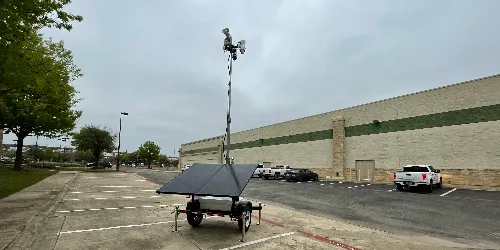
Temporary surveillance camera rentals with in-built intrusion detection provide 24/7 jobsite protection, regardless of lighting, weather, or shift changes. Standing up to 20-feet tall, our Surveillance Trailers operate autonomously for nearly 20 weeks without fixed infrastructure. When unauthorized entry is detected, live video monitoring personnel issue audio voice-down challenges and dispatch response teams immediately.
Licence Plate Recognition (LPR) solutions log every vehicle entering/exiting your jobsite, documenting access controls for compliance purposes. Time Lapse Video provides extra project documentation, showing continuous jobsite activity that supports insurance claims if incidents occur.
Read more:
- Construction Site Thefts Continue to Rise in North Texas
- Benefits of Mobile Surveillance for Construction Jobsite Security
- The Benefits of Integrating Your Security and Communications Systems
7. Cybersecurity slips
Many construction firms store sensitive data like project plans, employee records, construction accounting, and client information. These are often kept across multiple platforms online, such as cloud-based systems, email, and numerous mobile devices.
When cybersecurity protections are weak, ransomware can block you from accessing compliance documentation right before a scheduled audit, while malware can infiltrate systems and steal personal information, leading to legal action.
In fact, according to industry reports, 21.5% of construction/engineering firms experienced a cybersecurity incident in the past year, with 40% of those incidents causing operational disruptions.
How non-compliance happens:
-
Using unsecured platforms to store personal/compliance information.
-
Field teams accessing systems through public Wi-Fi.
-
No backup systems when primary platforms are compromised.
-
Weak encryption models.
Solution
Powered by industry-approved infrastructure, Stellifii uses AES256 encryption and NDAA-compliant components for all surveillance footage, compliance reports, and employee records. Project managers eliminate risks created by switching between multiple unsecured apps/spreadsheets across different jobsites, because all monitoring and reporting happens through a single, secure platform.
Read more: Stellifii: Our New Smart Platform Transforming Surveillance, Safety, and Compliance
Avoid Costly Compliance Mistakes With WCCTV Today
Construction compliance failures carry far more than financial consequences; they taint professional reputations, delay projects, and create legal liabilities that can take years to unwind.
These 7 common mistakes all share the same "fix": automated monitoring systems that continuously document compliance all in one place.
With over 20-years of expertise in wireless surveillance and monitoring, we provide fully-managed, integrated solutions built specifically for US construction. From Surveillance Trailers to Environmental Monitoring Sensors and Smart Detection Systems, our innovative technology keeps every project safe and compliant from day one.
Reach out to our monitoring experts to discuss how Stellifii can help.