In construction, sound levels fluctuate by task, equipment, crew density, and proximity. A reading taken mid-morning rarely reflects full-shift conditions.
Despite complex, dynamic variables, controlling sound levels to safeguard workers and the surrounding community is non-negotiable. Under federal law, employers must demonstrate that occupational noise exposure is measured and properly managed.
But manual spot checks and reactive responses are inadequate to prove effective jobsite noise control. Human error and oversight often miss critical exposures, leading to hearing harm and penalties.
The solution? Modern IoT technology.
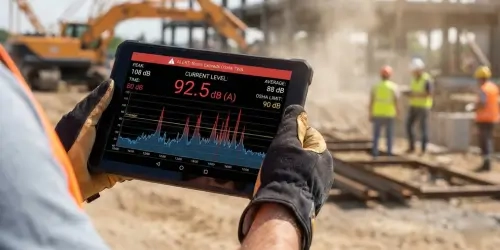
Smart IoT-based sensors collect data continuously and issue immediate alerts if limits are breached, allowing for earlier intervention, stronger compliance defense, and better protection against noise induced hearing loss and compensation claims.
Our article explains how automated noise monitoring, real-time alerts, and accurate documentation protect workers and provide clear evidence to meet OSHA compliance and defend against liabilities.
Why Traditional Noise Surveys Leave Compliance Gaps
Historically, construction firms have used handheld instruments such as sound level meters to conduct periodic noise surveys when tracking jobsite sound levels.
The limitation of manual measurements is that they only provide a snapshot of a single moment, without accounting for the dynamic nature of busy projects where conditions can change within minutes. Noise levels late in the shift may differ significantly from earlier readings.
Spot readings often miss dangerously high spikes, meaning personal noise exposure can exceed thresholds for a long period without intervention. Corrective steps, such as introducing PPE (hearing protection) or modifying operations, may come too late to prevent harmful exposure.
On top of that, paper logs aren't the best defense when it comes to oversight reviews and compliance audits. Spreadsheet processes are inevitably inconsistent, and forms may be inaccurate and lacking in detail.
Read more: The Hidden Costs of Legacy Systems on Modern Construction Jobsites
Key Noise Regulations: What Safety Leaders Must Manage
The two primary bodies driving noise regulation and enforcement in the US are:
-
OSHA: Occupational Safety and Health Administration
-
EPA: Environmental Protection Agency (through state and local agencies)
Let's see how each affects jobsite noise rules.
OSHA noise standards
Under 29 CFR 1926.52, construction employers must manage employee noise exposure within permissible exposure limits (PELs). Compliance is determined using a Time-Weighted Average (TWA), reflecting a worker’s average exposure over an 8-hour work shift. The higher the decibel level, the shorter the permitted exposure time.
Here's an indication of construction PELs:
-
90 dB averaged over 8 hours
-
100 dB averaged over 2 hours
-
105 dB averaged over 1 hour
-
110 dB averaged over 30 minutes
The regulation states that construction employers must:
-
Monitor employee noise level exposure.
-
Implement engineering and administrative controls when limits are exceeded, e.g., adjusting work activities to reduce sound intensity.
-
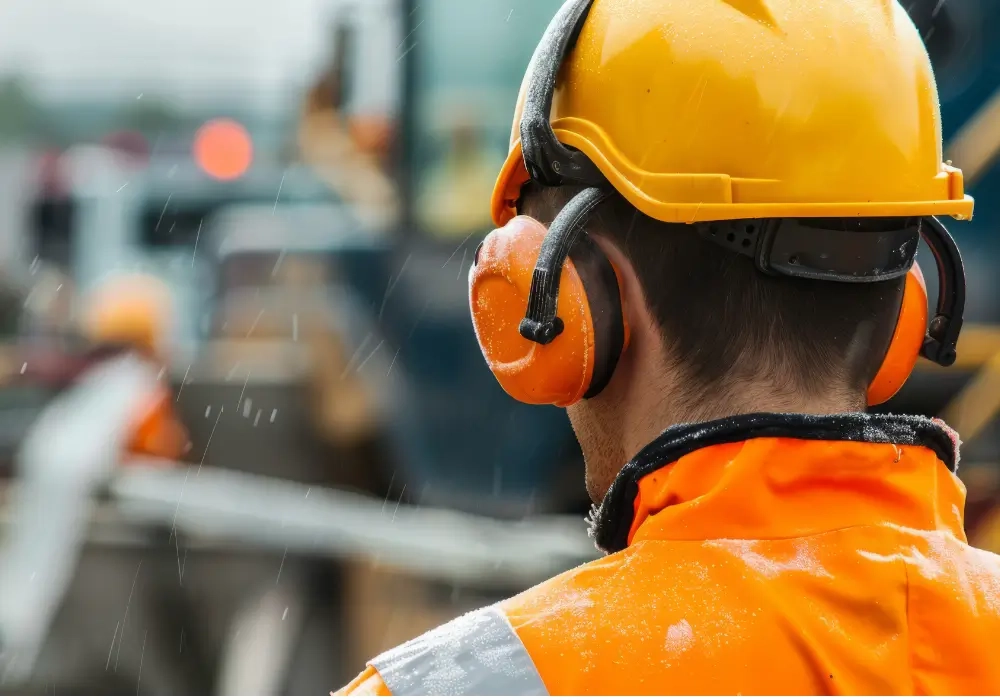
Provide and ensure the use of hearing protection when required.
Under OSHA standards, employers must implement a Hearing Conservation Program when employee noise exposure reaches or exceeds 85 dBA as an 8-hour average. While this isn't mandatory in the construction sector, many contractors implement elements of a hearing conservation program, including monitoring and audiometric testing.
EPA noise standards
The Noise Control Act of 1972 recognizes noise as a public health concern and authorizes the regulation of environmental noise that impacts communities. The EPA defines noise as a form of pollution, and it was classified as a public health hazard as far back as 1968.
Enforcement of public noise hazards is largely carried out by state and local authorities. To avoid complaints and regulatory actions, contractors operating near populated areas must manage community noise levels within locally permitted limits.
Legal penalties and enforcement
When investigating noise events, OSHA and environmental inspectors may request documentation showing:
-
When elevated sound levels occurred
-
What corrective actions were taken
-
How quickly conditions were restored
Without reliable monitoring data, it's difficult to produce evidence to satisfy the inquiry. This increases the likelihood of penalties and enforcement actions, such as:
-
OSHA can halt operations via stop-work orders if safety standards are not met.
-
OSHA violation penalties start at $16,550 per serious violation and can rise to $165,514 per violation for willful or repeated transgressions. In extreme cases, violations can result in criminal charges.
-
Local permitting or environmental authorities can shut down or suspend jobsites for noise ordinance violations and permit non-compliance.
-
Fines for EPA noise transgressions are established by local ordinances. Penalties vary based on location and whether it is a first or repeat offense. Amounts range from under $500 to well over $10,000 per violation.
Read more: Construction Jobsite Compliance Failures and Lessons Learned
The Health Impact of Noise Hazards on Workers
Occupational noise exposure poses several health risks to everyone on the jobsite. Adverse effects include:
-
Temporary hearing loss
-
Tinnitus (ringing in the ears)
-
Auditory fatigue (a feeling of muffled hearing or ear pressure)
The most serious consequence is noise-induced hearing loss. This condition usually develops over time to become a permanent disability; sensitive structures in the inner ear are gradually damaged by long-term exposure to high sound levels.
Workers often accept symptoms such as ringing in the ears as normal or aren't fully aware that their hearing is deteriorating because it happens incrementally. They continue working in conditions where the sounds of blasting, demolitions, earth moving, and heavy machinery aren't controlled responsibly.
Ultimately, the cumulative effect of the damage becomes irreversible, and they lose a percentage of their hearing.
How Smart Noise Monitoring Works to Help Safety Leaders
Modern jobsites use IoT-enabled sensors to provide 24/7 oversight of ambient noise. Moving beyond unreliable manual checks, these systems capture continuous insights that protect workers' hearing and defend your project against regulatory penalties.
How it works: Sound levels are recorded in decibels using an A-weighted filter that matches human hearing. Advanced sensors measure dynamic ranges from:
-
30-130 decibels
-
20Hz to 12.5kHz frequency
Project leaders set the noise thresholds to be tracked. When limits are breached, the system triggers a near-instant alert (under 3 seconds), allowing managers to intervene before a violation causes harm or triggers a formal complaint.
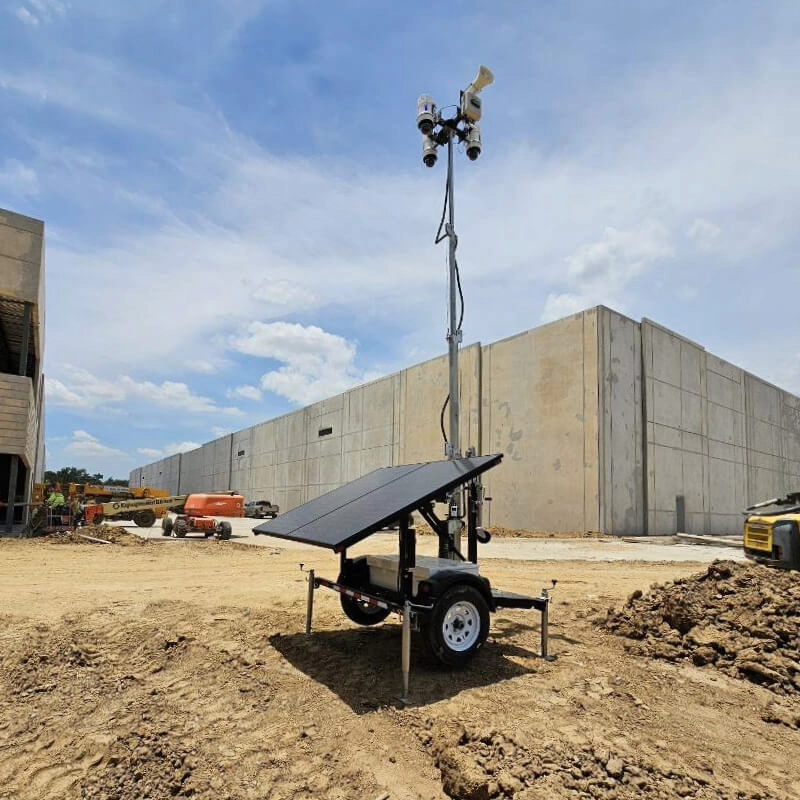
Our Noise Monitoring Sensors are deployed quickly and easily as add-on features to our Mobile Surveillance Trailers and temporary camera setups. These flexible surveillance solutions are purpose-built to deliver wide-area coverage of complex, continuously evolving environments.
Noise data from all your projects is accessible through Stellifii, our cloud-based management platform, where you can securely view the live dashboard remotely. Readings are timestamped and stored, allowing you to quickly retrieve documentation for compliance audits, reviews/investigations, environmental reporting, or trend analysis.
How does smart monitoring support EPA and OSHA compliance?
Digital systems automatically log:
-
Timestamped decibel readings
-
Exposure durations
-
Threshold breaches
-
Corrective actions
These audit trails serve as evidence of due diligence and compliance for OSHA and other audits.
Read more: Stellifii: Our New Smart Platform Transforming Surveillance, Safety, and Compliance
How noise monitoring works together with weather and air quality tracking
Weather factors can directly affect sound conditions, and air pollution is another health hazard that needs strict monitoring and control. Connecting camera coverage, noise, weather, and air quality management within Stellifii gives safety managers a comprehensive view of environmental health across all projects.
Here's what a smartly integrated environmental monitoring system looks like and delivers:
| Sensor Type | What It Does | Key Risks Identified |
| Noise Sensors |
|
|
| Air Quality Monitoring Systems |
|
|
| Weather Monitoring Stations |
|
|
When you connect surveillance coverage, you see the full picture. Cameras provide visual footage linked to readings, helping you pinpoint the work activity(s) that set off threshold warnings.
Read more: Air Quality Data Management: Turning Sensor Data Into Actionable Insights for Jobsites
Protecting your Crews and the Community
Workplace noise monitoring and control go beyond safeguarding workers and meeting occupational health standards. Contractors are also required to limit the impact of workplace noise on the surrounding neighborhood.
Protecting community relations
On large jobs, contractors become part of the local community for 12-24 months. As mentioned, noise is considered a public health hazard, and you are obligated to limit its effects.
The Noise Control Act of 1972 was designed to protect the general public from excessive noise that jeopardizes their health or well-being. The practical implication of this is that surrounding neighbors have a right to complain to local authorities if your operations are excessively loud, causing them distress and harm. Formal noise complaints have halted numerous projects and caused sizable losses.
Responsible firms monitor operational noise data and sound intensity continuously to reduce both community and worker exposure. This limits complaints and protects your company’s reputation.
Worker safety and security
Controlling noise exposure is mission-critical to ensure your crews don't incur hearing damage or distress. Besides complying with noise regulations, visible controls and high safety standards make workers feel protected.
Proper controls send a clear message to crews: the company values them and cares about their well-being. This boosts morale, strengthens safety culture, and forges industrial environments where everyone takes care of themselves, their equipment, and those around them.
Stellifii also serves our managed security systems to expand and deepen safety culture:
- Advanced Security Solutions use AI detection to protect your jobsite boundary against breaches and theft 24/7. Temporary or semi-permanent surveillance is deployed on pole cameras or our mobile trailers for around-the-clock scanning.
The system is backed by Live Video Monitoring. Here, trained operators in our control center receive alerts of security threats, check the feed, and issue immediate voice challenges to warn off intruders.
- License Plate Recognition (LPR) monitors all vehicles entering, exiting, and navigating jobsites, including speed tracking, to tighten access control and encourage safe driving.
These solutions contribute to building well-managed construction sites where crews feel safe and secure.
Read more:
-
The Future of Construction Security: From Guards to AI-Powered Smart Systems
-
The Benefits of Integrating Your Security and Communications Systems
5 Benefits of Smart Noise Monitoring with Stellifii
Replacing manual processes with automated noise tracking brings several advantages, including these 5 valuable wins:
-
Indisputable evidence: If you connect a surveillance system (e.g., through our mobile surveillance trailers), Stellifii can link noise alerts with high-definition video clips. This provides conclusive visual and data evidence of every noise incident and your team's response.
-
Smarter compliance: You can export audit-ready reports in minutes to meet OSHA and EPA agency expectations with timestamped, organized documentation. No more panicking to piece together information from scattered files and disconnected systems.
-
Remote monitoring of all environmental factors: Noise sensors can be combined with air quality and weather monitoring to provide a comprehensive view of environmental risks and your site's impacts on its surroundings.
-
Enterprise-grade security: All noise and other data are protected by AES-256 encryption, safeguarding your records from cyberthreats and data breaches.
Strong data security is essential in a cyberthreat landscape where 21.5% of construction/engineering firms experienced a cybersecurity incident in the past year, with 40% of those resulting in costly work disruptions.
-
Trend recognition: Continuous monitoring helps to identify patterns. Over time, these systems reveal recurring noise hotspots and compliance trends. These could be:
-
Repeated exposure spikes in specific work zones
-
Equipment and machinery types that consistently exceed safety levels
-
Time-of-day activity overlaps that together create unacceptably high noise exposures
-
By analyzing and understanding trends, leaders are able to redesign workflows or implement engineering controls to minimize such problems.
Read more: How Can Construction Jobsites Adapt To Digital Transformation
Intelligent Integrations to Expand Safety and Compliance
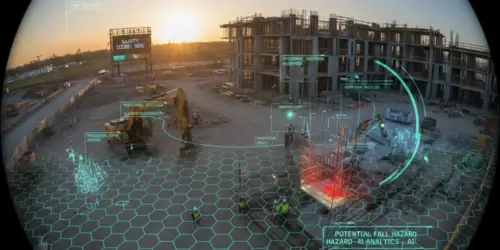
Integrating surveillance, noise and environmental monitoring systems with automated PPE, fire detection, and intrusion controls provides safety managers with a near 360° command of all project risks across every location.
Implementing PTZ (Pan-Tilt-Zoom) cameras alongside IoT sensors enables you to connect the following smart detection solutions and significantly extend jobsite safety:
-
Smoke and Fire Detection tools with AI-powered video analytics recognize the earliest warning signs of fire and issue immediate alerts.
-
PPE Monitoring tracks and ensures that workers are wearing proper personal protective equipment.
-
Intrusion Detection systems prevent unauthorized access that could lead to untrained people being in high-risk areas. It also protects valuable assets from theft, vandalism, and other site security
All risks relating to the above are identified in real-time and easily managed from Stellifii's centralized control point. Alerts from every project appear instantly in a unified dashboard, so managers can prioritize urgency and respond right away.
Central platform management means less vendor sprawl and hopping between apps. This improves productivity and ROIs while ensuring that nothing falls through the cracks.
Read more:
Choose Smart Noise and Safety Monitoring
Manual checks and paper logs simply cannot capture fluctuating sound levels across complex jobsites effectively. That's why companies are implementing smart noise monitoring, achieving automated 24/7 tracking of all sites and work activities.
Continuous monitoring of worker noise exposure delivers actionable, real-time data and trend intelligence. Armed with reliable insights, leaders can protect their workforce proactively, limit occupational hearing loss claims, and strengthen regulatory compliance.
For safety professionals committed to proactive management and companies dedicated to genuine social responsibility, the goal is clear: establish systems that prevent employee hearing issues and local noise disturbances before they even occur.
Reach out today for smart workplace noise and other powerful monitoring solutions on your next project.