
With multiple subcontractors, suppliers, regulators, and safety requirements all impacting construction project timelines, superintendents have to stay one step ahead of risks that could undermine productivity. Even small disruptions, such as a delayed delivery or subcontractor no-show, can have a cascading effect that sets back operations by a day or longer.
Managers who track build progress and risks in real time using automated tools are far better positioned to prevent problems from disrupting schedules than those who rely on delayed updates and manual processes.
Modern automated tools provide 24/7 visibility into jobsite conditions, reducing the compliance blind spots associated with traditional oversight systems. This real-time visibility is often the difference between a project that hits its milestones and one that lags behind schedule.
Our article explores factors that derail timelines and explains how smart monitoring solutions give superintendents real-time insight into jobsite activity, helping them detect issues earlier and keep schedules on track.
7 Common Causes of Project Schedule Disruptions
In US construction, even the most carefully planned schedules are routinely thrown off by various external forces and internal weaknesses, including outdated manual scheduling processes.
Let's take a look at 7 of the most common reasons project schedules go off course.
1. Subcontractor issues
Successful project completion depends heavily on managing schedules for multiple subcontractors. Get this wrong, and delayed and/or poor subcontractor performance will halt the job's progress. For example, when an electrical or demolition team doesn't arrive on time, entire project phases are held up.
Weak subcontractor supervision and safety protocols increase the risks of accidents or compliance breaches that can result in work stoppages. Variable quality standards or the wrong materials result in failed inspections and rework, putting you under pressure from executives.
Without constant checking, you may miss that a trade crew is not at full strength because they’ve split their labor across projects. When subcontractor updates are delayed or incomplete, small problems can quickly snowball, and by the time you realize there's an issue, you have scheduling conflicts to unravel.
The bottom line: Site leaders need to keep a close eye on the trades that are vital to hitting key project milestones.
How real-time visibility helps:
Tech-enabled monitoring allows general contractors to confirm:
-
Whether subcontracting crews arrive on schedule
-
That the crew size is adequate to complete the job properly and on time
2. Material supply disruption
For construction superintendents, material delays and delivery problems are a constant worry. Although this is often an external problem you can't fully control, you can ensure the correct order is placed and the supplier has available inventory and can deliver on time. However, global supply chain issues and natural disasters affecting transport routes are simply out of your hands.
Whatever the cause, when crucial inputs such as steel, lumber, concrete, glass panels, or specialized equipment don’t arrive on time, your schedule takes a serious hit. For example, a concrete pour can be delayed by days due to late material delivery. But when you have astute, informed scheduling systems in place, you can make immediate adjustments and reduce downtime.
How real-time visibility helps:
- Connected cameras and automated alerts via License Plate Recognition (LPR) systems help project managers verify that materials arrive as scheduled and respond quickly if deliveries are missed.
3. Weather delays and disruptions
Unpredictable weather is one of the most difficult variables to plan for in the construction industry. Heavy rain can flood excavation areas and damage already completed structures. Extreme heat forces work pauses, while freezing temperatures often compromise equipment performance. High winds and lightning storms bring crane operations and work at height to an immediate halt.
These interruptions ripple across workflows. A delayed roofing installation, for example, can set back dependent tasks (cladding, insulation, solar setups) requiring smart scheduling to get back on course.
How real-time visibility helps:
-
Integrated weather monitoring stations and jobsite cameras provide immediate updates on environmental conditions.
-
Real-time alerts notify construction managers when work zones become unsafe or unusable, allowing you to make agile, real-time scheduling adjustments to minimize project delays.
4. Safety incidents and accidents
Accidents on your jobsite can bring entire projects to a standstill. When a serious incident occurs, work areas may be shut down for regulatory or legal investigations. When employees are injured, your workforce is depleted, and if equipment is damaged, there is a delay pending repairs and replacement.
Repeated safety issues damage the company's reputation and usually attract intensified regulatory attention. If compliance inspectors aren't satisfied with your safety standards, you may face penalties and work stoppage orders that compound the problem even further.
How real-time visibility helps:
-
AI-powered camera systems, including smoke and fire detection, provide immediate warning of unsafe conditions or incidents.
-
Live monitoring of PPE use helps supervisors enforce compliance by intervening proactively.
5. Rework frustrations
The need to redo a task because it doesn't pass inspection or meet quality/safety standards can be incredibly damaging to your schedule.
Causes for rework range from poor communications to following the wrong plan or using incorrect materials. Each instance of rework disrupts subsequent tasks, often resulting in idle time and costly delays. When electrical or foundation work must be redone, entire phases of the project grind to a halt.
Rebuilds consume additional materials, drive up labor costs, and risk budget overruns. On top of that, when timelines come under pressure, crews race to catch up lost ground, sometimes taking shortcuts and working unsafely, which leads to errors and additional rework.
While realistic schedules build in some provision for rework, project efficiency depends on limiting these frustrating do-overs.
How real-time visibility helps:
-
Cameras and live feeds allow managers to verify work quality as it happens.
-
Continuous monitoring ensures crews follow specifications and safety standards.
6. Labor challenges
Labor availability and crew reliability are central to effective workforce management and ultimately project success. When crews/field teams are understrength, overextended, or lack the necessary skills, it's difficult to maintain forward momentum.
Labor shortages are one of the top 3 work challenges cited by US construction companies. Issues such as absenteeism, high turnover, and substance abuse all contribute to productivity lags and unnecessary delays, while weak supervision or complacency during repetitive tasks increases the risk of mistakes and rework.
How real-time visibility helps:
-
Live monitoring highlights under‑staffed teams or idle work areas.
-
Quick alerts help managers identify bottlenecks and staffing gaps, allowing them to intervene early to avoid missed deadlines.
7. Regulatory compliance risks
If OSHA or local regulators deem your jobsite unsafe or a hazard to the local community, they can restrict work or even shut down the entire project.
Inconsistent safety standards across multiple trades make regulatory compliance a risky area, especially on large, complex projects. Small oversights, like expired permits, a noise limit breach, or undocumented PPE checks, can escalate into further investigations. When inspectors cite the project for compliance violations, they may also enforce a work stoppage until issues are corrected.
How real-time visibility helps:
-
Continuous visibility, including PPE monitoring and detection and environmental monitoring, helps ensure regulatory requirements are consistently met across all work areas.
-
Automated alerts flag compliance failures in real-time, facilitating quick corrective action.
-
Automated logs and digital records create clear, timestamped evidence for audits and inspections.
7 Smart Tools For Real-Time Construction Site Visibility
Intelligent modern tools have reshaped project management, providing leaders with continuous insight into conditions and activities on their builds. Working through centralized platforms, these tools feature artificial intelligence and machine learning to deliver actionable, real-time insights that guide continuous improvement in workplace safety.
Below, we highlight our range of live monitoring systems that help managers control safety and compliance risks that torpedo timelines.
1. Smart centralized platform
At the heart of a 24/7 oversight system is a central platform where leaders get live reports on the range of factors that jeopardize schedules and workforce deployments, from weather events to compliance violations:
Our secure, cloud-powered platform offers a range of integrations that bring tighter control to project risk areas, including:
-
Safety violations (including PPE and unsafe vehicle operations)
-
Site air pollutant and noise levels
-
Subcontractor no-shows and/or safety protocol breaches
-
Security and access control threats
The unified platform consolidates dashboards into one place and brings all teams onto the same page for real-time communication. Users can access live jobsite intelligence to keep projects on course from any connected device (on web and/or mobile).
Other core features and benefits:
-
Reduced vendor sprawl: A key benefit of the platform is that it reduces the costs and inefficiencies of switching between several tools to manage multiple responsibilities, including security, PPE compliance, noise levels, and construction emissions.
-
Compliance records: The system secures the documentation (data logs, timestamped evidence, video material, incident reports) you need to satisfy stakeholders' or regulators' inquiries.
-
Streamlined efficiencies: By strengthening oversight with our smart platform, construction companies achieve measurable improvements in minimizing delays, rework, and cost overruns, compared to outdated legacy systems.
-
Data security: The platform is AES-256 end-to-end encrypted to protect sensitive project information in line with data privacy regulations.
2. Smart surveillance
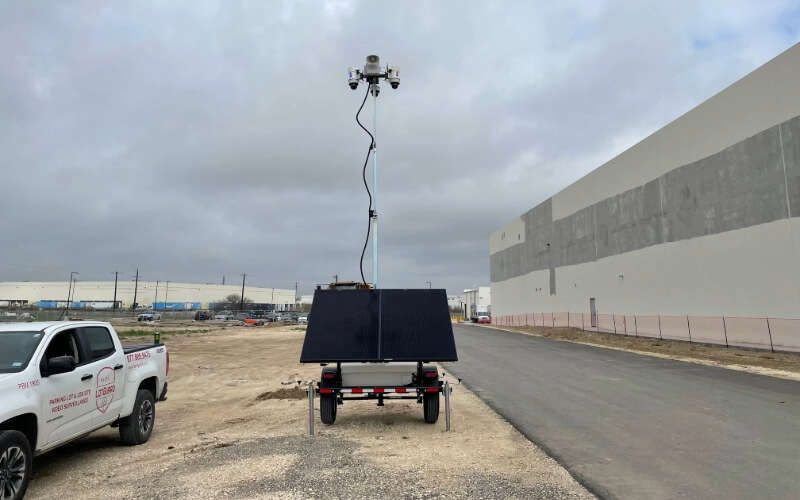
The foundation of complete project visibility is a network of high-definition PTZ (Pan-Tilt-Zoom) cameras and sensors that record work zones continuously to capture real-time data and events.
This surveillance system is deployed on versatile, mobile infrastructure, including:
-
Mobile Solar Surveillance Trailers: Standing up to 20 feet tall, these units deliver wide-area jobsite coverage (with adaptable positioning to ensure clear sightlines). Solar-powered and with 4G/5G connectivity, they are ideal for remote locations without fixed infrastructure.
-
Pole Cameras: Equipped with infrared night vision, easy-setup pole cameras provide temporary or semi-permanent site coverage without the need for fixed cabling or complex installation.
3. PPE Monitoring and Detection
Using AI analytics, PPE monitoring notifies managers when employees fail to wear required personal protective equipment (hard hats, vests, face/eye/ear/foot protection). The smart detection systems can also issue a live warning to workers who ignore this essential safety rule.
Active, visible enforcement reduces accidents and injuries, and supports smoother operations with fewer disruptions. Like all our monitoring tools, the system logs incidents, so you can easily retrieve records for subcontractor reviews, insurance discussions, and to prove proactive enforcement to compliance inspectors.
Read more: AI for PPE, Fire, and Intrusion Safety
4. Smoke and Fire Detection
Cameras with AI-powered video analytics flag the early signs of smoke or flames. These systems recognize indicators as slight as a faint smoke trail or a few dangerous sparks, while understanding and ignoring false alarms such as diesel emissions.
They typically react faster than traditional detectors, which often require a concentrated heat or smoke buildup before activating.
Smart fire detection limits worker injuries and property/equipment damage, mitigating rework and other costly interruptions.
Read more: Why Video Analytics is Best for Smoke and Fire Detection
5. Environmental monitoring sensors
IoT-based environmental monitoring systems track real-time jobsite air quality, noise, and weather data via sensors and connected surveillance. Live readings keep you fully informed of environmental factors that might threaten workflows and prompt OSHA, EPA, or local authority investigations.
-
Weather Monitoring Stations measure site-specific conditions, including temperature, wind, humidity, and storm indicators that present dangers, so you can manage operations around weather risks to avoid delays. The system protects your crew and company by notifying you when thresholds approach safety or legal limits, e.g., OSHA's Heat Hazards NEP guidelines, while timestamped event records help you justify schedule changes to stakeholders.
-
Air Quality Sensors measure particulate matter (PM1, PM2.5, PM10), CO₂, dust, and VOCs in real-time. They give live insights into changing conditions, helping you manage crew and public health risks to keep jobs moving.
-
Noise Monitoring Sensors measure a wide decibel (30-130 dB) and frequency (20Hz to 12.5kHz) range that complies with both OSHA and federal noise standards. By controlling site sound levels, you avoid complaints and compliance issues while protecting workers and timelines.
Read more:
6. Intrusion Detection Systems
Smart security and intrusion monitoring deploy cameras and AI analytics to detect perimeter breaches and unauthorized access.
Scanning day and night, tech-enabled security solutions protect against theft of copper, expensive materials, equipment, and other valuable assets. The platform raises near-immediate alerts of security breaches and supplies detailed, timestamped documentation for internal and external investigations.
Read more: The Future of Construction Security: From Guards to AI-Powered Smart Systems
7. Live Video Monitoring and License Plate Recognition (LPR)
Live video monitoring and license plate recognition systems build extra layers of vigilance into site security and access authorization.
-
Our Live Video Monitoring service connects jobsite security feeds to a professional control center. Here, specialist operators receive near-instant AI alerts of unauthorized activities and take immediate action, including audio voice down challenges, which chase off the majority of trespassers.
-
License Plate Recognition uses AI-imaging to automatically read and log all vehicles entering and exiting jobsites. This strengthens access control, accountability, and responsible driving, and prevents theft.
These systems log all events, allowing you to pull reports for audits, insurance claims, security reviews, or law enforcement.
Read more: Benefits of Remotely Monitoring Video Surveillance
Gain Confident Control of Future Project Schedules
Digital transformation has led many firms to integrate intelligent tools that expand project oversight and strengthen risk management, improving scheduling accuracy in the process.
24/7 project monitoring via smart detection, security, and environmental tracking gives you a bird's-eye view of critical site activities, enabling you to catch potential problems the minute they arise. This way, you can make real-time adjustments to protect schedules and your reputation for delivering on time and on budget.
If your current oversight strategy lacks the urgent reporting that modern construction demands, reach out today and let's chat about real-time visibility solutions that put you fully in the picture.
