
The US construction industry continues to face rising material and diesel costs, labor shortages, increasingly unpredictable weather, and regulatory pressures. All of these factors squeeze project margins, often making it difficult to return a decent profit.
Several jobsite risks erode tight margins further. Delays, rework, compliance failures, and theft can potentially turn a viable project into a loss-making venture.
A strong monitoring and reporting system is vital to manage these threats effectively. Modern solutions deliver real-time visibility and early risk detection, enabling leaders to prevent incidents from escalating into expensive budget overruns.
To help you protect timelines, operational efficiency, and margins, our article explains how smart monitoring keeps projects safe, compliant, and on course to profitability.
The Cost of Monitoring Gaps on Construction Sites
Construction projects are fast-evolving environments with many moving parts and risks. Every element, from your crews to subcontractors, equipment, and suppliers, can let you down at any time, potentially hitting margins. This risk multiplies when construction companies work on several complex builds at the same time.
When project managers (PMs) lack clear, consistent visibility into jobsite conditions, they inevitably miss problem triggers, which can quickly spiral into a major financial setback.
Consider these common examples:
-
Missing PPE leads to an unfortunate worker fatality, halting work and prompting an investigation.
-
Theft or vandalism causes delays while you wait for the replacement of materials or equipment.
-
Miscommunication between teams leads to errors, requiring expensive rework.
-
A failed compliance inspection results in penalties or a work stoppage order.
-
Local community complaints about the noise or pollution from your construction site cause an investigation, disrupting operations.
These risks are often tied to legacy reporting systems that fail to adequately meet the demands of the 21st-century construction industry. Outdated processes (physical inspections and safety checks, delayed updates, scattered records, paper incident logs, and human error/oversight) are fundamentally reactive. In many cases, this means problems are only registered after loss and damage have already occurred.
The bottom line: Real-time monitoring is a critical project management tool for modern site managers and construction professionals. It helps leaders track risks proactively, staying ahead of problems and safeguarding operational efficiency, project performance, schedules, and ultimately the bottom line.
Read more: 7 Costly Compliance Mistakes US Construction Firms Can't Afford
How Smart Construction Monitoring Gives Project Managers Financial Control
Smart construction site monitoring replaces guesswork and slow manual processes with urgent data-driven oversight and control. These solutions are purpose-designed to give leaders 24/7 insight into the entire site.
Using connected HD security cameras, AI-powered analytics, and centralized dashboards, modern monitoring systems provide a live, unified view across every project.
Our cloud-technology platform is a smart safety and project management solution for construction firms that consolidates critical data from multiple sites into a central hub. Transforming raw data into actionable intelligence, the mobile-friendly platform lets project managers track:
-
Compliance with safety protocols (e.g., proper PPE use, water breaks in high heat)
-
Fire and smoke risks
-
Environmental hazards
-
Unsafe conditions and behaviors
-
Vehicle access and construction site security
-
Project progress and jobsite activity
With remote access, you can oversee the construction process on all sites from your phone, tablet, or desktop. Real-time visibility and incident alerts provide the insights you need to make informed decisions and take actions that support better project management, even when you're not physically present.
Data security in our dedicated cloud platform is assured by enterprise-grade AES-256 end-to-end encryption (14 rounds of encryption processing).
Read more: Stellifii: Our New Smart Platform Transforming Surveillance, Safety, and Compliance
5 Ways Smart Monitoring Protects Construction Site Margins
Proactive monitoring with real-time alerts gives leaders a powerful, mobile-friendly tool for reducing risks and controlling costs. We highlight 5 ways these systems help construction firms stay profitable despite lean margins.
1. Early risk detection for better site safety
A 2025 industry study shows that only 48% of construction leaders feel even somewhat confident that their workplaces are consistently safe and compliant.
The reality is, it's difficult to improve safety if you rely on manual data collection. The traditional way is too slow and exposes too many gaps. By contrast, technology-enabled monitoring gives you immediate, continuous intelligence about events on the ground, and the earlier you highlight a problem, the easier and less expensive it is to fix.
How smart monitoring reduces safety incidents and costs:
Smart detection flags issues quickly and triggers a real-time alert that allows you to shut down the threat before it creates liability risks. AI-powered cameras continuously scan jobsites for safety violations, fire dangers, unauthorized access, environmental issues, and other hazards. Our cutting-edge tools that strengthen site safety and security include:
-
PPE Monitoring: PPE compliance monitoring spots crew members not wearing appropriate protective gear and issues alerts and live audio warnings. This active, visible enforcement builds a stronger safety culture and limits accidents, fines, and work disruptions that shrink margins.
-
Smoke and Fire Detection: Automated fire detection with AI-driven analytics identifies the earliest sign of a fire and quickly notifies your designated contact or the fire department. The near-instant warning enables a rapid response to safeguard buildings, materials, equipment, and crews.
-
License Plate Recognition (LPR): LPR systems record vehicles and machinery moving through access points and across work zones. Vehicle tracking improves access control and encourages safer driving, minimizing unsafe behaviors that lead to accidents and work stoppages.
The key benefit of tech-enabled monitoring is that it transforms oversight from reactive firefighting to proactive prevention. Managers and teams can now anticipate problems and intercept them before they hit the bottom line.
Read more:
2. Reducing rework through better oversight
Every rework on a construction project whittles away at the job’s margin. Dismantling and redoing a task is frustrating, but it may be unavoidable due to:
-
Poor quality workmanship
-
The use of incorrect or inferior materials
-
Structural safety concerns
-
Deviations from specifications or plan
Whatever the cause, extra labor hours and material costs must immediately be added to the budget. Rework can also hold up subsequent tasks, increasing costs and slowing productivity. This bottleneck may even lead to contractual penalties for late delivery.
If the rebuild involves high-value materials such as steel, glazing, or MEP systems, the loss can really sting. In an effort to make up time after rework, construction teams sometimes take shortcuts, leading to even more slip-ups.
How can smart monitoring help reduce rework
Professional monitoring with video surveillance positions managers to avoid errors through:
-
Improved visibility: Real-time tracking and alerts ensure issues are identified early, allowing you to rectify mistakes before other work is built on top of the defect.
-
Keeping everyone on the same page: Shared access to the latest plans and schedules mitigates miscommunication and helps ensure work is done properly the first time.
-
Consistent processes: Better oversight creates safer conditions and consistent standards, limiting confusion and safety-related disruptions that prompt rushed work and quality lapses.
3. Improving reporting and communications
Inconsistent or incomplete reporting creates uncertainty and risk, which translates into mistakes and cost overruns.
Project owners and subcontractors often use different systems, making critical information sharing more difficult. Poor coordination between teams threatens the schedule as work sequences become misaligned and time management slips. Every unplanned work stoppage has the potential to cut into profit.
How smart monitoring can improve comms and defend profit:
A central cloud platform brings everyone on the same page, providing a view of actual progress vs the project timeline. Executives, construction managers, subcontractors, and teams see the same progress and schedule information. With live updates, managers can refine workflows and coordinate tasks to keep productivity on track.
Real-time data collection presented in unified dashboards also makes it easier for PMs to track construction equipment status and material and resource usage, which can unlock measurable cost savings that go straight to the bottom line.
4. Strengthening compliance reporting and avoiding penalties
With 20% of all US worker fatalities occurring in the construction industry, the sector is strictly overseen by compliance authorities, including the federal OSHA and EPA agencies.
Failure to comply with regulatory standards comes with steep financial consequences. OSHA penalties can reach $165,514 for violations such as noise level and air pollution transgressions. EPA civil penalties for Clean Air Act violations can be as high as $472,901 per violation. In addition, regulators can enforce work stoppages for compliance breaches, upsetting project timelines.
How smart compliance monitoring reduces regulatory pressures and costs:
-
PPE Monitoring catches workers not wearing the required PPE, enforcing compliance and reducing safety risks and fines.
-
Environmental monitoring provides live data on air pollutants and noise hazards to ensure they don't endanger workplace and public safety or bring inspectors to your site.
-
Air Quality Sensors: IoT sensors measure dust, gases, fumes, and chemical emissions in real-time. The system automatically alerts managers before jobsite conditions reach permitted limits.
-
Noise Monitoring Sensors: Precision devices continuously track noise levels in all work zones. Alerts are auto-generated if unsafe/illegal limits are approached, protecting worker safety and avoiding problems with inspectors and the local community.
-
Weather Monitoring: Environmental sensors track temperature/humidity, winds, rainfall, and other micro-climate factors affecting your jobsite. This data helps you plan workflows around weather risks to minimize downtime. For instance, the system enables leaders to schedule rehydration breaks in high heat as expected by OSHA's NEP for Heat-Related Hazards.
-
-
If you can’t physically check a task before a scheduled compliance inspection, monitoring systems can help you to remotely:
-
Review site conditions before inspectors arrive
-
See that the work meets general safety standards
-
-
With centralized cloud storage via our secure platform, leaders can pull timestamped video evidence for audits at the push of a button, demonstrating professional due diligence. By showing authorities that you maintain a safe, secure environment, you mitigate the risks of regulatory fines, work stoppages, and legal liabilities.
Read more:
5. Preventing theft and damage
Construction sites are frequent targets for theft and vandalism, especially when left unmonitored.
When materials or equipment are stolen, and machinery or infrastructure is damaged, the project incurs replacement and repair costs. On top of that, workflows may be disrupted pending repairs, rework, insurance claims, or the supply of new materials.
While security guards have a role to play in safeguarding jobsites, smart surveillance systems prevent security breaches and theft attempts more consistently. AI-powered systems never blink or stop scanning the target area, which gives them a clear edge over human-only patrols.
Here's an overview of a modern security system, suitable for both urban and remote construction sites.
|
What It Does and Key Components |
Security System Benefits |
|
|
Surveillance Network |
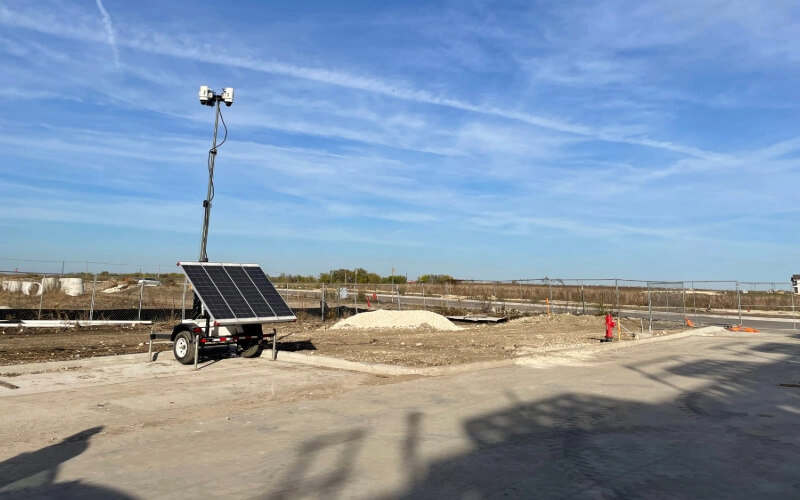
High-definition infrared cameras deliver broad coverage across complex construction sites. Surveillance can be deployed temporarily or semi-permanently on versatile monitoring equipment such as our Mobile Solar Surveillance Trailers with 4G/5G connectivity, enabling simple, rapid setup. |
The backbone of your jobsite security plan, delivering visibility into every monitored area. Helps ensure only authorized personnel enter work zones. Protects crews, equipment, materials, and other valuable assets around the clock. |
|
AI-enabled cameras continuously scan your perimeter and defined zones, identify threats, and send near-instant alerts to designated contacts or remote monitoring partners. |
Reduces theft, safeguards infrastructure, and restricts unauthorized access and trespassing. Provides detailed logs, reports, and video evidence to support incident investigations and strengthen security systems. |
|
|
Surveillance cameras connect to a control center where intervention specialists receive automated alerts of suspicious activity and respond immediately. |
Prevents incidents before they escalate through talk-down capabilities; fortifies construction jobsite security and helps lower insurance costs. |
Read more:
Why Real-Time Monitoring Has Become a Necessary Tool for Construction Companies
Manual oversight and fragmented reporting systems leave too much room for error, exposing vulnerabilities across your portfolio, especially in high-stakes, multi-site operations. More than a safety/security measure, technology-driven monitoring has become an invaluable management tool.
These modern systems promise:
-
Proactive risk management that helps you spot and resolve issues before they derail projects.
-
Fewer delays and rework through real-time visibility into jobsite activity.
-
Stronger compliance with safety and regulatory standards, minimizing downtime and liabilities.
-
Healthier finances by protecting margins, schedules, and budgets.
-
A means of tracking progress and allocating resources more cost-effectively.
A core financial advantage is scalability, since this monitoring technology can be inexpensively expanded across multiple locations. The platform gives you centralized control of each site without being physically present, enabling you to drive consistent standards and make faster, informed decisions toward project and financial success.
Read more: The Future of Safety in US Construction: Proactive Protection
Improve Project Margins with Smart Construction Monitoring
Profitability in construction is heavily dependent on strong controls. Of course, you must control costs and budgets, but you must also manage jobsite risks, timelines, quality standards, and compliance. Weak oversight in any of these areas can quickly leak costs that hit your margins.
Smart monitoring systems offer control through real-time visibility, early detection, and data-driven decision-making, empowering managers to protect performance and profitability across their portfolio.
To discover how you and your key managers can confidently keep projects on track, whether you're on-site, traveling, or at the head office, contact us today.
