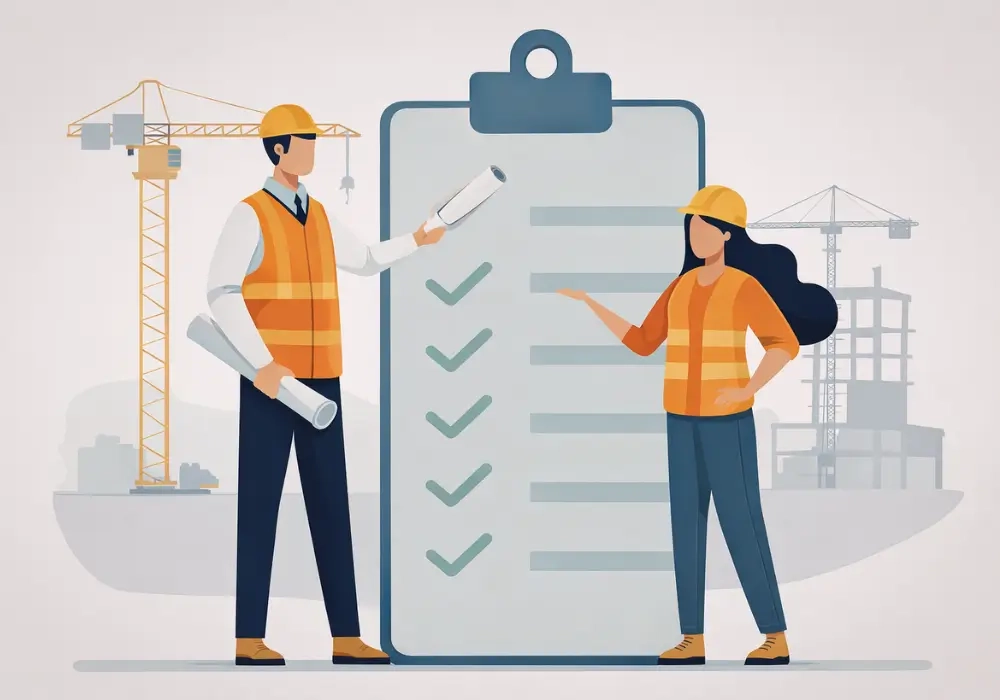
Safety management in the US construction industry is changing. As projects grow more complex and digital transformation accelerates, safety processes have become increasingly automated and proactive.
Modern strategies focus on preventing accidents before they happen. This represents a shift from inconsistent manual processes that often only report on events after the damage is done and the loss suffered.
Today, leading contractors use live monitoring, smart surveillance, and data-driven insights to intervene earlier and reduce jobsite risks, even if they're working on multiple widely dispersed projects. The result is measurable improvement in worker safety and well-being.
A proactive approach also creates stronger safety cultures and builds trust with OSHA, other regulators, and project stakeholders.
Read on to learn how you can move from reactive paperwork to proactive, real-time protection that stands up to OSHA scrutiny and performs in real-world jobsite conditions.
Why Manual Safety Processes Fail on Construction Projects
Safety management that relies on physical inspections and spreadsheet reporting is no longer fit for purpose in the modern construction industry. This is especially true if you manage multiple large projects in different locations.
We spotlight 5 critical weaknesses of manual systems:
-
Delayed event reporting: An incident occurs, but the report is completed days later or forgotten altogether. Periodic checks and audits contain outdated data that quickly becomes worthless.
-
Higher incident rates due to visibility gaps: When safety leaders spend hours on the road traveling to different locations to conduct inspections, there are long time lags between visits. This leads to unsafe behaviors going uncorrected, increasing the risk of accidents and compliance failures.
-
Poor records: Incident reports are inconsistent and scattered in disconnected systems, and these data silos complicate information sharing between teams. There is no big-picture view of the company's operations because everything is fragmented and lacking proper detail.
-
Human error: Human fallibility is a major shortcoming in manual inspection workflows. Sometimes serious hazards (e.g., a carbon monoxide buildup) are missed entirely. Data files are lost or incomplete, while evidence relies on memory and subjective accounts, which are not always reliable.
-
Compliance and audit vulnerability: When information must be stitched together from different processes to meet compliance and audit requirements, it becomes more challenging to satisfy OSHA and other regulators. If authorities lack confidence in your safety protocols and standards, expect increased regulatory scrutiny.
These legacy system weaknesses are real and often come with costly consequences.
What are the Costs of Outdated Construction Site Safety Systems?
There are several areas where the cost of outdated controls can severely impact project profitability.
Higher incidents and accidents
The stats may only tell part of the story, but they highlight the high-risk nature of building work:
-
1 in 5 worker fatalities in the US occurs in the construction industry
Contractors have a legal duty to safeguard construction workers by ensuring a workplace free of known hazards. Weak, reactive controls jeopardize worker safety every day, increasing the risk of incidents and accidents. The cost is measured in fatalities, injuries, lost productivity, mounting liability, and mental health issues.
Higher insurance and claims costs
Insurance companies view employers with high accident rates and frequent workers' compensation claims as higher-risk clients. They are usually penalized with above-average Experience Modification Rates (EMR), meaning:
-
Higher premiums (on workers' compensation, auto, builder's risk, and other insurance policies)
-
Fewer coverage options
-
Less favorable renewal terms
For context of the sums involved for workers' comp, in its 2025 Workplace Safety Index, Liberty Mutual estimated that US employers paid more than $1 billion weekly in direct workers' compensation costs for disabling, non-fatal workplace injuries.
Enforcement actions
When safety measures don't meet standards or if permits and/or ordinances are breached, construction projects can be shut down or suspended by regulators:
-
OSHA can halt operations via stop-work orders if safety standards are not met
-
Local permitting or environmental authorities can shut down or suspend jobsites for ordinance violations and permit breaches
Each day construction is halted costs thousands of dollars in lost productivity. Add to that the legal and administrative expenses required to lift shutdown or suspension orders, and the financial hit grows quickly and heavily.
Weak legal defenses
If workplace injuries lead to a lawsuit, your legal defense will depend on the quality of your safety records. Poor documentation makes it harder to prove you exercised due diligence, such as:
-
Identifying and limiting workplace hazards
-
Actively enforcing safety procedures
-
Delivering proper training
Without this evidence, you are exposed to potentially crippling liabilities and costs.
Regulatory penalties
Construction companies face sizable fines for violating mandated safety protocols. Here are a few examples of regulatory penalties:
-
OSHA fines for violations start at $16,550 and rise to $165,514 per violation.
-
Companies guilty of repeat offences can be placed in OSHA's Severe Violator Enforcement Program (SVEP), which creates additional compliance headaches.
-
Repeated, willful OSHA violations can lead to criminal charges.
-
EPA civil penalties for Clean Air Act violations may reach up to $472,901 per violation.
-
In a well-documented case, Jasper Contractors Inc. was penalized over $280,000 for OSHA rule breaches.
Read more: 7 Costly Compliance Mistakes US Construction Firms Can't Afford
Managing Construction Safety Compliance
OSHA can shut down entire projects and impose stiff penalties for inadequate safety measures. The regulator takes its mandate to enforce occupational safety in the construction sector seriously, focusing strongly on high-risk areas such as fall protection, environmental hazards, PPE use, and heat exposure.
Here's an overview of critical OSHA enforcement areas that all industry leaders should be aware of.
| Risk area/ OSHA Regulation | Key Construction Safety Requirements |
| Fall Protection (Subpart M regulations) | Fall prevention equipment, like harnesses and guardrails, and safety practices are required when working at heights of 6 ft+ above a lower level. |
| Fall Training Records (1926.503) | Regular training around fall prevention and protection is mandatory; training programs must be documented. |
| Ladder Safety (1926.1053) | All ladders must be securely used and maintained on jobsites. |
| Personal Protective Equipment (PPE) | Construction workers must wear appropriate PPE: hard hats, hi‑vis vests, goggles, hearing protection, footwear, and respirators. |
| Noise Exposure (1926.52) | Permissible Exposure Limits (PELs) set legal limits for maximum noise levels workers can be exposed to during a workday, e.g., 90 dB over an 8 hr average. |
| Hazard Communication (HazCom) | Hazardous materials must be labeled; workers must be regularly trained; safety data sheets must be kept. |
| Scaffolding (1926.451) | Scaffolds must be properly built, secured, and maintained. |
| Air Quality Hazards(Permissible Exposure Limits) | Permissible exposure limits apply for airborne contaminants (e.g., CO₂, CO, silica, dust, asbestos). |
| Heat Exposure NEP(NEP for Outdoor and Indoor Heat-Related Hazards) | Employers must have a written heat exposure prevention plan, provide shade/water breaks, and acclimatize crews to hot conditions. |
| Recordkeeping | Injuries/illnesses must be logged and retained for 5 years (Forms 300, 300A, 301). |
While OSHA is the chief workplace safety regulator, there is a sweep of laws that safety and business leaders must navigate. Here's a summary of other regulatory expectations that project safety/ compliance programs should factor in, where applicable.
| Regulatory Body | Key Requirements |
| EPA (Environmental Protection Agency) |
|
| Local/State Regulations | Local and building codes, zoning laws, permits, and state-specific safety/environmental rules. |
| CPRA (California Privacy Rights Act) | Applies to construction firms operating in California. Requires protection of employee and client data, with strict privacy and disclosure rules. |
| NDAA (National Defense Authorization Act) | Restricts the use of certain foreign-made technologies and materials in federally funded projects. |
Why Technology-Driven Safety is the Future
Future-focused construction firms have adopted tech-enabled safety management to protect crews and projects more effectively. This proactive strategic approach has meaningfully improved compliance and reduced legal liabilities on projects.
Smart modern solutions enable 24/7 real-time monitoring, mobile access and reporting, and centralized dashboards for "single-point" control. The cutting-edge technology includes AI-powered detection and reporting that prevent construction accidents and incidents before they occur. Let's take a closer look at the features and capabilities.
Components of smart safety solutions
Digital safety systems are built around automation, AI-driven surveillance, centralized dashboards, and mobile-friendly access using cloud technology.
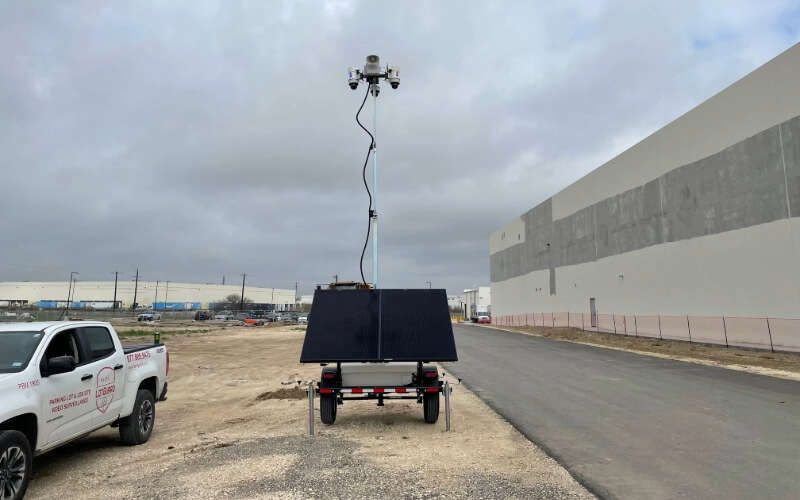
- AI-powered surveillance: High-definition PTZ (Pan-Tilt-Zoom) cameras and advanced sensors are the backbone of smart monitoring systems. They capture project data and operational video footage from easily deployed Mobile Surveillance Trailers or temporary camera
Never sleeping or losing focus, intelligent networks scan jobsites continuously to collect the critical data leaders need to understand site conditions and make well-informed decisions.
- Automation: Digital tools automatically monitor and report on safety hazards and environmental conditions. This approach improves workplace safety by moving away from slow, flawed human checks and manual data collection.
Alerts on non-compliance (e.g., crews not wearing hard hats) or unsafe conditions (dust and winds) are auto-generated and sent to the responsible site manager in real-time. System-generated, executive-ready reports are available much more quickly than if they were prepared by a busy project manager.
-
AI analytics: Modern solutions use machine learning and AI-video analytics to track, analyze, and document jobsite activities. The artificial intelligence is trained to recognize potential hazards and breaches (e.g., PPE non-compliance or unauthorized access) and raise near-instant alerts.
-
Unified information: Smart systems consolidate all project data into a single interface, making it easy for safety managers and other authorized users to view and act on the information. This is a major improvement over separate, disconnected processes that often leave costly information gaps.
-
Cloud-based: Leading safety systems usually run on cloud platforms. Cloud services are flexible, secure, and easily accessible from anywhere on mobile devices. Capacity can be effortlessly scaled to expand site coverage or roll out across new projects.
Our smart, cloud-based Stellifii platform is a safety solution that enables you to manage regulatory and safety risks from central dashboards. Stellifii consolidates all critical project data into a single interface, providing managers with mobile access and real-time visibility into:
-
Fire and smoke detection
-
Safety compliance
-
PPE compliance
When issues arise, the system triggers warnings with timestamped evidence. Stellifii stores a log of the incident and a record of the corrective action, ensuring you always have clear proof of due diligence to show inspectors.
Read more:
5 Benefits of Proactive Digital Safety Systems
Let's explore 5 major benefits of proactive safety tools and systems.
1. Stronger site safety and risk management
Real-time monitoring transforms reactive responses into proactive risk management. When systems detect potential hazards (missing PPE, unsafe weather conditions, etc.), automated tools trigger immediate notifications that allow for corrective action.
Faster responses mean fewer injuries and incidents. Swift resolution keeps projects on schedule and protects against a range of liabilities, such as reputational harm and lawsuits.
Investigations and root-cause analysis also become simpler and are based on solid evidence. Continuous real-time tracking uncovers trends, like weak subcontractor supervision of high-risk tasks, and actionable insights guide mitigation strategies to drive continuous improvement in safety standards across all locations.
2. Watertight audits with evidence
Automated systems provide a reliable record of compliance documentation, ensuring you're always audit-ready. Instead of searching scattered files for records, you can pull comprehensive reports on environmental compliance, PPE adherence, and security checks at the touch of a button.
If an inspector investigates an environmental issue from 3 months ago, you can quickly produce a timestamped sensor reading linked to corrective actions taken. The idea is to prove that even if a temporary breach occurred, you acted quickly and responsibly to resolve it.
This shows authorities that you have strong safety practices and are serious about legal compliance.
3. Less administration and travel
Digital oversight significantly cuts down on administration and travel for performing site inspections. Automated oversight keeps you fully updated on the safety status of every jobsite with detailed executive and compliance reports at your fingertips.
By minimizing manual workloads and travel, oversight teams can focus on higher-value tasks such as strategic reviews. Eliminating separate systems (vendor sprawl) and unifying reporting in a central hub brings teams onto the same page, improving information sharing and decision-making.
4. Stronger safety cultures
Visible, proactive management signals to crews that leadership values safety and is concerned about their well-being. When workers experience consistent monitoring and real-time intervention/ feedback, they feel more secure, trusting, and accountable for their actions.
Over time, crews become more invested in project safety efforts. They take ownership of their actions and contribute more actively to protecting both themselves and their teammates. As everyone on site prioritizes safety as part of everyday operations, a stronger compliance culture emerges.
5. Fewer claims and lower insurance costs
Organizations with strong safety records submit fewer workers' comp and other insurance claims. Insurers view safety-conscious contractors more favorably and offer them lower premiums and better terms.
Construction projects carry several types of coverage to protect themselves financially, so insurance savings could be substantial across the portfolio, which might include:
-
Builder's Risk Insurance
-
Workers' Compensation
-
General Liability
-
Commercial Auto
-
Subcontractor Default
8 Digital Tools Securing a Safer Future On Construction Jobsites
To enhance construction safety and security, we offer cutting-edge AI-powered surveillance and monitoring solutions, including smart detection systems (PPE, intrusion, fire), environmental monitoring, and jobsite security systems.
1. PPE Monitoring
Proactive AI PPE monitoring reduces incidents and claims while protecting workers way more effectively than inconsistent spot checks. Equipment monitoring systems scan jobsite zones continuously for required protective gear, including:
-
Hard hats
-
High-visibility vests
-
Goggles
-
Hearing protection
-
Safety boots
-
Respiratory masks
When a worker enters a designated zone without proper equipment, the system automatically captures a timestamped snapshot and sends real-time alerts to safety/project managers. It can also issue a live warning to non-compliant workers.
The incident, including the corrective action, is logged on Stellifii, creating a record of enforcement.
2. Noise Monitoring Sensors
Besides safeguarding the crew from hearing damage, analytics-backed noise control proves compliance with regulations and ordinances. Integrating directly into Stellifii, IoT Noise Monitoring devices continuously monitor jobsite sound levels across:
-
30-130 Decibels
-
20Hz to 12.5kHz frequency
The system generates instant alerts and records for noise violations and potential hazards, like spikes from machinery or blasting.
3. Air Quality Sensors
To manage the risks of airborne hazards and reduce air quality breaches, IoT air sensors capture thousands of data points every hour, storing up to 180,000 time-stamped records for trend analysis and compliance. Our field-ready Air Quality Sensors measure:
-
Dust and PM1, PM2.5, PM10 particulate matter
-
Volatile organic compounds (VOCs)
-
Chemical fumes
-
Carbon dioxide (CO₂)
-
Carbon monoxide (CO)
Sensors trigger immediate alerts if pollutant thresholds or safety levels are breached, allowing you to pause, adjust operations, and/or eliminate hazards to restore safe conditions.
Read more: Air Quality Data Management: Turning Sensor Data Into Actionable Insights for Jobsites
4. Advanced Weather Monitoring
Extreme weather, like storms and flooding, can be catastrophic for construction sites. To stay ahead of weather risks, monitoring stations track meteorological conditions continuously, including:
-
Extreme temperatures
-
Winds (speed and directions)
-
Humidity
-
Rainfall
-
Storm indicators
AI monitoring stations protect the crew and site from imminent danger (high heat, heavy rains, winds) by activating work stoppages when necessary to prevent harm and OSHA penalties.
Accurate, up-to-date weather insights enable managers to introduce safety measures and reschedule activities around weather events to mitigate risks and avoid project delays.
5. Smoke and Fire Detection
Advanced smoke detection uses HD cameras and AI to scan jobsites 24/7 for flickering light and heat signatures that indicate early-stage smoke or flames. When fire signs are identified, the system flags the situation instantly. To help responders understand the full extent of the danger, notifications include:
-
A timestamped image of the blaze
-
Video footage
-
Precise source and location details, e.g., Zone A, Level 3, Grid B5
Intelligent fire detection systems are proven to respond faster than regular fire alarms, minimizing incidents and potentially costly losses.
Read more: Why Video Analytics is Best for Smoke and Fire Detection
6. License Plate Recognition (LPR) and Access Control
License Plate Recognition monitors and logs all vehicles entering and exiting jobsites to strengthen access controls. It also tracks speeds to encourage safer driving and supports:
-
Theft prevention
-
Vehicle accountability
-
Breakdown responses
With every entry and exit logged, LPR helps investigations and provides audit trails for compliance purposes.
7. Security Systems
AI-equipped security systems monitor jobsite perimeters and restricted zones, guarding against:
-
Perimeter breaches
-
Unauthorized access to off-limit sectors
-
Trespassing and vandalism
Our fully-managed and easily deployable systems (added onto Solar Surveillance Trailers or other mobile monitoring setups) detect suspicious behavior and trigger immediate warnings, while eliminating false alarms (animals, weather, debris, and blowing tarps). The platform retains logs and video evidence for reporting and investigations.
Our security service integrates with Live Video Monitoring, where trained specialists respond within seconds to suspicious behavior detected on the feed.
Read more:
-
The Benefits of Integrating Your Security and Communications Systems
-
The Future of Construction Security: From Guards to AI-Powered Smart Systems
8. Centralized dashboards
Operational leaders can manage all of the above on Stellifii. Safety, environmental, and security data all flow into the platform's central dashboards, and security and compliance managers can easily view the latest intel from all projects remotely.
Real-time data and AI analytics deliver high-value, actionable insights that help leaders make better, faster project and security decisions.
Stellifii is end-to-end AES-256 encrypted to protect project data from hacking and cyberattacks. The platform and tools are also NDAA-compliant, meaning the system can be used on federal contracts.
Related Article: How Can Construction Jobsites Adapt To Digital Transformation
The Next Steps to Smart Proactive Jobsite Safety
The future of construction safety will feature automated tools, mobile-friendly platforms, and real-time risk scanning. By implementing systems with built-in AI insights, leaders gain a powerful advantage in safeguarding crews and jobsites.
Real-time monitoring and detection deliver immediate alerts, enabling prompt corrective actions. Centralized dashboards deliver actionable information, easily accessible on any connected device (on mobile or desktop).
Automated reporting ensures audit requests from regulators or insurers can be answered in minutes with defensible, timestamped documentation, saving considerable time and money.
To upgrade your safety program and better protect your workforce and company's valuable assets, contact us today to discuss future-ready digital solutions designed specifically for the construction field.