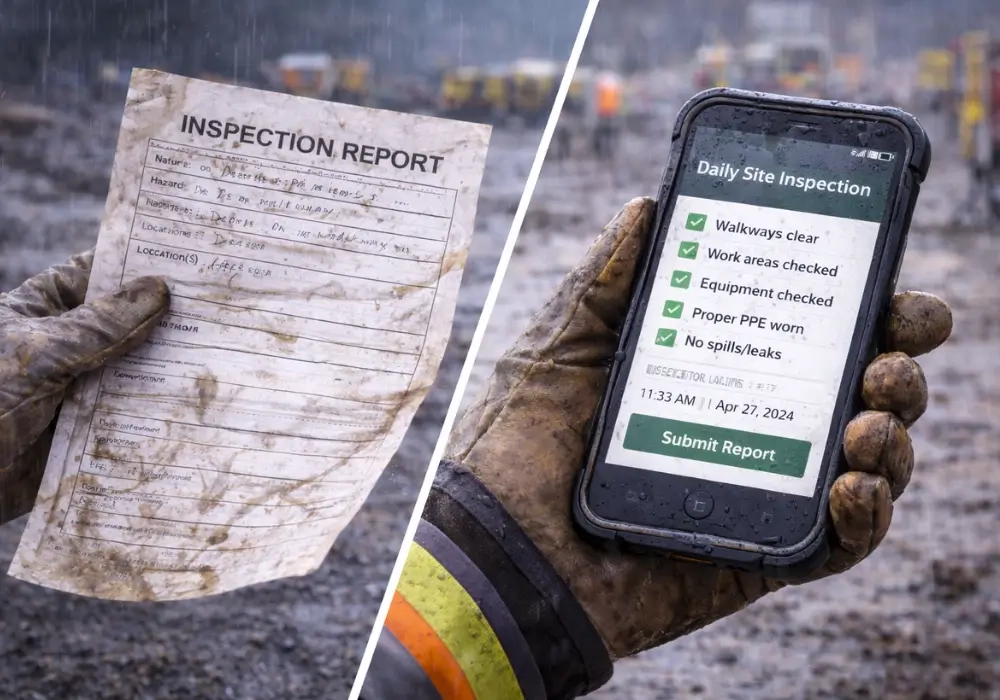
Modern safety leaders can no longer rely on periodic jobsite visits and manual forms to manage construction safety effectively. Clipboard inspections leave critical gaps and vulnerabilities, especially given the complexity of today's projects and growing compliance pressures.
Even if you only manage one site, safety managers can’t be everywhere at once. And if you oversee multiple projects, the window between inspections widens, so risk incidents like PPE failures, unsafe hot work, or CO₂ buildup can go undetected and lead to accidents and regulatory fines. Paper logs only record these issues after the fact, which is way too late.
By replacing paper trails with a centralized digital platform using smart technology, safety professionals can stay on top of every risk on every site, even when they are miles away.
In this article, we break down how mobile monitoring and digital inspections have reshaped construction safety management by providing real-time visibility and continuous multi-location oversight while reducing travel and administration.
Why Manual Inspection Processes Let You Down
Oversight that relies on paper-based safety inspections and spreadsheet reporting no longer meets the demands of modern construction operations. This is especially true if you manage multiple large projects in different locations.
Let's briefly touch on the weaknesses of manual systems:
-
Delayed reporting: An incident occurs, but the report is completed days later or forgotten altogether. Periodic checks and audits contain outdated inspection data that quickly becomes worthless.
-
Visibility gaps: When safety leaders spend hours on the road traveling to different jobsites to conduct field inspections, there are long time lags between visits. This often leads to unsafe behaviors going uncorrected, increasing the risk of accidents and compliance failures.
-
Poor records: Inspection reports are inconsistent and scattered in disjointed systems. Data silos complicate information sharing between teams. There is no big-picture view of the company's operations because everything is fragmented, so information must be frantically pieced together to meet regulatory compliance and other audit reporting requirements.
-
Human error: Human fallibility is a major shortcoming in manual inspection workflows. Risks are missed entirely, and data files are lost or incomplete. Evidence relies on memory and subjective accounts, which are not always reliable. For instance, a distracted officer fails to raise an alert about missing safety equipment.
These legacy system weaknesses are real and often come with costly consequences.
The costs of inspection gaps
Unchecked or overlooked safety issues frequently lead to injuries and even fatalities in construction. Major incidents can disrupt work and force projects off schedule and over budget.
In addition, construction companies face hefty fines for violating mandated safety protocols. For context, here are a few examples of regulatory penalties:
-
OSHA fines start at $16,550 and rise to $165,000 per violation. Extreme cases can lead to imprisonment.
-
EPA civil penalties for Clean Air Act violations may reach up to $472,901 per violation.
-
Regulators can restrict working hours or shut down projects entirely, causing substantial losses.
-
In Secretary of Labor v. Juan G. Quevedo-Garcia, the owner of a limited liability company was held personally liable for approximately $2 million in penalties.
-
Jasper Contractors Inc. was penalized over $280,000 for breaching OSHA regulations.
Read more: 7 Costly Compliance Mistakes US Construction Firms Can't Afford
What Mobile-Friendly Digital Monitoring Looks Like
The mobile-friendly systems modernizing inspection processes are built around AI surveillance networks and centralized management platforms:
-
Digital surveillance: Provides 24/7 eyes and ears on the ground across every jobsite.
-
Centralized reporting platform: Unified dashboards present real-time inspection data, incident reports, and insights to inform better, faster management decisions. The information is readily available on desktop or mobile devices.
Digital surveillance
High-definition PTZ cameras and advanced sensors continuously capture data from all your sites. This data might range from environmental conditions to PPE and perimeter security information. When critical events (e.g., noise ordinance violations) occur, real-time alerts are pushed to the responsible manager.
The cameras and sensors are deployed on smart surveillance infrastructure, such as:
-
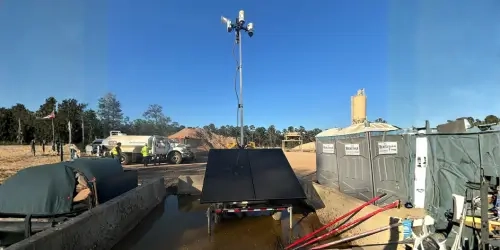
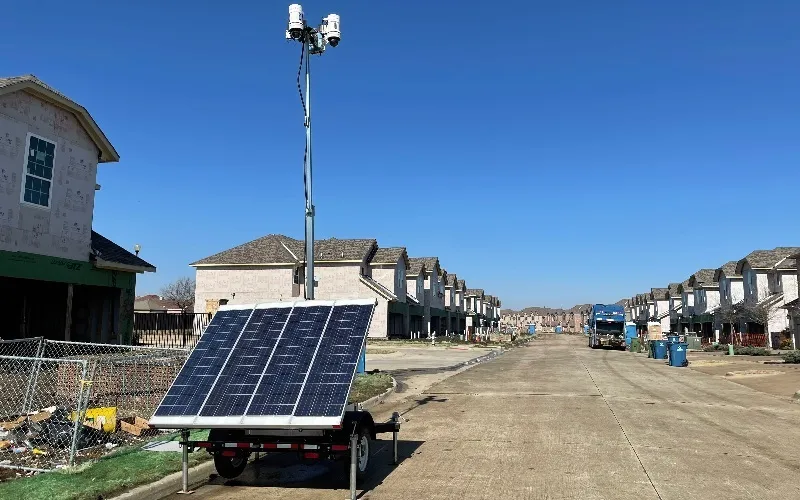
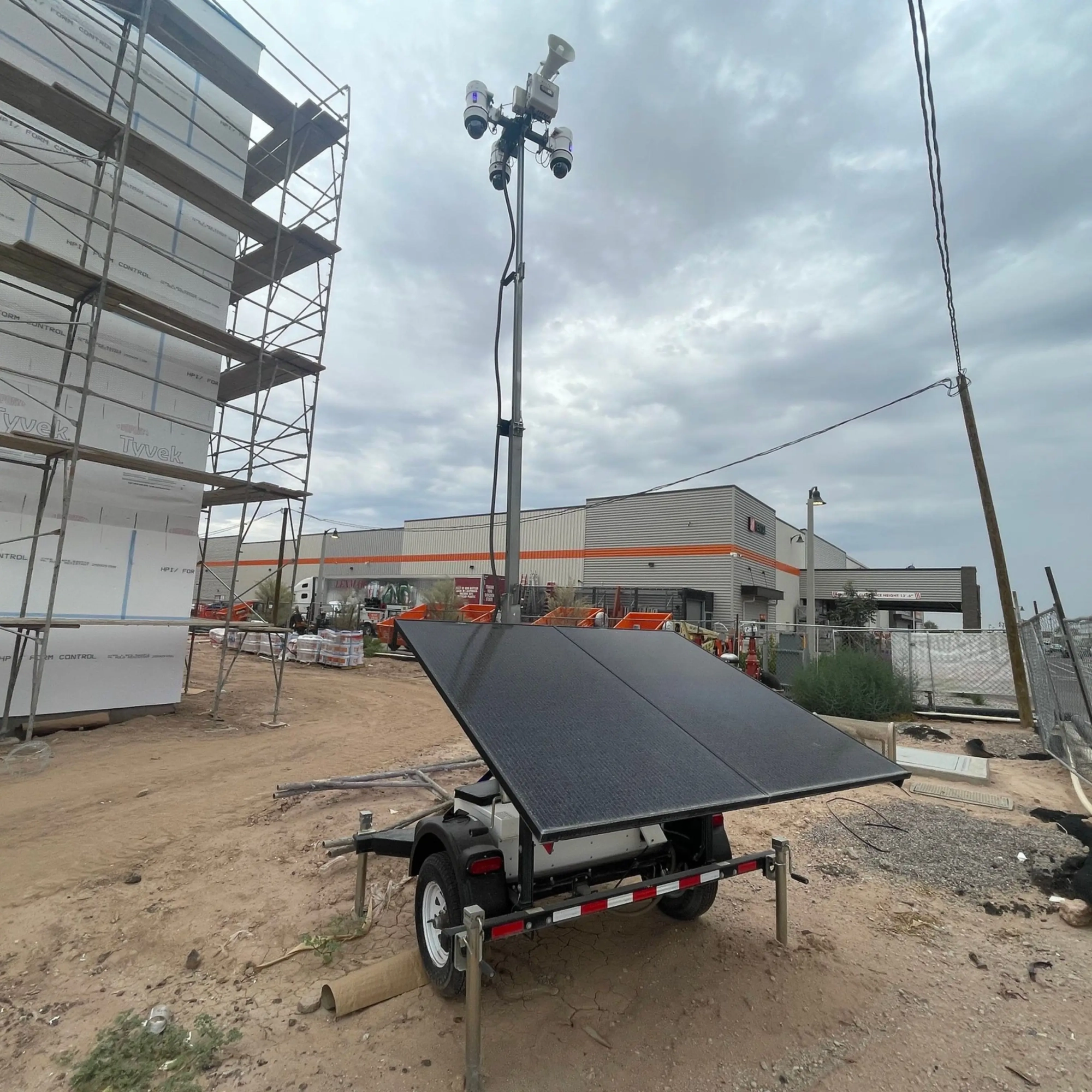
Mobile Surveillance Trailers: Standing around 20 feet tall, these are rapidly deployable solar platforms for wide-area monitoring in even the most complex project environments, ideal for remote jobsites with little or no permanent infrastructure.
-
Pole Cameras: Equipped with infrared (IR) night vision, pole cameras are fixed to existing infrastructure, including utility poles or buildings. They provide automated compliance tracking without the need for permanent cabling or tricky installations.
-
Temporary and semi-permanent camera installations: The network is installed based on your safety management and compliance tracking needs.
Modern surveillance cameras use built-in AI video analytics and advanced safety inspection software to recognize the data they track quickly and accurately.
-
Advanced Security Systems use artificial intelligence (AI) to "read" motion and behavior patterns. They accurately identify intruders while filtering out false triggers caused by animals, passing vehicles, debris, or shifting shadows.
-
Specialized Smoke and Fire Detection systems recognize early heat signatures or the faintest trail of smoke to alert teams to fire dangers. They distinguish genuine fires from harmless indicators (e.g., fumes, controlled welding sparks).
By implementing digital surveillance on all your construction sites, you no longer need to conduct inspections in person and can save countless hours of travel.
Read more: Why Smart Surveillance Systems Are the Future of Business Security
Centralized reporting platform
Centralized reporting consolidates safety, security, compliance, and environmental monitoring into a single user-friendly interface. A unified platform reduces the need for spreadsheets, paper logs, and manual inspection processes and eliminates juggling multiple tools searching for information, which wastes 10% productive hours each week.
Our trusted cloud-based platform, Stellifii, brings surveillance feeds from every camera/sensor on every jobsite into structured dashboards. The smart management software transforms multi-site complexity into clear, actionable insights.
Leaders access real-time intelligence on their mobile devices from any location with an internet connection. Armed with the latest safety information, you can initiate corrective actions to address safety issues before they unravel. The capability shifts safety management from a reactive exercise to a proactive strategy, where you anticipate and prevent incidents before they occur.
Ensuring you're always prepared for inspections, Stellifii generates compliance reports at the push of a button. Besides enhancing workplace safety, unified knowledge boosts operational efficiencies. A 2025 Bloomfire study shows that smart information management with AI-insights improves workflow speeds by up to 39%.
Stellifii safeguards project data with end-to-end AES-256 encryption (14 rounds of encryption). Our technology is NDAA-compliant, making it suitable for use on federal contracts.
Related Article: Stellifii: Our New Smart Platform Transforming Surveillance, Safety, and Compliance
3 Digital Monitoring Systems Transforming Construction Safety Inspections
3 modern tools that automate inspections and strengthen safety programs on jobsites are:
-
IoT monitoring devices
-
Smart Detection tools
-
Security/access control solutions
These tools are all designed for mobile convenience and operate through a central platform that generates reports and compliance documentation for up-to-the-minute oversight.
Let's take a closer look at each:
1. IoT-based environmental tracking tools
IoT-based tools have significantly improved environmental data tracking and control on jobsites. Smart sensors collect and transmit real-time information about environmental conditions that pose safety risks to crews and the surrounding community.
Measuring continuously, they detect potential hazards far faster and more accurately than physical checks.
-
Noise Monitoring Sensors track jobsite sound levels across decibel and frequency ranges of 30-130 dB and 20Hz to 12.5kHz. OSHA safety regulations (52) set noise limits that workers can legally be exposed to. To protect your crew and relations with the local community, sensors send immediate alerts when limits are breached. As with the other tools, data and reports are logged on Stellifii and accessible when an inspector queries an incident.
-
Air Quality Sensors monitor fine particulate matter (PM1, PM2, PM10), CO₂, VOCs, and other air-borne hazards. To ensure regulatory compliance, project leaders set the sensors to trigger a notification when jobsite conditions reach legal limits (e.g., EPA thresholds under the National Ambient Air Quality Standards (NAAQS) of the Clean Air Act (CAA)).
-
Weather Monitoring Stations provide real-time data collection of meteorological conditions, including temperature,/humidity, winds, rainfall, lightning, and storm activity that impact operations. These insights help you to plan proactively around weather events. Planning might involve building rest and rehydration breaks into timelines ahead of an expected heatwave.
Read more: Air Quality Data Management: Turning Sensor Data Into Actionable Insights for Jobsites
2. Smart detection tools
Intelligent field-ready tools are trained on tens of thousands of hours of footage to accurately identify and flag construction safety risks such as fire and missing PPE.
-
Smoke and Fire Detection systems use cameras and AI analytics to spot the early signs of smoke or flames. The automated system triggers alerts faster than traditional fire alarms that often only activate after a large smoke or high heat accumulation, by which time flames are already spreading dangerously. Smart fire warnings include a timestamped snapshot and video clip, so that responding teams can understand the size and danger of the threat.
-
Intrusion Detection: Intrusion detection monitors jobsite security perimeters and restricted zones continuously, guarding against unauthorized access, trespassing, and theft. Unlike security guards on foot patrol, real-time overwatch doesn't sleep, lose concentration, or head on annual vacation. The platform automatically logs reports of suspicious activity, complete with timestamped images and video footage.
-
PPE Monitoring: Workers not wearing PPE is a common construction safety challenge. Clipboard equipment inspection clearly isn't enough to consistently reinforce this essential safety standard. Many companies utilize digital tools to continuously scan and flag when employees fail to wear proper protective gear. Automated oversight and enforcement, including live-voice warnings, significantly reduce PPE-related accidents, injuries, fines, and legal liabilities.
Seamless integration of these tools and their surveillance streams into Stellifii provides live dashboards to guide management decisions in the moment. It also ensures all incidents and reports are logged and retained within the platform to assist with later audits.
Read More: The Benefits of Smoke And Fire Video Analytic Detection On Jobsites
3. Security and access control
Easily deployable security surveillance (on trailers, temporary cameras, or other mobile monitoring setups) spots suspicious behavior and triggers immediate warnings. Analytics distinguish real threats from false alarms and retain timestamped logs and video evidence for security reporting and investigations.
Fully-managed with ongoing support, our security solutions integrate Live Video Monitoring alongside their surveillance. Operators in live monitoring control centers take immediate action in response to any suspicious activity spotted in the feeds. Interventions include:
-
Live voice warnings/ challenges
-
Activating strobe lights
-
Dispatching a keyholder
License Plate Recognition (LPR) automatically tracks and logs all vehicles entering and exiting jobsites. The system helps to bolster:
-
Access control
-
Vehicle accountability
-
Vehicle safety on-site
Connecting smart detection tools (fire, PPE) and environmental monitoring to these security measures gives you comprehensive jobsite visibility and safety control.
Read more:
5 Advantages of Digital Monitoring Tools
Mobile-friendly compliance tracking unquestionably enhances safety in construction and industrial environments and offers several other benefits.
Here's a rundown of the major advantages over more traditional systems:
1. Real-time visibility and instant documentation
Digital monitoring provides instant access to safety data across every corner of every work zone. Instead of waiting days for foremen's reports or reviewing hours of surveillance footage after incidents, you can view live jobsite conditions as they develop.
Toggling multiple applications or searching scattered files to prove compliance becomes a thing of the past. All relevant documentation is available almost immediately, supported by objective evidence, free of human bias.
2. Watertight evidence
Tech tools document what happened, when it happened, and the real-time responses that were made. Stellifii can link sensor data (e.g., a noise hazard) with an alert and a video clip, showing the exact location, source, and corrective actions.
If an OSHA official investigates the incident, you can produce a report detailing the event, the automated alert, and your rapid, effective response. You prove your case with irrefutable evidence instead of unreliable manual logs that can be challenged.
3. Reduced administration and travel
Digital inspections significantly cut down labor-intensive administration. Automated compliance tracking keeps you fully updated on the safety status of every jobsite with detailed reports at your fingertips. Executive and compliance reporting can be handled at the push of a few buttons.
By minimizing manual workloads and travel, oversight teams can focus on higher-value tasks such as strategic reviews. Eliminating separate systems (vendor sprawl) and unifying reporting in a central hub brings teams onto the same page, improving information sharing and decision-making.
4. Predictive analysis and preventive safety
Monitoring tools enable proactive data-driven risk prevention. By collecting historical safety data across multiple projects, monitoring platforms can analyze inspection data to uncover compliance trends and identify patterns, such as repeat access breaches or workers skipping required water breaks.
This predictive analysis allows you to intervene before minor non-compliance becomes a major issue.
5. Stronger safety audits in all areas
With the capability to monitor compliance across virtually every risk area, you are audit-ready to handle every type of inspection covering any jobsite, including:
-
Demonstrating PPE enforcement to an OSHA inspector.
-
Providing detailed fire alerts and response logs to fire marshals.
-
Producing continuous logs of air pollutant and noise monitoring, plus corrective steps for an EPA agency or permitting authority.
Audit reports are supported by surveillance footage to back up your case with verifiable evidence.
Read more: Top Strategies for Ensuring Jobsite Safety
Replace Manual Monitoring with Smart Oversight Today
By integrating digital monitoring into your daily operations, you improve inspection results and build safer environments and stronger compliance management.
With complete visibility into every jobsite risk on your mobile app, you ensure compliance and drive continuous improvement in safety standards wherever you work.
Leaders who protect crews and the company’s reputation and bottom line (through fewer penalties and legal claims) earn a deserved reputation as valued team players.
Ready to switch from manual safety processes and experience smart, dynamic monitoring that never sleeps? Reach out today, and let's find the best solution for your tomorrow.