US construction managers must navigate a complex web of overlapping regulations. The California Privacy Rights Act (CPRA), the Occupational Safety and Health Administration (OSHA), and various federal environmental laws all have specific requirements, but none work in isolation.
Here are a few examples: jobsite surveillance cameras must adhere to CPRA's data privacy laws, OSHA requires detailed record-keeping for all occupational injuries, and the Environmental Protection Agency's (EPA) Clean Water Act (CWA) requires permits when construction activities disturb more than one acre of land and have the potential to pollute waterways.
The challenge isn't simply understanding each rule but knowing where they intersect without missing crucial details. When construction teams rely on disconnected spreadsheets and manual logs, it's easy for key information to slip through the cracks during inspections and audits.
The answer? Integrated monitoring systems that simplify overlaps of CPRA, OSHA, and federal rules in real-time.
In this article, we'll break down each regulatory framework, show you where they overlap, and explain how centralized monitoring platforms streamline multi-framework compliance without overloading your team in administrative chaos.
Why CPRA, OSHA, and Federal Rules Matter in US Construction
Understanding these 3 regulatory frameworks individually is the first step toward managing where they overlap:
1. California Privacy Rights Act (CPRA)
The CPRA, an addition to the California Consumer Privacy Act (CCPA), controls how organizations manage and handle residents' personal data in California.
In the construction sector, this may involve workers, subcontractors, vendors, clients, and site visitors, whether through surveillance, GPS apps, or employment-related data (e.g., contracts, biometrics, or attendance records).
In a nutshell, CPRA applies if your construction firm operates in California, has an annual gross revenue exceeding $25 million, and/or handles data of 100,000+ California residents.
Here are a few key requirements set by the California Privacy Protection Agency (CPPA):
-
Individuals' rights: California residents have the right to know what personal information is collected, correct inaccuracies, request information to be deleted, and/or limit processing of sensitive personal information without being discriminated against for exercising their CPPA rights.
-
CPRA rules: Data can only be collected for legitimate purposes (e.g., jobsite security surveillance) and must not be retained longer than what is "reasonably necessary" for those purposes.
-
Non-compliance: The CPPA enforces compliance. Violations can result in civil penalties of up to $2,500 per unintentional violation or $7,500 per intentional violation, including breaches involving minors.
2. Occupational Safety and Health Administration (OSHA)
According to the Bureau of Labor Statistics, around 150,000 construction workers are injured each year.
To reduce these risks, OSHA enforces federal safety and health standards in the US construction industry. Its goal is to prevent fatalities, injuries, and noise exposure through proper training, PPE usage, and proactive risk management. OSHA focuses on mitigating high-risk hazards such as falls from heights, scaffolding failures, excessive noise exposure, and workplace injuries.
Key OSHA requirements affecting construction include:
-
Fall protection (or fall arrest systems): Subpart M regulations cover working from heights of 6 feet above a lower level, measures to prevent falling objects, and safety around dangerous equipment. To ensure compliance, construction companies must provide proper safety training, guardrails, and safety nets as standard.
-
PPE enforcement: OSHA requires the use of personal protective equipment (PPE) such as hard hats, hi-vis vests, safety goggles, hearing protection, protective footwear, and respiratory devices where needed.
-
Occupational noise exposure: Subpart D states construction noise levels cannot exceed 90 dB during an 8-hour workday or 105 dB for up to 1 hour of work.
-
Hazard Communication (HazCom): Provide workers with Safety Data Sheets (SDSs), training on hazardous materials, and the appropriate PPE.
-
Record-keeping: Under 29 CFR 1904 regulations, all work-related injuries and illnesses must be recorded for compliance purposes for at least 5 years. These forms include the OSHA 300 Log, 300A Summary, and 301 Incident Report.
-
Non-compliance: OSHA violation penalties can range from $16,550 per serious violation and up to $165,000 for willful or repeated infringements, including the possibility of criminal charges.
3. Federal rules
Federal construction rules go beyond OSHA by including wage, Net Zero, and environmental (ESG) obligations. These regulations apply to federally funded projects and, in many cases, private construction that affects public resources.
Key federal requirements affecting US construction include:
-
Davis-Bacon Act: Applies to contractors/subcontractors performing work on federally funded or District of Columbia projects exceeding $2,000. Employers must pay "locally prevailing wages and fringe benefits" to all employees.
-
Clean Water Act (CWA): Permits required for stormwater runoffs from construction jobsites disturbing 1+ acres.
-
Clean Air Act (CAA): Strict National Ambient Air Quality Standards (NAAQS) to protect public health (including construction workers) and regulate/monitor hazardous air pollutant emissions.
-
Toxic Substances Control Act (TSCA): Addresses the production, use, exposure, and disposal of specific chemicals (PCBs, asbestos, lead-based paint).
-
NDAA-compliance: Legislation adhering to the National Defense Authorization Act (NDAA), which restricts the use of video surveillance equipment from certain Chinese manufacturers to prevent potential security vulnerabilities.
-
Non-compliance: Repeated CWA non-compliance can cost $5,000 per day. CAA violations can result in a maximum daily fine of up to $472,900, and serious TSCA infringements can carry up to 1 year imprisonment.
Overlap of CPRA, OSHA, and Federal Government Rules in US Construction
Let's take a closer look at where these 3 frameworks coincide:
| Aspect | CPRA | OSHA | Federal rules |
| Surveillance footage | Must protect persons' privacy, limit retention, and store data securely. | Document PPE compliance, hazard exposure, and work-related injuries/accidents. | Provide evidence for EPA violations (air quality, etc.) and wage compliance. |
| Environmental monitoring | May collect personal data if linked to specific construction activities (e.g., welding, excavation). | Demonstrate due diligence for ESG purposes (air quality control, dust emissions, etc.). | Prove compliance with ESG/EPA/Net Zero standards (air control, noise levels, hazardous material handling). |
| Record keeping | Personal data may only be kept for as long as "reasonably necessary". | Keep work-related injury and illness records for 5 years. | Must keep general CAA monitoring logs for at least 5 years. |
| Audit documentation | Must prove data protection measures. | OSHA 300, 300A, and 301 forms, injury/illness reports, and training records. | Payroll records, environmental permits, and NDAA-compliance. |
Example: Installing temporary surveillance systems to monitor PPE compliance (OSHA requirement) means you must protect worker privacy under CPRA law and inform your workforce why surveillance is in place. If these surveillance solutions also integrate with environmental monitoring sensors to monitor air quality (EPA/federal requirement), you're managing compliance across all 3 frameworks from a single unit.
Read more: The Benefits of Mobile Surveillance in Construction
Ensuring Jobsite Regulatory Compliance for CPRA, OSHA, and Federal Rules
You don't need separate systems to comply with each overlapping regulation. Integrated monitoring platforms centralize footage, simplify reporting, and ensure nothing slips through the cracks when it matters most.
Surveillance
-
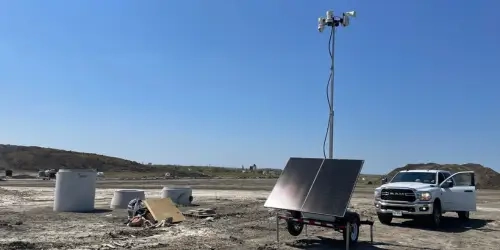
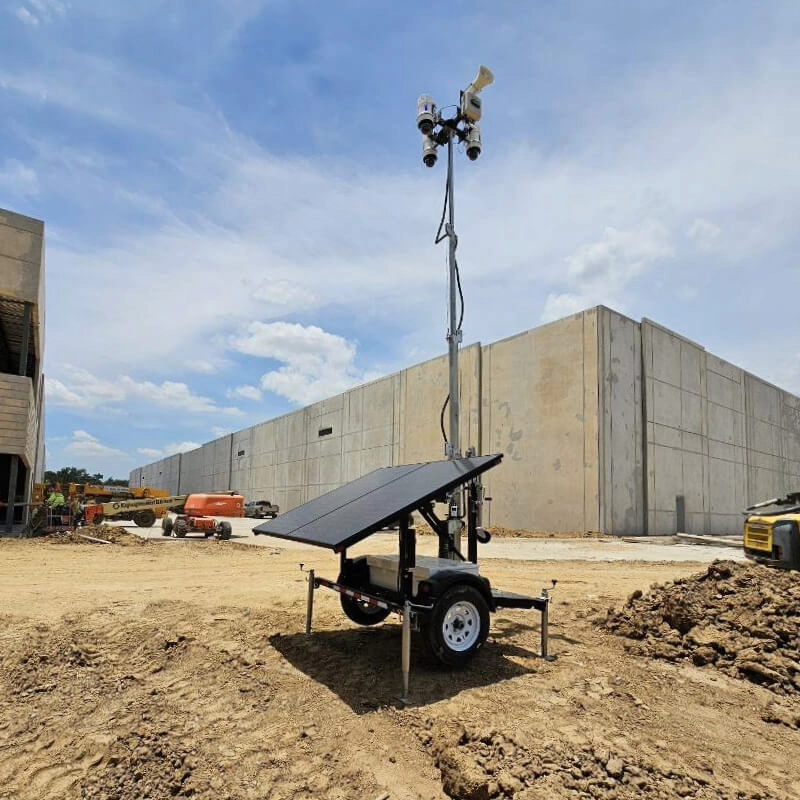
Mobile Surveillance Trailers, standing up to 20-feet tall with near-360° coverage, provide the visual documentation needed for OSHA inspections and CPRA-compliant monitoring. They function on solar power and 4G/5G connectivity, making them ideal for multi-jobsite operations in remote locations where fixed infrastructure is limited or impractical.
-
Pole Cameras provide rapid-deployment surveillance for temporary security, live monitoring, and targeted investigations. They provide time-stamped records and automated evidence trails for all jobsite activity, meeting OSHA, CPRA, and federal requirements.
Linked to live monitoring services, these surveillance systems provide 24/7 professional oversight, allowing real-time response to compliance violations before they become citation-worthy incidents.
How they support compliance
-
CPRA: Secure, AES256-encrypted storage protects worker privacy.
-
OSHA: Document PPE compliance, hazard exposure, and security breaches in real-time with time-stamped video logs and alerts.
-
Federal: Provides visual evidence for EPA inspections (air quality, noise, weather) and accurate incident documentation via NDAA-compliant devices.
Read more: The Future of Construction Security: From Guards to AI-Powered Smart Systems
Smart detection systems
Using PTZ (Pan-Tilt-Zoom) cameras and AI-video analytics to identify violations in real-time, smart detection systems allow for quick corrective action long before inspectors arrive on-site.
-
PPE detection and monitoring instantly flag workers missing the required safety equipment, creating audit-ready OSHA documentation while respecting CPRA privacy laws.
-
Intruder detection prevents unauthorized access that could lead to both OSHA liability (untrained persons in restricted zones) and CPRA concerns (uncontrolled access to areas with personal data).
-
Smoke and fire detection catch the earliest signs of fire hazards, protecting employees (OSHA) and spotting environmental damage (air pollution) that could breach EPA/ESG rules.
Read more:
Environmental monitoring
IoT-based [environmental monitoring] solutions provide real-time jobsite data needed to demonstrate EPA/ESG compliance while supporting OSHA's health and safety obligations and aligning with Net Zero targets.
-
Weather monitoring stations display OSHA and federal due diligence by tracking wind speed (0–110mph), rainfall (hourly), temperature (-4° F to 122° F), humidity (10-99%), lightning, and extreme heat in real-time. The system automatically alerts project managers when conditions are deemed unsafe for crane operations, concrete pouring, and workers' safety via time-stamped evidence alongside correlating footage.
-
Air quality sensors measure particulate matter (PM1, PM2.5, PM10), CO₂, dust, and VOCs in real-time, triggering alerts when construction activities near OSHA/EPA/ESG threshold limits. They give live insights into changing conditions, helping you reduce health risks, respond more quickly to harmful emissions, and maintain a safer working environment
-
Noise monitoring sensors measure a wide decibel (30-130 dB) and frequency (20Hz to 12.5kHz) range that complies with both OSHA and federal noise standards. Should construction work like welding or demolition near the 90 dB mark (for an 8-hour workday), the system instantly alerts jobsite managers and logs every incident through our cloud-based platform, Stellifii.
Read more:
- How IoT Improves Both Safety and IT Overview on Construction Jobsites
- Air Quality Data Management: Turning Sensor Data Into Actionable Insights for Jobsites
Centralized data management
Stellifii, our cloud-based platform, combines all surveillance footage, environmental jobsite data, AI-analytic alerts, and compliance reports in a single dashboard. Eliminating the vendor sprawl often associated with using multiple monitoring platforms, Stellifii streamlines reporting and reduces the risk of non-compliance across all 3 regulatory frameworks.
-
CPRA compliance: AES256 end-to-end encryption and secure 4G/5G networks transmit live data.
-
OSHA documentation: Automated incident reports, PPE compliance logs, training records, and injury/illness tracking all in one place.
-
Federal requirements: Powered by industry-approved, NDAA-compliant infrastructure, Stellifii eliminates the need to switch between providers or systems.
-
Unified, audit-ready reporting: Generate automated exports 5X faster than legacy systems.
Read more: Stellifii: Our New Smart Platform Transforming Surveillance, Safety, and Compliance
Other digital tools
-
License Plate Recognition (LPR) accurately reads vehicle speeds and distances using AI-assisted imaging and logs every vehicle entering/exiting jobsites. This creates accountability for worker attendance, material deliveries, and unauthorized access that could create OSHA or EPA liability.
-
Time Lapse Video condenses days/weeks of jobsite activity into a single video clip, providing visual evidence of building work and compliance with federally funded projects.
Navigate Overlap of CPRA, OSHA, and Federal Rules the Smart Way
CPRA, OSHA, and federal regulations intersect across multiple points on a jobsite. Managing these overlaps requires a coordinated compliance strategy because outdated, disconnected manual systems no longer meet these demands.
Cloud-based platforms like Stellifii eliminate the complexity of centralizing evidence across all 3 frameworks. They consolidate surveillance feeds, environmental data, incident reports, and PPE monitoring into one, CPRA-compliant interface, allowing jobsite managers to pull reports in just a few clicks.
With more than 20-years of experience in wireless monitoring, we provide fully-managed, fully-compliant surveillance solutions that help you meet your regulatory obligations.
Chat to our monitoring experts to discuss your needs today.