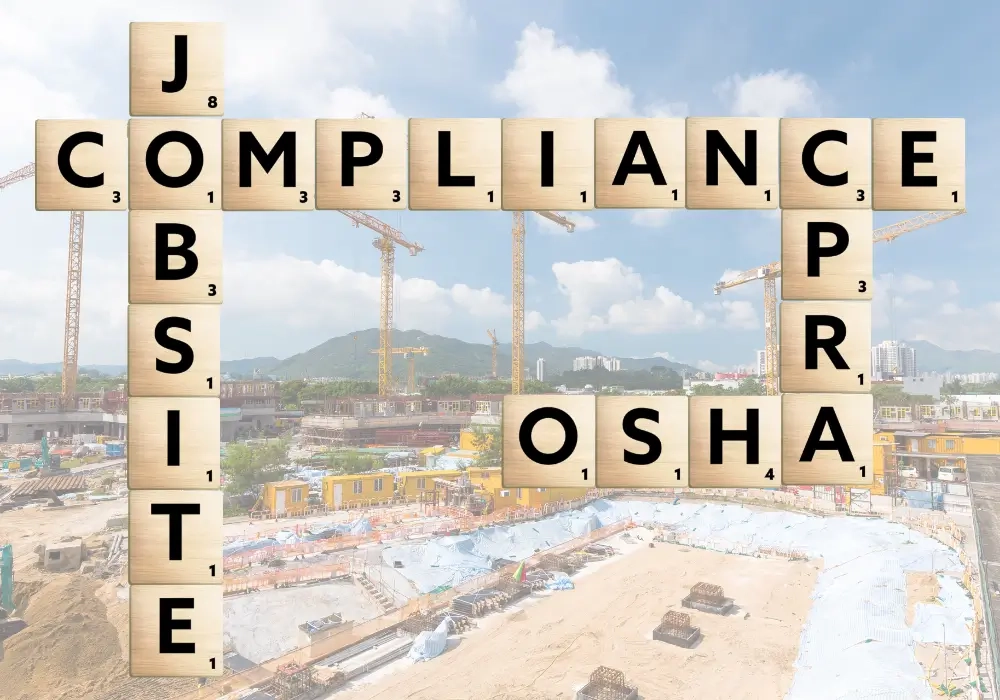
For construction companies operating in California, maintaining compliance with CPRA and OSHA standards is crucial to avoid jobsite accidents and data breaches that can lead to 7-figure liabilities.
The Occupational Safety and Health Administration (OSHA) enforces federal safety and health standards in the US construction industry, with the primary goal of preventing workplace fatalities and injuries, while the California Privacy Rights Act (CPRA) controls how organizations collect and handle residents' personal data in California.
The challenge is knowing where these laws intersect, so that your company can design safety programs that protect crews on the ground while safeguarding their personal information.
But with increasing audit loads and personal liability risks, compliance teams can no longer afford to rely on paper logs, foreman's reports, physical inspections, and other outdated oversight efforts.
Our article examines construction compliance, covering everything from CPRA data privacy obligations to OSHA safety enforcement standards, as well as technology solutions that reduce risk and support due diligence.
Understanding CPRA and OSHA Regulations in California Construction
The CPRA (California Privacy Rights Act) and OSHA (Occupational Safety and Health Administration) are two of the most important laws affecting construction compliance in California.
Introduced in November 2020, the CPRA builds on and expands the California Consumer Privacy Act (CCPA) of 2018, by setting strict requirements for how organizations must manage personal data when operating in California. In construction, this includes data from workers, subcontractors, vendors, clients, site visitors, and financial partners.
The CPRA applies to companies that collect Californians’ personal data and meet at least one of these criteria:
-
Over $26.625 million in annual gross revenue
-
100,000+ California residents' personal data processed
-
50%+ of revenue from selling or sharing personal data
Smaller firms below these thresholds are exempt, but may still have CPRA obligations through contracts with clients bound by the Act.
OSHA, a division of the US Department of Labor, enforces workplace safety regulations under the Occupational Safety and Health Act of 1970. This federal legislation applies nationwide and requires all private-sector employers to provide a safe workplace, free of recognized hazards to employees.
OSHA priorities on construction projects range from PPE compliance and fall prevention to protecting worker safety by limiting their exposure to heat, noise, and airborne hazards.
The table breaks down key CPRA and OSHA focus areas for construction compliance and safety. It summarizes regulatory priorities based on common compliance gaps.
|
|
CPRA |
OSHA |
|
Purpose |
To protect California residents’ personal data and privacy rights. To regulate how organizations collect and handle personal information. |
To prevent injuries, illnesses, and fatalities in the construction industry by enforcing worker health and safety standards. |
|
Key Requirements and Common Oversight Gaps |
Individual rights: Residents can know, correct, delete, and limit use of their personal data. Data rules: Data can only be collected for legitimate purposes (e.g., security surveillance). Information can only be kept for a period that is “reasonably necessary.” Non-discrimination: Organizations cannot penalize individuals for exercising CPRA rights. Oversight: The California Privacy Protection Agency (CPPA) enforces regulatory compliance. |
Fall protection: Requires safety practices and equipment when working at heights of 6 ft+ above a lower level (Subpart M regulations). Fall training records: Fall protection training programs are mandatory and must be documented (Standard: 1926.503). Ladder safety: Requires the secure use of all ladders on sites (1926.1053). PPE: Regulates the wearing of proper personal protective equipment such as hard hats, hi-vis vests, goggles, hearing protection, footwear, and respirators. Noise exposure: Sets noise limits that workers can be exposed to - e.g., 90 dB for 8 hours, 100 dB averaged for no more than 2 hours, 105 dB averaged for no more than 1 hour (Subpart D). Hazard Communication (HazCom): Requires that hazardous materials be clearly labeled. Workers must be trained about all hazardous substances they may handle. Safety data sheets must be kept. Scaffolding: Scaffolds must be properly built and maintained (1926.451). Air quality hazards: Sets permissible exposure limits of the maximum levels of air contaminants workers can legally be exposed to during their shifts (including CO₂, Silica, dust). Heat Exposure NEP: Expects employers to have a written heat exposure prevention plan, safeguard workers by introducing shade and water breaks, and acclimatize new and returning crews to hot conditions. Recordkeeping: Injuries/illnesses must be logged and the information kept for 5 years (Forms 300, 300A, and 301). |
|
Penalties |
Unintentional violations: Up to $2,663 each. Intentional violations: Up to $7,988 each. Violations involving minors: $7,988 each. Large-scale incidents: Fines can exceed $1 million in large-scale incidents. |
Serious/other-than-serious: $16,550 per violation. Willful or repeated: $165,514 per violation. Criminal charges are possible for severe violations. |
How CPRA Data Privacy and OSHA Safety Regulations Intersect
CPRA and OSHA can't be treated as separate compliance management areas. On any construction project, the two laws overlap across worker safety, environmental monitoring, surveillance, and reporting.
Consider these examples:
- OSHA safety procedures involve tracking and controlling noise levels, temperature extremes, dust, and toxic substances.
If exposure data is linked to an identifiable employee, it becomes subject to CPRA rules. Employers must ensure that affected individuals understand why their data is retained, and it cannot be kept for longer than necessary.
- To enforce OSHA standards, you might install temporary cameras to monitor that crew members are wearing PPE.
Video footage capturing identifiable workers is considered personal data, meaning workers must be informed under CPRA why PPE cameras are in use. The captured data must be securely controlled and not improperly shared.
- Safety incident reports contain personally identifiable information.
CPRA rules state that this data must be controlled diligently and securely. In addition, workers have the right to access their personal information and correct errors.
How to adhere to CPRA when practicing OSHA oversight
Construction professionals must pay close attention to the following CPRA rules when deploying monitoring and data collection as part of a larger safety plan:
-
Data can only be collected for legitimate purposes (e.g., jobsite security or compliance tracking). This might mean limiting live monitoring to safety-critical zones instead of continuously tracking employees.
-
Personal data collected should only be kept as long as it's needed for compliance purposes.
-
California residents have the right to know what personal information is captured. They can also correct inaccuracies, request that information be deleted, and/or limit the processing of sensitive personal information.
-
Information must be stored securely with strict permissions to prevent unauthorized access and misuse.
-
Transparency is essential so that all parties understand the reasons for monitoring and what data is being collected.
Read more:
How WCCTV's Tech-Driven Tools Improve Oversight and Audits
Maintaining compliance with multiple laws and standards becomes extremely difficult without an effective, structured system. In a complex project environment where good data is vital to drive the best decisions, outdated spreadsheets and manual site inspections simply don't cut it.
Integrated technology systems, like our smart detection, environmental tracking, and surveillance solutions, simplify and tighten oversight plus organize and present leaders with valuable real-time insights.
1. Smart detection systems
Our Smart Detection Systems use PTZ (Pan-Tilt-Zoom) cameras and AI-video analytics to identify violations in real-time, allowing for quick corrective actions.
-
PPE Detection and Monitoring instantly flags workers not using the required safety equipment, creating audit-ready OSHA documentation while respecting CPRA privacy laws.
-
Intruder Detection prevents unauthorized access that could lead to both OSHA liability (untrained people in off-limits zones) and CPRA concerns (uncontrolled access to areas with personal data).
-
Smoke and Fire Detection spots the first signs of fire and triggers immediate warnings, protecting construction workers in line with OSHA expectations that employers provide a safe workplace.
Read more:
-
The Benefits of Smoke And Fire Video Analytic Detection On Jobsites
-
The Rise of Smart Construction Jobsites: How Tech Is Transforming the Industry
2. IoT-based environmental tracking
IoT monitoring sensors collect and transmit real-time data about environmental conditions, keeping you fully informed about potential hazards.
-
Noise Monitoring Sensors track jobsite noise levels continuously across a wide decibel (30-130 dB) and frequency (20Hz to 12.5kHz) range. This monitoring includes alerts if limits are breached, ensuring you protect both your crew and your company's reputation in the local community. Easy-to-access data and automated reports are available if a noise ordinance officer queries a sound-level incident.
-
Air Quality Sensors monitor fine particulate matter (PM1, PM2, PM10), CO₂, VOCs, and other air-borne pollutants. You set limits for each hazard (guided by OSHA permissible limits and EPA thresholds), and the system triggers a warning when jobsite conditions exceed a set threshold, allowing you to take remedial steps.
-
Weather Monitoring Stations provide live insights into temperature/humidity, wind conditions, and rainfall likely to affect your project, helping you to mitigate risks by planning for weather events. For example, you can prepare a heat break schedule ahead of expected rising temperatures to protect your crew and meet the Heat NEP's construction safety expectations.
Information from every sensor across every jobsite flows into one unified dashboard, giving construction managers a complete overview.
3. Advanced safety and security
Modern safety systems work side-by-side with jobsite security solutions to create a safer environment overall. Our smart security setups include:
-
License Plate Recognition (LPR): Automatically tracks all vehicles entering and exiting construction sites to improve access controls and safety.
-
Live Video Monitoring: Helps to stop crime in its tracks. Surveillance Systems are connected to control centers where live operators monitor video feeds continuously, taking immediate action in response to incidents or perimeter breaches, including:
-
Live audio voice-down challenges
-
Activating strobe lights
-
Dispatching a keyholder team
-
Summoning law enforcement
-
These systems timestamp every incident, allowing you to easily review and retrieve data for audits, insurance claims, security reviews, or law enforcement investigations.
Read more: The Future of Construction Security: From Guards to AI-Powered Smart Systems
4. Surveillance infrastructure
Our surveillance hardware supports 24/7 professional oversight, providing the visual evidence needed for OSHA inspections and CPRA-compliant monitoring.
-
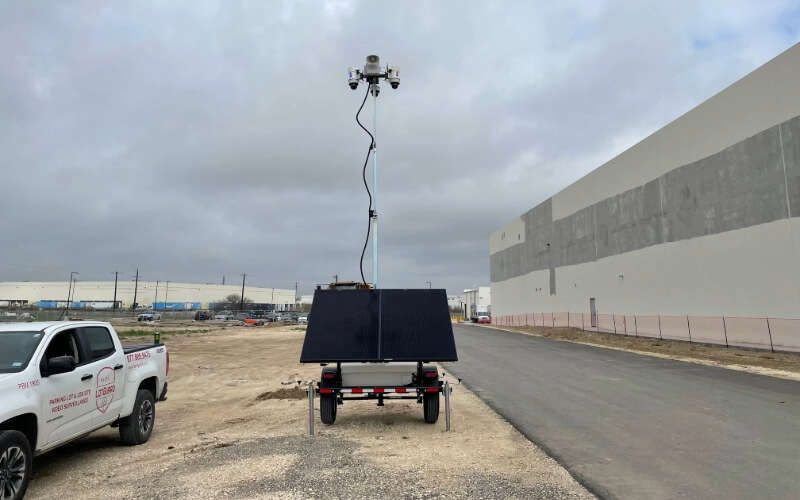
Mobile Surveillance Trailers: These versatile units stand up to 20-feet tall and offer near-360° coverage. Functioning on solar power and 4G/5G connectivity, they are ideal for multi-site operations in remote locations where fixed infrastructure is impractical.
-
Pole Cameras: Provide rapid-deployment surveillance for temporary security, live monitoring, and targeted investigations. They provide time-stamped records and automated evidence trails for all jobsite activity, meeting OSHA compliance requirements.
Video footage can be used to create a Time Lapse Video, transforming project progress into engaging content to show clients, motivate teams, or use in marketing.
5. Centralized Management on One Platform
Compliance leaders can manage the above safety standards on our cloud-based platform, Stellifii. There's no need to jump between separate systems to oversee each overlapping regulation or standard.
Stellifii consolidates all monitoring feeds into a single interface. Safety, environmental, and security data all flow into one central user-friendly dashboard.
Here, project owners can view:
-
Crucial live information
-
Compliance data, including compliance failures
-
Safety incidents
-
Safety records
You can access the latest information remotely and address compliance issues from your office, truck, or at home on the weekend. This capability greatly reduces the time spent traveling between sites to conduct manual checks.
Built with security and flexibility at its core, Stellifii runs on resilient cloud infrastructure and is AES256 encrypted, providing first-class data privacy protection. The platform is NDAA-compliant and connects over 4G/5G networks.
Read more: Stellifii: Our New Smart Platform Transforming Surveillance, Safety, and Compliance
How Smart Oversight Delivers Proactive and Defensible Compliance
Let's look at the dynamic features that transform compliance from reactive firefighting into a proactive strategy process.
Real-time monitoring
A smart AI-driven system continuously analyzes video and sensor feeds in real-time. Live monitoring provides immediate, actionable insights into PPE adherence, air pollution levels, noise risks, and more. It flags situations with near pinpoint accuracy when something looks off.
Precise alerts give compliance managers and response crews the information they need to address incidents urgently, embedding a culture of proactive risk management where rapid responses resolve minor issues before they escalate into costly damages.
Project wins:
-
Real-time visibility significantly improves construction worker safety and overall project outcomes.
-
Compliance leaders have fewer injuries, claims, fines, and inspection reports to deal with.
-
Projects stay on schedule, and the company maintains its good name.
Automated evidence capture
Tech-enabled platforms monitor all compliance risks automatically and deliver the insights and action steps you need to satisfy CPRA and OSHA regulations.
Environmental monitoring sensors compile months of air quality, noise, and weather readings into exportable logs for safety inspection reports. Smart detection systems flag intrusions and/or fire hazards, creating incident logs with corresponding video evidence and location timestamps.
Project wins:
-
Continuous automated monitoring that doesn't rely on manual involvement eliminates human error, ensuring that vital evidence doesn't fall through the cracks.
-
Fast actionable insights enable consistent enforcement of safety protocols and environmental (noise, pollutant) ordinances, avoiding project delays.
Centralized reporting
Proving compliance is nearly impossible when records live in separate systems (e.g., spreadsheets, email threads, paper logs).
Centralized data and reporting overcome the problems of scattered documentation and missing files. Incident reports, PPE compliance logs, safety training records, and injury/illness tracking are all housed securely in one place.
This neat organization streamlines inspections and can cut audit prep time in half. Compliance and safety professionals can generate automated, audit-ready reports 5X faster than on legacy systems.
Project wins:
-
Leaders can quickly and confidently address issues to reassure OSHA inspectors and other construction industry regulatory bodies.
-
Centralized reports show regulators that safety procedures and compliance activities are at the center of the company's projects, not an afterthought.
The Benefits of Intelligent Technology in Oversight and Compliance
Here's a summary of the proven advantages of intelligent, tech-driven compliance.
| Outcomes | How Technology Solutions Enhance Oversight | Business Benefits |
| Reduced Risk and Improved Worker Safety | Real-time intervention prevents incidents (injuries, theft, fire) from escalating or occurring, protecting people and assets. | Fewer injuries and fines, lower insurance premiums, reduced asset damage. |
| Improved Efficiency and Productivity | Automation handles continuous monitoring, freeing up management and crews for more productive operations.A unified platform eliminates the vendor sprawl of using multiple oversight systems. | Redirects compliance and safety personnel from spot checks/patrols to higher-value tasks such as modernizing safety plans; eliminates manual data collection and logging.Managing from a single point allows firms to expand compliance without increasing headcount.A 2025 Bloomfire report says well-organized information (i.e., with less vendor sprawl) and AI insights can improve task speed and efficiency by nearly 40%. |
| Reduce Friction between Compliance and Operations | A centralized compliance and safety platform brings everyone onto the same page, with common goals. | Focusing on the same KPIs, achieves better project safety and compliance performances. |
| Strengthened Compliance and Simplified Audits | AI-powered reporting produces solid evidence of compliance that is easily accessible and hard to dispute. | Complete timestamped audit trails; faster responses to OSHA regulators; solid proof of due diligence available to all stakeholders (including executives, insurers, clients, external auditors).Proving adherence to safety regulations also protects compliance officers from personal liability claims, including for subcontractor compliance breaches. |
| Fewer Work Disruptions | Proactive oversight and rapid risk responses (to control noise levels, mitigate fire, and pollutants) prevent work stoppages. | Fewer OSHA-related stoppages and penalties; faster dispute resolution; more predictable timelines. |
The Cost of CPRA and OSHA Violations
CPRA and OSHA non-compliance can have serious consequences, including costly penalties and enforcement actions. Let's take a brief look at the costs of violating these regulatory standards.
CPRA: The Act is enforced by the California Privacy Protection Agency (CPPA), which can impose civil penalties of:
-
Up to $2,663 per unintentional violation
-
Up to $7,988 for intentional breaches, including those involving minors
-
Fines for large-scale incidents can easily approach $1 million, because each affected party may count as a separate violation. If, for example, sensitive data from 100 employees/vendors/clients is wilfully mishandled, the fine could be $798,800.
-
Start at $16,550 per serious violation
-
Fines can climb to $165,541 for willful or repeated violations
Projects can be shut down or the work hours restricted if OSHA's construction standards are breached or if excessive noise or pollution becomes an issue.
In extreme cases, OSHA violations can lead to criminal charges.
Switch to Smart CPRA and OSHA Compliance with Stellifii
Modern jobsites demand a unified approach to compliance that scattered, manual record-keeping cannot provide. Construction firms are increasingly integrating technology and automation to achieve a better, big-picture overview of their operations.
By consolidating surveillance feeds, PPE scanning, and environmental sensors into the Stellifii cloud platform, you have a CPRA-compliant hub that significantly strengthens OSHA oversight and documentation.
Compliance and safety professionals can now quickly generate comprehensive reports to defend liability claims with solid evidence of due diligence, protecting both the business as a whole and accountable individuals.
With a two-decade track record in wireless monitoring, WCCTV takes the complexity out of compliance so you can focus on project success. To learn more about how Stellifii can enhance oversight and regulatory adherence on your projects, reach out and let's talk.