Construction jobsite operations managers spend their days managing project timelines and driving operational efficiencies while trying to stay compliant with construction regulations. Meanwhile, the compliance team is tasked with interpreting and enforcing those rules, often without full visibility into day-to-day jobsite pressures.
Unsurprisingly, compliance and operations' perspectives often clash. Tension between these departments can slow projects down, frustrate teams, and expose construction firms to unnecessary risk. Successfully balancing these 2 functions is challenging but vital in the highly-regulated US construction landscape.
In this article, we explore how US construction firms can bridge the gap between compliance and operations by adopting smart, unified monitoring and automated reporting systems that make everyone's job easier and jobsites safer.
Why Compliance and Operations Departments are Misaligned
On many construction projects, compliance and operations workflows operate independently.
Compliance officers are tasked with ensuring that a range of state and federal rules and regulations are followed during construction, including:
-
OSHA worker safety regulations, such as fall protection, correct PPE, and Hazard Communication (HazCom). To highlight the challenges here, a recent study found that only 52% of leaders are confident that their employees are performing their jobs safely and compliantly.
-
Environmental regulations enforced by the Environmental Protection Agency (EPA) and state agencies, such as air quality, toxic substance control, and waste management.
-
Local and municipal noise restrictions, dust control, and building codes.
-
Internal reporting, including occupational incident reporting and compliance documents for project stakeholders and local authorities.
-
Operations teams manage workers and materials and deal with project timelines, productivity, and cost control. Their main objective is to complete construction projects on time and within budget.
Where the friction happens
Without effective alignment between these 2 departments, overall project management is much harder, causing unhealthy tensions that sometimes spill over.
This gap is seen most obviously in competing agendas: Ops needs to meet deadlines, while compliance officers must enforce rules. The disconnect also shows up in haphazard, manual data collection and siloed teams plagued by poor communication, no real-time visibility, and fragmented workflows. In fact, siloed data is a major factor holding back businesses generally.
Read more: 5 Ways Manual Reporting is Putting Compliance Leaders at Legal Risk on Jobsites
The Costs of Disconnected Compliance on Construction Projects
The cost of disconnected compliance in the US construction industry is immense. Lives, company reputations, and money are all at stake, as these 4 major consequences show:
1. Financial and legal impacts
Construction companies often incur 6-figure OSHA fines for failing to enforce safety standards. EPA agencies also penalize projects that can't demonstrate regulatory compliance, especially when they lack the continuous environmental monitoring logs that must be submitted for every project.
Injuries, fines, equipment/building damage, and project delays are the immediate costs. Increased insurance and potential legal liabilities are longer-term burdens.
Read more: 7 Costly Compliance Mistakes US Construction Firms Can't Afford
2. Safety risks
According to the US Bureau of Labor Statistics, 1 in 5 worker fatalities in the US occurs in the construction industry, highlighting how dangerous jobsites can be. Effective worker safety protocols and PPE monitoring are essential to avoid adding to these statistics.
The Occupational Safety and Health Administration (OSHA) scrutinizes the construction sector more closely than almost any other. Construction companies that don't take safety seriously can be placed in OSHA's Severe Violator Enforcement Program (SVEP), saddling themselves with additional compliance requirements and costs.
3. Project inefficiencies
When ops and compliance work in silos, information isn't shared, documentation is harder to find, and key performance metrics aren't met.
It's estimated that project inefficiencies cost $177 billion a year. The main culprits are searching for data, resolving conflicts, and rework, which all negatively impact project completion and jeopardize your reputation with clients and stakeholders.
Read more: The Hidden Costs of Legacy Systems on Modern Construction Jobsites
4. Reputational damage
Poorly managed compliance affects project performance and completion. It can lead to contractual agreements being breached and weakened relationships with the surrounding community. On top of this, a damaged reputation and loss of clients' trust make it harder to bid successfully for future construction contracts.
What construction firms need to combat this is a unified monitoring and automated reporting solution.
Unified Monitoring and Automated Reporting Explained
Successful, future-focused US construction companies are using smart integrated platforms to enhance collaboration and simplify the entire construction process, including operations, compliance, and reporting.
Unified monitoring and automated reporting enable project owners to track resource management, jobsite conditions, construction teams, compliance tasks, and project outcomes effectively in real-time.
Here's what this system looks like in action:
Centralized data and event capture
A centralized system consolidates all monitoring feeds into one “control hub,” such as our cloud-based platform, Stellifii.
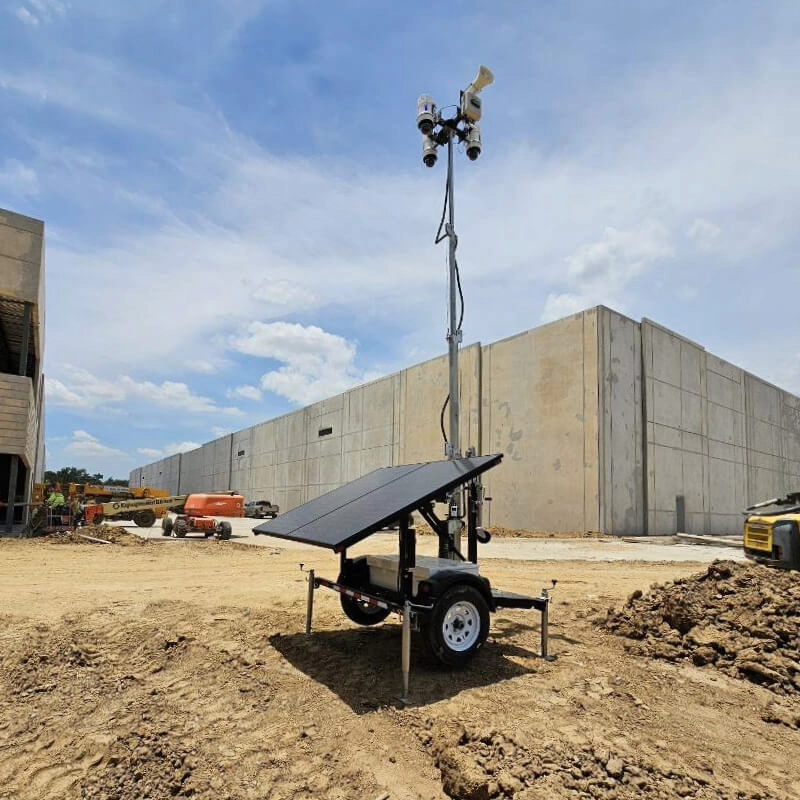
High-quality PTZ (Pan-Tilt-Zoom) cameras and advanced environmental sensors (monitoring dust, noise, and weather) track events and capture data. Additional surveillance cameras and sophisticated sensors are deployed on all of our mobile Surveillance Trailers and Pole Cameras. The fully-contained network means there is no need for separate power and setups for each sensor/camera type, as they're powered by a blend of solar energy and fuel cell batteries.
Built with security and adaptability at its core, Stellifii runs on government-approved cloud infrastructure and it's AES256 encrypted, NDAA-compliant, and 5G-ready. The platform also complies with major data privacy laws, such as the California Privacy Rights Act (CPRA).
Automated compliance with AI-video analytics
This is where static video feeds become actionable insights, allowing you to address safety and compliance issues fast. Stelliffi uses AI-based software to automate the monitoring of high-risk activities and deliver the insights and action steps you need to respond.
This AI-driven system continuously analyzes live video feeds in real-time. It flags situations with near pinpoint accuracy when something looks off or security protocols are compromised. We should mention that we provide complete security solutions and temporary cameras for short-term sites.
Let's break down how automation and analytics help you cover the different risk areas.
| Compliance requirement | Automated monitoring | Quick wins |
| Safety and PPE Monitoring | AI detects when workers enter designated zones without the required PPE or are performing their jobs unsafely. | Fewer injuries and fines. |
| Intrusion Detection, Security Management, and Smart Detection Systems | The system triggers warnings if unauthorized personnel or vehicles enter a dangerous zone (e.g., active excavation area). It also alerts managers to security breach attempts. | Protects assets and reduces accidents and unauthorized activities. Live Video Monitoring can stop crime before it happens; License Plate Recognition (LPR) technology helps project managers identify unauthorized vehicles on the jobsite; time lapse videos provide a showreel of project progress. |
| Environmental Monitoring | Integrates visual confirmation with environmental sensor data (dust, vibrations, noise monitoring). If a sensor triggers, the AI checks the corresponding video feed for the cause and source. | Enables immediate responses to noise and air quality breaches and enhances weather tracking; supports compliance with environmental impact assessment conditions. |
| Smoke and Fire Detection | AI identifies smoke or fire indicators in video feeds and triggers immediate alerts, allowing rapid response. | Minimizes smoke and fire damage and improves site safety. |
Automated reporting and shared alerts
Unified platforms generate the necessary alerts and reports automatically. They also retain user-friendly logs to support compliance, insurance, legal actions, or investigations.
-
Alerts: When the system detects a risk (e.g., a fire, a truck in an authorized zone, an air quality issue), it instantly alerts the responsible project owner or team.
-
Hard evidence: The alert includes a time-stamped image or short video clip and the exact location. This lets you isolate the incident swiftly and serves as a reliable record of the event.
-
Incident logging: Unified platforms automatically log and store all safety and compliance incidents, including video evidence. You can pull up accurate data for further investigation in just a few clicks.
-
Advanced reporting: Stellifii can produce comprehensive reports documenting and analyzing proof of compliance, as well as safety breaches. This rich reporting helps leaders to improve and stand confidently behind their audits.
4 Business Benefits of Aligning Compliance With Operations
Unified monitoring is the bridge that helps ops and compliance teams operate more cohesively, with less friction. When all team members are on the same page, you can expect the following benefits:
1. Improved information flows
Unified data consolidates everything in one place. This matters because when data integrity is established and recognized, there is less debate about whose information is "right." Expectations are clearer, and everyone can focus on the overall mission, driving the project’s success.
2. Stronger compliance adoption
When sharing information and finding answers is quick and simple, both ops and compliance teams can do their jobs more effectively. Consistent data and automated reporting also make it easier for managers to button down their audits.
When compliance processes are simple, it's easier to get buy-in project-wide. Soon enough, compliance becomes part of normal operational workflows.
Read more: How Digital Tools Ease Audit Prep and Cut Reporting Time in Half for Your Jobsite
3. Faster incident resolution
Immediate, indisputable evidence cuts down detection and investigation times. Precise alerts give your managers and response crew the information they need to tackle risks urgently, from noise hazards and security breaches to PPE non-compliance.
Faster resolution limits damage and dodges EPA/OSHA penalties. It keeps projects on track and protects against a range of liabilities, such as reputational harm and lawsuits.
Investigations and root-cause analysis also become simpler, faster, and evidence-based (no "he said, she said").
4. Better decision-making and problem-solving
Real-time visibility into risks and incidents enables better, faster decision-making, ensuring project progress isn't hindered by unnecessary delays.
For example, 54% of leaders find PPE compliance a challenge. Tracking PPE adherence closely and analyzing the insights can lead to a solution where employees become more diligent about wearing their protective gear. The result? You no longer have to pull crew off a shift because they're not wearing hard hats or high-visibility vests.
Unify Compliance and Operations Across Your Jobsites with WCCTV Today
Construction jobsite compliance violations can have devastating consequences for the offending company. Regulatory breaches can collapse entire projects, ruin professional reputations, and create legal disputes that take years and hundreds of thousands in lawyers' fees to resolve.
Because of their different focuses, there is a natural friction between operations and compliance teams. If these 2 departments aren't on the same page regarding regulatory compliance, the risk on your jobsite is unacceptably high.
By aligning safety and environmental rules with day-to-day workflows, construction firms can transform compliance from a clash point into a shared mission. Our Stellifii platform is a centralized "control hub" for smart monitoring and reporting that brings everyone on the same page and keeps jobsites compliant.
With over 20-years of expertise in wireless surveillance and monitoring, we provide this integrated solution built specifically for the US construction sector. From Environmental Monitoring Sensors to PPE Monitoring, our Smart Detection Systems and innovative technology keep every project safe and compliant from day one.
Reach out to discuss how Stellifii can help you and your ops and compliance teams succeed.