As OSHA and EPA regulatory requirements become stricter and stakeholder demands for environmental responsibility grow stronger, air quality monitoring in construction has become an operational necessity.
Failure to track and address harmful air pollutants on jobsites has serious consequences. Weak controls can threaten workers' health and lead to project shutdowns, damaging your professional reputation and creating legal disputes that can cost hundreds of thousands of dollars in lawyers' fees to settle.
To help you avoid these unhappy outcomes, we highlight how smart environmental monitoring safeguards your jobsite, workforce, and the public, while demonstrating meaningful corporate responsibility.
Why Air Quality Monitoring is Important to Construction Risk Management
Air quality monitoring on construction jobsites addresses multiple business and health risks simultaneously, from immediate worker safety concerns to long-term regulatory relationships.
Protecting employees' health
On a typical jobsite, a range of air hazards pose health risks to your managers and crew, including:
-
Dust and particulate matter
-
Chemical fumes
-
Volatile organic compounds (VOCs)
-
Carbon dioxide (CO₂)
-
Carbon monoxide (CO)
-
Nitrogen dioxide
The National COSH reports that thousands of US workers die every year from long-term exposure to hazardous substances. According to the CDC, occupational exposures are largely preventable through the implementation of proper controls.
Smart air quality monitoring identifies pollutants and risks early, enabling leaders to take swift preventive action. Prevention might involve detecting and shutting down the source, enforcing PPE use, or temporarily halting operations until work conditions are safe.
Site owners have a duty to protect workers from airborne contaminants. A key aspect of workforce development is providing a safe environment where employees feel that management values them and cares for their well-being.
Meeting regulatory compliance
Air quality laws are becoming increasingly stringent, with both the OSHA and the EPA (and its agencies) strongly focused on regulating pollutants and hazards in construction environments.
-
OSHA establishes permissible exposure limits that define the maximum levels of air pollution workers can legally encounter during their shifts. Fines for violating these limits can exceed $100,000.
-
Falling under the EPA, NESHAP (National Emission Standard for Hazardous Air Pollutants) targets hazardous air pollutants (HAPs) that are known to cause cancer and other serious health complications.
-
The EPA’s NAAQS (National Ambient Air Quality Standards), established under the Clean Air Act (CAA), sets concentration limits for common air pollutants that affect public health. These include particulate pollution, nitrogen dioxide, lead, and carbon monoxide.
-
Maximum penalties for non-compliance with EPA regulations are severe:
-
NESHAP breaches can lead to up to 5 years in prison and costly fines (fines/sentences can double for second or subsequent convictions).
-
EPA civil penalties for Clean Air Act violations may reach $472,901 per violation, depending on the nature and duration of the transgression.
By monitoring and managing on-site air pollution proactively, you demonstrate due diligence to EPA, OSHA, and state inspectors, as well as a broader commitment to limit your company's environmental impact.
Being a responsible neighbor
Airborne contaminants from construction projects often cause distress and health issues in surrounding neighborhoods.
Effective monitoring helps reduce these tensions by catching problems before neighbors do, which reduces complaints and protects your company’s reputation. Demonstrating care and responsibility towards the local community builds trust and strengthens all stakeholder relationships.
How to Safeguard Your Jobsites from Airborne Risks
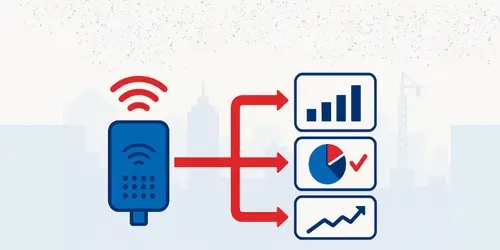
Modern construction operations are employing IoT (Internet of Things) solutions to safeguard their jobsites from airborne hazards. Advanced sensors and intelligent software collect and transmit real-time data about air conditions continuously, supporting "live" risk management.
Smart Air Quality Monitoring Systems can detect substances more quickly and accurately than human senses or manual processes. The system delivers precise measurements and automatic alerts to project managers well before jobsite conditions approach threat levels.
Monitoring both outdoor and indoor conditions, it measures fine particulate matter (PM1, PM2, PM10), CO₂, VOCs, and other airborne pollutants and gases.
Let's take a closer look at the main sensors and alerts.
1. CO₂ sensors
CO₂ (carbon dioxide) is a serious threat in enclosed indoor spaces with limited airflow. A high CO₂ concentration can cause headaches, shortness of breath, fatigue, and reduced focus. Smart sensors can be set to track indoor air quality, alerting you when a space needs greater ventilation.
2. Dust/particulate matter sensors
Particulate matter (PM1, PM2.5, PM10) is released during construction activities such as:
- Cutting, grinding, and sanding
- Excavation, trenching, and demolition
- Grading and leveling
- Cement loading and mixing
- Earthmoving machinery operations
Numerous everyday operations agitate particles that can enter workers' lungs, and long-term exposure can lead to serious respiratory problems. Our monitoring sensors measure dust and PM concentrations and alert you when they exceed permissible exposure limits.
3. Volatile organic compounds (VOCs)
VOCs are chemicals that dissolve in water and evaporate at room temperature, releasing gases into the air that workers then breathe. These gases are found in industrial solvents such as paints, sealants, adhesives, fuel, and cleaning materials, causing eye, nose, and throat irritation. They are known to cause headaches and breathing difficulties, while long-term exposure can damage the lungs and lead to chronic conditions that affect workers for the rest of their lives.
How WCCTV's smart air quality monitoring solution works
Purpose-built for US construction jobsites, our IoT air monitoring sensors have robust IP43-rated casings to withstand tough outdoor environments and work in temperatures from -4 °F to 122 °F.
Here's what deployment and operations look like on the ground:
-
After determining the best locations to take readings, sensors are deployed around the jobsite (or sites) and linked to our secure cloud-based management platform, Stellifii.
-
You set the threshold for the conditions being monitored, based on site rules and regulatory limits.
-
Stellifii brings all sensor readings into one place, giving you total visibility across all projects. Air readings are analyzed in real-time, triggering automated alerts and enabling rapid responses.
-
Site managers receive instant notifications via the app, SMS, or email when air quality issues are detected. The setup supports full remote monitoring and reporting, eliminating the need for manual tracking and recording.
-
The Stellifii platform securely stores up to 180,000 timestamped records, providing useful metrics for trend analysis and detailed documentation for inspection.
-
Other Environmental Monitoring capabilities that run through Stellifii, providing a fuller picture of site conditions, include:
-
Weather Monitoring: Weather monitoring stations track extreme conditions such as high temperatures/humidity, dangerous winds and rainfall, and incoming storm conditions. The system protects the crew and jobsite by triggering work stoppages when necessary.
-
Noise Monitoring: Continuously measures jobsite sound levels against thresholds to ensure compliance with noise limits. Noise sensors measure across ranges of 30-130 Decibels and frequencies of 20Hz to 12.5kHz.
Read more: What Does System Integration Really Mean and Why Does It Matter?
How Real-Time Air Quality Monitoring Improves Compliance
Smart tracking of airborne exposures enhances compliance and on-site vigilance in several measurable ways:
24/7 visibility
Traditional monitoring via manual spot checks or periodic sampling misses short-term exposure spikes. Continuous monitoring, on the other hand, delivers round-the-clock data. Capturing fluctuations in dust, gases, particulates, and pollutants as they occur ensures you always have the latest readings and the most accurate risk assessment data.
Early detection of breaches
Real-time monitoring identifies when air quality levels approach regulatory or site-specific limits, while automated alerts notify site managers and safety teams the moment thresholds are breached.
This allows your teams to respond immediately (e.g., by adjusting work methods, increasing ventilation, or introducing appropriate protective equipment). Rapid intervention prevents exposures escalating into health incidents or violations.
Evidence-based compliance reporting
Continuous data and automated reporting create an accurate time-stamped record of air quality conditions and corrective actions. Defensible digital documentation supports OSHA and EPA compliance and cuts audit times by half.
Read more: Air Quality Data Management: Turning Sensor Data Into Actionable Insights for Jobsites
Best Practices for Smart Air Quality and Other Jobsite Monitoring
Here's a 4-step checklist to successfully implement and operate effective project monitoring:
-
Optimize sensor placement: Map your jobsite to identify the best locations for the sensor footprint, positioning devices to avoid blind spots.
Pay particular attention to high-risk zones such as:
-
Excavation sites and demolition areas
-
Confined spaces
-
Site boundaries near residential zones
-
Fuel/chemical storage facilities
Choose quality sensors: Research and select sensors with:
-
High accuracy and calibration support
-
Weatherproof housings
-
Long battery life or solar charging
Integrate with other environmental tracking priorities: Air quality data becomes even more valuable when combined with other environmental information (noise and weather) in your management platform. For example, weather monitoring can alert you to opportunities to collect rainwater you can use later to suppress dust.
Connect all compliance and jobsite security functions to optimize monitoring: The best construction practices emphasize comprehensive monitoring for near-360° visibility and oversight.
The table below summarizes additional Smart Detection Solutions you can integrate into Stellifii for streamlined efficiency and all-in-one management.
| Project Area | Monitoring Outcomes | Business and Compliance Benefits |
| PPE Monitoring | Tracks and flags crew not using the required protective gear. | Shows proactive enforcement, reduces injuries, and protects leaders from liability. |
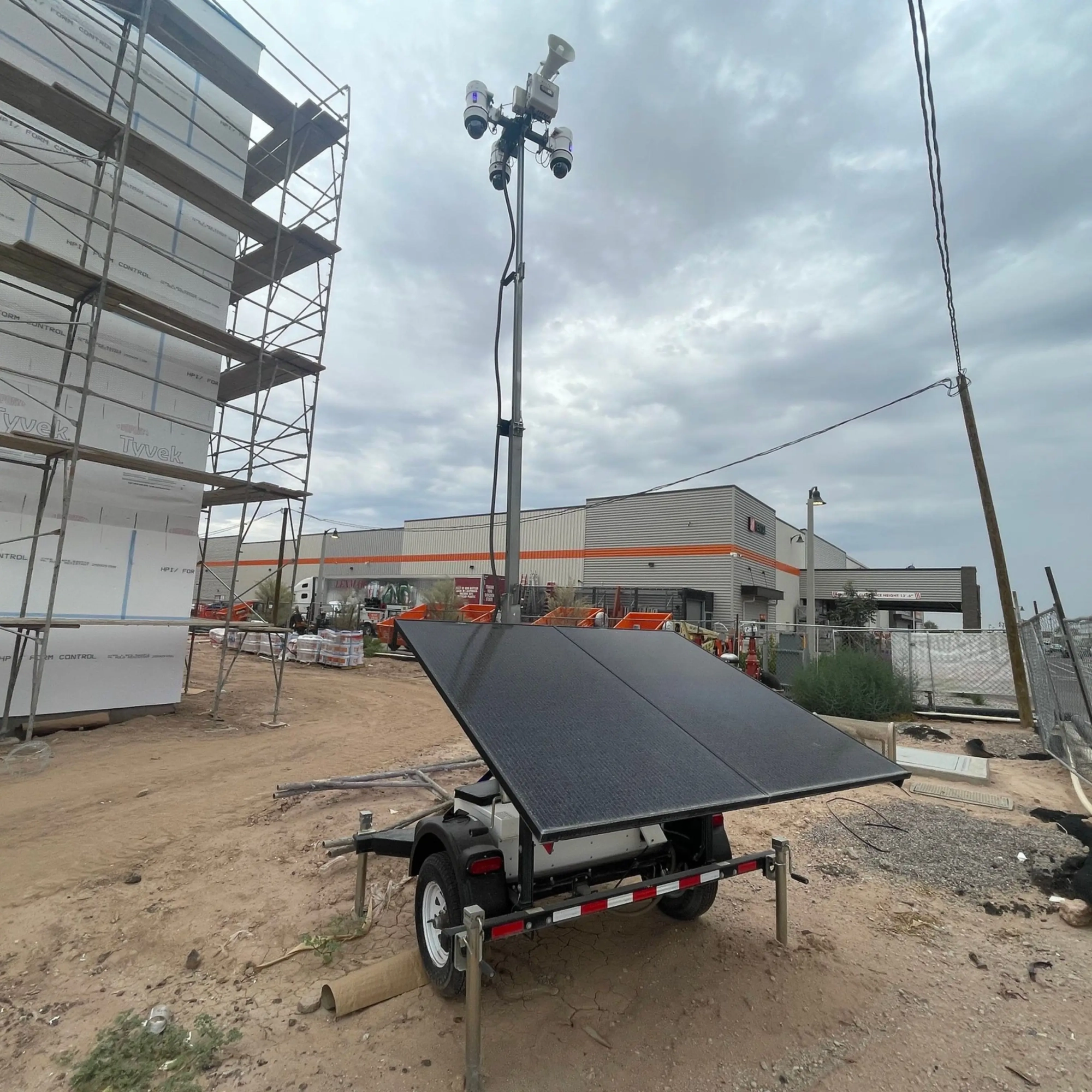
| Smoke and Fire Detection | Instant detection and logged responses to fire/smoke risks; deployed on Pole Cameras and Surveillance Trailers. | Intelligent analytics reduces fire dangers and provides evidence of rapid responses. |
| Intrusion Detection | Automated intrusion detection and security vigilance, including alerts and incident logs. | Protects assets, demonstrates proactive safeguarding, and provides evidence in investigations. |
| License Plate Recognition | Automated tracking of vehicles entering and exiting facilities. | Improves access control, supports investigations, and provides transparent audit trails for compliance. |
Security Systems: Build out your jobsite defenses further with an advanced security system (including Temporary Cameras where needed) to protect your perimeter and assets. This can be augmented by Live Video Monitoring that detects suspicious behavior and issues a live voice challenge before activating warning lights.
Read more:
-
The Future of Construction Security: From Guards to AI-Powered Smart Systems
-
The Rise of Smart Construction Jobsites: How Tech Is Transforming the Industry
The Next Steps For Smarter Monitoring and Compliance
Smart air quality tracking and reporting provide the real-time insights you need to protect your crews and meet regulatory obligations.
Combining air quality monitoring and other environmental and surveillance tracking into a single platform significantly strengthens your compliance capabilities, which results in improved worker and project safety and reduced audit risk.
Backed by over 20-years of site monitoring expertise, our compliance management solutions are trusted and deployed successfully on projects of all sizes across the US.
Contact our team today to discuss how our air quality and other monitoring solutions on Stellifii meaningfully strengthen and prove compliance to all stakeholders.