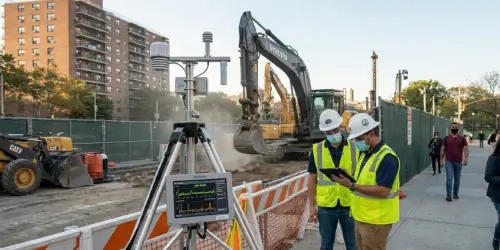
Despite construction activities producing vast amounts of airborne contaminants, jobsite air quality measurement is often treated as an afterthought.
This is concerning, considering that air pollutants can seriously affect workers' health. Dust, diesel emissions, invisible gases, and chemical fumes are known to impair concentration and productivity in the short term and often lead to chronic illnesses and lung disease after prolonged exposure.
Effective air quality monitoring identifies harmful air contaminants before they reach dangerous levels. This is vital to protect the crew's health and comply with OSHA and EPA regulations.
The article looks at common air quality hazards in construction and the weaknesses of manual reporting processes. We explain how real-time environmental monitoring and proactive intervention are vital to keeping crews safe, projects on track, and regulators off your back.
Air Quality Risks on Construction Jobsites
Construction activities generate a wide spectrum of airborne pollutants every day. Demolition, excavation, grinding, and heavy equipment operations all release particles and gases into the atmosphere.
Common sources of potentially unhealthy air contamination include:
-
Demolition and cutting activities that release large volumes of dust, PM10, and PM2.5 particles, which can quickly exceed OSHA exposure limits if not controlled.
-
Earthmoving and excavation equipment that agitate soil and particulate matter. Heavy machinery stirs up dust clouds that linger in the air, making breathing difficult and reducing visibility.
-
Diesel-powered machinery and vehicles that emit exhaust gases create poor air quality conditions that can make workers feel tired and nauseous.
-
Fuel combustion from generators and heaters. Burning fuel indoors or in enclosed spaces releases CO₂ and ultrafine particles, causing fatigue and contributing to long-term health risks.
-
Chemical products such as paints, adhesives, and solvents can cause dizziness, nausea, and increase the risk of chronic health problems.
Some contaminants pose immediate dangers (e.g., high concentrations of carbon monoxide), while others cause long-term health complications that are only diagnosed years later.
For construction managers, the challenge is that many of these exposures occur gradually or intermittently. This makes them difficult to detect without continuous tracking.
Air quality compliance obligations and risks on jobsites
Construction companies must comply with air quality regulations enforced by the Occupational Safety and Health Administration (OSHA) and the Environmental Protection Agency (EPA).
-
OSHA establishes permissible exposure limits that define the maximum levels of hazardous substances workers may encounter. Violating permissible exposure limits can result in fines of up to $165,514 per transgression.
-
The EPA’s NAAQS (National Ambient Air Quality Standards), established under the Clean Air Act (CAA), sets concentration limits for common air pollutants that affect public health. These include particulate pollution, nitrogen dioxide, lead, and carbon monoxide. Serious EPA violations under the Clean Air Act may carry civil penalties up to $472,900 per incident.
Effectively monitoring and controlling on-site air pollution is essential to strengthen your company's compliance position and avoid admin-intensive scrutiny from regulators.
Real-time air quality monitoring combined with early intervention procedures to mitigate hazards shows EPA, OSHA, state inspectors, and the broader community that you are serious about workplace safety and do everything you can to limit your project's environmental impact.
Read more: Construction Jobsite Compliance Failures and Lessons Learned
Why Air Quality Risks Are Difficult to Track
These 5 factors help explain why even experienced managers can struggle to accurately assess airborne risks in busy construction environments.
1. Environmental factors
Wind direction, temperature, rain, and humidity influence how pollutants disperse across a jobsite. Sudden weather shifts can change exposure conditions dramatically.
2. Limitations of spot checks
Traditional monitoring methods rely on periodic sampling or manual inspections. These approaches capture only a single moment in time and often miss multiple harmful exposure spikes throughout the day.
3. Fluctuating exposure levels
Air pollution can change rapidly depending on work activities, equipment use, and weather conditions. A safe reading in the morning may become hazardous an hour later.
4. Cumulative exposure
Workers may be exposed to low-level contaminants repeatedly over multiple days. Even if each exposure is minor, the cumulative effect can lead to health issues and long-term illnesses.
5. Delayed health effects
Workers exposed to harmful contaminants may not experience immediate symptoms. In some cases, illnesses develop years later, making it difficult to identify the original hazard source.
Given these factors, it's easy to understand that periodic monitoring can never provide the full picture of air conditions in and around your jobsite. The only way to achieve this is through continuous real-time tracking of air quality data.
Read more: The Hidden Costs of Legacy Systems on Modern Construction Jobsites
Top 7 Airborne Hazards on Construction Jobsites
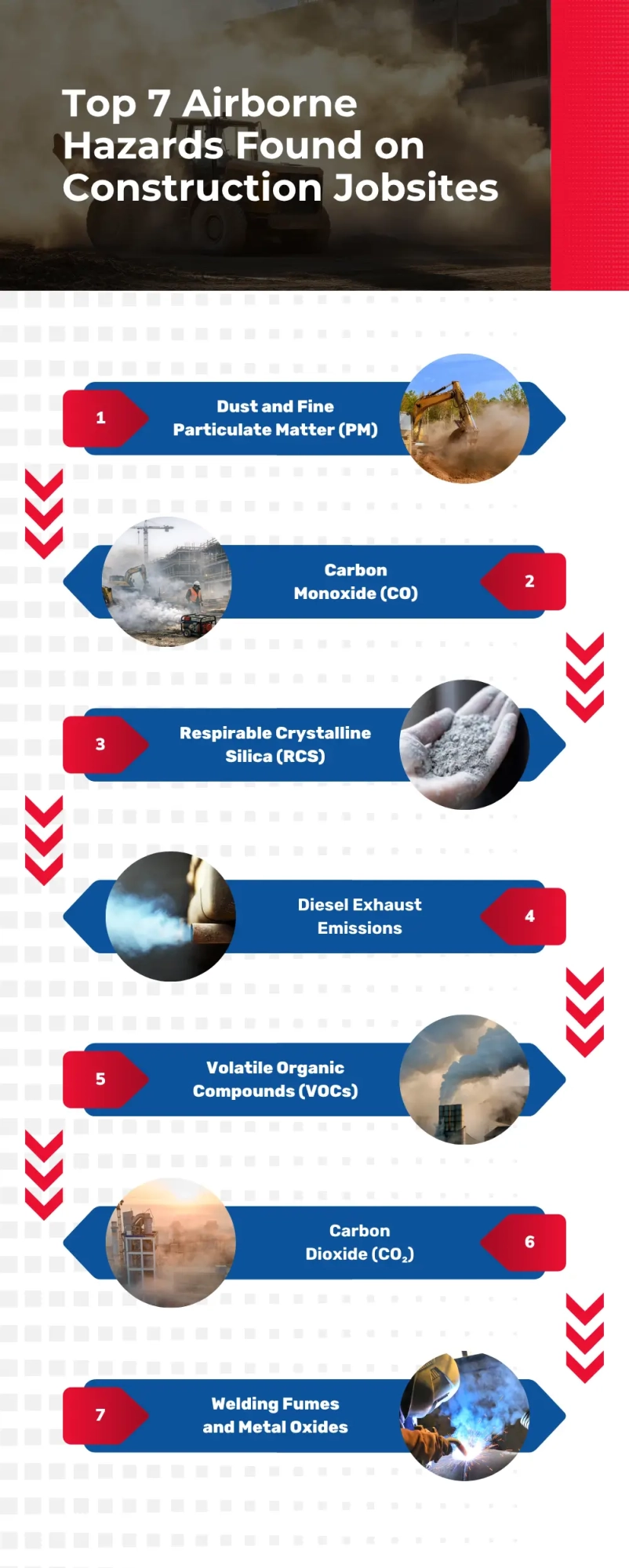
To appreciate the main threats project managers must grapple with to protect their crews and meet regulatory compliance, we highlight 7 leading jobsite airborne hazards.
1. Dust and Fine Particulate Matter (PM)
Dust is the most widespread airborne issue in construction. Cutting, drilling, demolition, grinding, and earthmoving all release quantities of particulate matter into the air.
These particles are classified as:
-
PM10 - inhalable particles that can reach the upper respiratory system.
-
5 - fine particles capable of penetrating deep into the lungs and entering the bloodstream.
-
PM1 - extremely fine particles that reach the alveoli in the lungs, usually associated with cardiovascular and respiratory disease.
Exposure to excessive dust has been linked to asthma, chronic bronchitis, cardiovascular disease, and long-term respiratory damage. Because these particles can remain suspended for hours, especially in dry or windy conditions, dust exposure often spreads beyond the immediate work area.
2. Carbon Monoxide (CO)
Carbon monoxide is one of the most dangerous gases on jobsites. Produced by generators, heaters, and fuel-powered machinery, CO is colorless and odorless, making it impossible for workers to detect without sensors.
Even moderate concentrations can cause symptoms such as headaches, dizziness, fatigue, and impaired coordination. At higher levels, carbon monoxide can be fatal within minutes.
CO risks are particularly high in confined or poorly ventilated areas, including tunnels and partially enclosed structures.
3. Respirable Crystalline Silica (RCS)
Respirable crystalline silica is a serious hazard generated when cutting, drilling, grinding, or crushing materials such as concrete, brick, mortar, and stone.
The tiny silica particles produced are small enough to penetrate deep into the lungs, where they can cause severe and irreversible diseases, including silicosis, chronic obstructive pulmonary disease, lung cancer, and kidney disease.
4. Diesel Exhaust Emissions
Diesel-powered construction equipment produces a mixture of airborne contaminants collectively known as diesel engine exhaust (DEE). This includes CO, nitrogen oxides (NOx), VOCs, and fine particulate matter.
Diesel exhaust exposure is associated with headaches, respiratory irritation, and fatigue in the short term. Prolonged exposure has been linked to serious health risks, including lung cancer.
5. Volatile Organic Compounds (VOCs)
Volatile organic compounds are gases released from chemical products commonly used in building, including paints, adhesives, sealants, and solvents.
When these substances evaporate, they release vapors that can irritate the eyes, nose, and throat while causing headaches and dizziness. Long-term exposure to certain VOCs may lead to organ damage or serious respiratory problems.
6. Carbon Dioxide (CO₂)
While carbon dioxide is naturally present in the atmosphere, high levels on jobsites often indicate poor ventilation or heavy emissions from equipment. High CO₂ concentrations are common in enclosed spaces where many engines or generators are operating simultaneously.
CO₂ is rarely fatal, but unhealthy exposure can cause shortness of breath, headaches, fatigue, and reduced concentration
7. Welding Fumes and Metal Oxides
Welding and cutting metals generate fumes containing a mixture of metal oxides and gases. These airborne particles cause a condition known as metal fume fever, which presents as flu-like symptoms including chills, fever, and muscle aches.
Repeated exposure may lead to respiratory disease and neurological (brain and nerve) issues.
Moving to Proactive Jobsite Safety with Real-Time Air Monitoring
To overcome the limitations of manual sampling, leading construction firms have embraced IoT-enabled air quality monitoring systems that provide 24/7 insight into jobsite conditions.
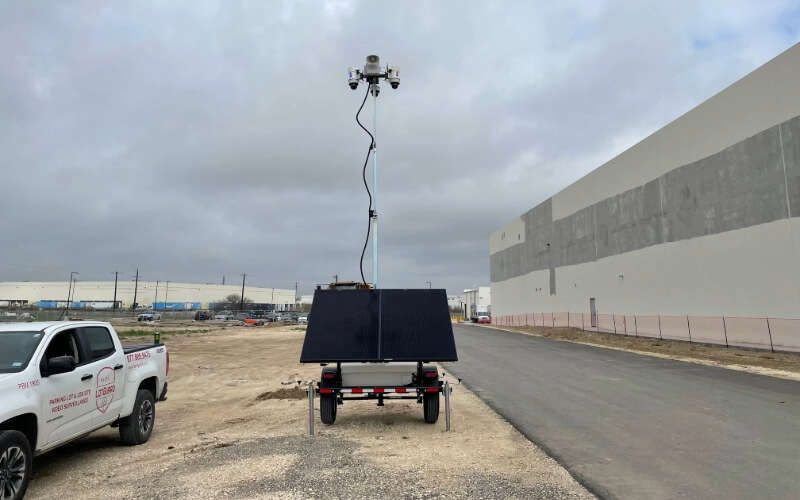
Our Air Quality Monitoring tools integrate with solar Mobile Surveillance Trailers or Temporary Camera systems, creating a cutting-edge monitoring platform.
Advanced sensors connected to high-definition PTZ (Pan-Tilt-Zoom) cameras track a wide range of airborne pollutants and let you see how conditions are affecting work activities, e.g., productivity has slowed in a dusty work zone because crew members don't have the necessary face and respiratory protective gear.
Key pollutants measured include:
-
Fine particulate matter (PM1, PM2.5, PM10)
-
Carbon dioxide (CO₂)
-
Carbon monoxide (CO)
-
Volatile organic compounds (VOCs)
-
Environmental conditions such as temperature and humidity
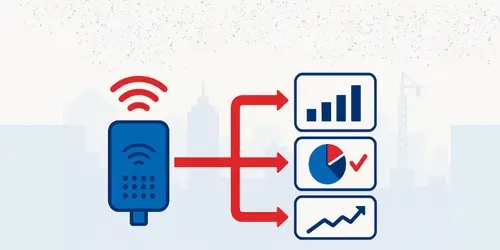
Instead of relying on manual logs or occasional testing, smart digital systems collect thousands of readings every hour, giving project teams a far more accurate understanding of air quality standards across the build.
Read more: Air Quality Data Management: Turning Sensor Data Into Actionable Insights for Jobsites
The role of Stellifii: One platform for all environmental monitoring
All tracking data feeds into Stellifii, our secure cloud-based platform for complete jobsite safety management. The platform combines critical data from across the project and provides leaders with a clear, real-time view of air conditions.
Stellifii's key capabilities are:
-
Customizable thresholds: Managers can set alert levels based on regulatory limits or internal policies.
-
Real-time alerts: If air pollutants approach or exceed thresholds, notifications are sent immediately via mobile app, SMS, or email.
-
Remote monitoring: Project leaders can check conditions anytime from any connected device.
-
Secure data storage: Up to 180,000 timestamped records are stored for reporting and compliance documentation.
This level of visibility allows construction teams to identify problems early and respond before conditions threaten worker safety or legal limits.
Read more: Stellifii: Our New Smart Platform Transforming Surveillance, Safety, and Compliance
The Safety and Compliance Benefits of Real-Time Air Quality Monitoring
Let's look at the proven safety and compliance benefits of these digital tools.
Better workplace safety
Real-time air quality monitoring systems allow managers to intervene proactively before safety thresholds are breached.
When air pollution levels begin to rise, teams can quickly take corrective actions such as:
-
Increasing ventilation to improve indoor air quality and conditions in enclosed spaces
-
Adjusting work activities or equipment usage to limit pollutants
-
Ensuring the crew wears face and respiratory PPE
-
Deploying dust suppression measures, such as water sprays and misting systems
-
Temporarily pausing work until conditions improve
By acting early, leaders can prevent exposures from escalating into potential health risks and forcing work stoppages.
Strong compliance defense
Proactive 24/7 monitoring of on-site pollutants signals to authorities that you have strong safety and environmental controls in place. This generally keeps regulators happy and ensures audits proceed smoothly.
Through Stellifii, project managers can quickly pull historical records showing:
-
Which pollutants were measured
-
Exact concentration levels
-
The time and location of readings
-
Actions taken when measurements approached permitted limits
Clear, defensible documentation of proactive safety management demonstrates to inspectors that you run a diligent and professional operation.
Read more: How Digital Tools Ease Audit Prep and Cut Reporting Time in Half for Your Jobsite
Manual air quality monitoring vs smart tracking
Here's a side-by-side comparison of traditional air quality sampling vs. real-time monitoring, highlighting the major advantages of today's digital tools.
|
|
Traditional Monitoring |
Real-Time Monitoring |
|
Speed |
Dependent on human checks and legacy systems, often delayed. |
Instant alerts and continuous data for quick, easy viewing. |
|
Data Provided |
Limited snapshots at specific times. |
Continuous, 24/7 monitoring and accurate readings. |
|
Crew Protection |
Reactive - workers may be exposed before dangers are addressed. |
Proactive - hazards are identified before exposure becomes unsafe. |
|
Compliance Documentation |
Manual reports, often incomplete and inconsistent, with files sometimes lost. |
Automated logs with detailed records, including timestamped data, incident reports, and video. High audit-readiness. |
|
Operational Impact |
Higher risk of harming workers' health due to late detection. Regulatory enforcement may shut down or restrict work. |
Better worker protection and reduced downtime through early interventions. |
Connecting Air Monitoring With Other Jobsite Safety Systems
Air quality monitoring systems are more powerful when integrated with other smart detection and monitoring tools. Stellifii serves a range of additional environmental and safety systems, including:
Weather Monitoring
Weather Stations track wind speed and direction, temperature, humidity, and rainfall. These conditions influence how pollutants disperse, and insights can help managers plan safer work schedules and manage weather risks responsibly.
Noise Monitoring
Noise Monitoring Sensors measure sound levels across ranges of 30-130 Decibels and frequencies of 20Hz to 12.5kHz to ensure compliance with local noise laws and reduce worker stress and hearing injuries.
PPE Monitoring
AI-powered video analytics can verify whether workers in high-risk zones are wearing required protective equipment, such as respirators and protective glasses. Advanced systems trigger live warnings to non-compliant workers and send automatic alerts to supervisors.
Smoke and Fire Detection
Video-based fire detection systems identify early signs of smoke or flame and instantly alert teams to the danger. This digital solution is proven to react faster and identify the flame source more accurately than traditional fire alarms.
Read more: AI for PPE, Fire, and Intrusion Safety
Advanced Security Systems
For near 360° safety and security coverage, project owners can connect specific security solutions to guard their perimeters day and night. These networks use AI-powered cameras on rapidly deployable mobile surveillance trailers or temporary surveillance setups:
-
Our Intrusion Detection Systems incorporate AI analytics to identify threats and protect your site and assets against breaches and theft 24/7. Intrusion Detection can also flag trespassers or employees in areas where they're not allowed to be.
-
License Plate Recognition (LPR) tracks and logs all vehicles entering and exiting the jobsite using intelligent surveillance. Accurate monitoring of movement and speed/distance traveled strengthens access control and encourages safer driving in work areas.
-
Our Security Surveillance is supported by Live Video Monitoring, where intervention specialists issue immediate voice challenges to stop criminals from even attempting to break in.
Read more:
-
The Future of Construction Security: From Guards to AI-Powered Smart Systems
-
The Benefits of Integrating Your Security and Communications Systems
Create Cleaner, Safer Work Environments for the Future
Every construction worker who suffers illnesses because of airborne contaminants is one too many. Every OSHA or EPA regulatory fine cuts into the project's bottom line and damages the company's reputation. Such consequences are largely avoidable with better controls and early detection.
Smart air quality tracking and reporting deliver the insights you need to control airborne hazards effectively and keep jobsites safe and projects running smoothly. When construction companies invest in smart monitoring technologies, they send a powerful message to their teams and regulators: safety is a top-tier priority.
To build cleaner, safer workplaces with lower air pollution levels, contact us today about best-in-class environmental monitoring solutions